Beyond the Muse: The 3-Pillar System for Mastering Creative Skills, Driving Innovation ROI, and Becoming AI-Proof
Published: 02/12/2025
For years, we’ve been told that creative genius is a rare, inherent talent—something that only a select few are born with. Artists, musicians, writers, and designers are often depicted as possessing some magical spark of inspiration that allows them to create masterpieces. But what if this idea is not only misleading but also harmful?
The truth is, creativity is not a mysterious, inborn gift. It is a trainable skill—one that can be cultivated, refined, and leveraged for professional success. In today’s world, where automation and artificial intelligence (AI) are rapidly changing the landscape, creative thinking has become more essential than ever. It is no longer just about being “creative”; it’s about mastering a system of creativity that allows you to tackle complex problems, drive innovation, and stay indispensable in the face of AI-driven change.
Welcome to the 3-Pillar System for mastering creative skills, driving innovation ROI, and becoming AI-proof. This system will help you transform your creativity from a sporadic burst of inspiration into a structured, high-income competency that guarantees you stay at the forefront of your field, no matter how technology evolves.
In this blog, we’ll explore:
- How creativity can be trained and developed like any other high-level skill.
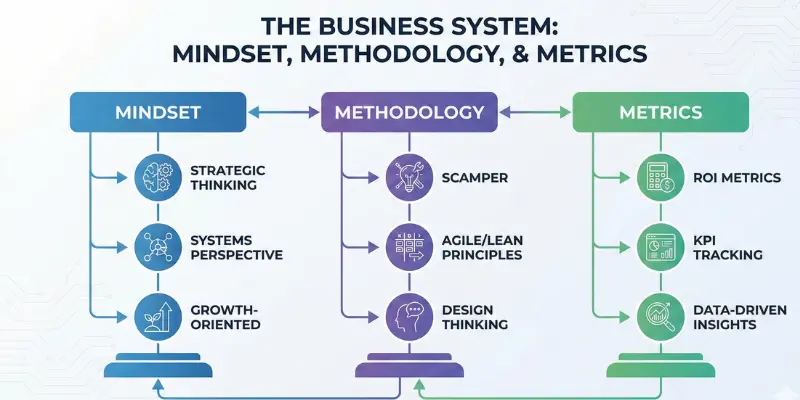
- The 3-Pillar System that combines Mindset, Methodology, and Metrics to make your creativity both strategic and measurable.
- Why AI collaboration is the future of creative work, and how you can position yourself as the Innovation Architect—not someone replaced by technology, but someone who thrives alongside it.
If you’ve ever felt uncertain about your creative abilities or feared that automation might make your skills obsolete, this guide is for you. By the end, you’ll have a clear framework to reframe your mindset, improve your creative process, and prove your value through measurable results.
The Problem: Debunking the Myth of Innate Creative Talent
For centuries, society has held the belief that creativity is something that certain individuals are simply born with. This idea has pervaded every industry, from art to business, and has shaped the way we view and value creative skills. It’s the misconception that creative genius is reserved for a lucky few, making the rest of us feel like we lack the “it factor” to excel in creative endeavors.
This myth is not only inaccurate but also harmful. It perpetuates a mindset of limitation, where individuals believe they must either be “naturally creative” or they will never reach their full potential. In the world of business and innovation, this kind of thinking is especially damaging. It fosters anxiety, stagnation, and the belief that creativity is a rare commodity—something that can’t be cultivated or leveraged for professional success.
Debunking Misconception 1: Creativity is Not an Innate Talent
The truth is, creativity is a learned skill, not a genetic gift. It can be developed and honed over time with the right mindset, methodology, and metrics. Creativity is not about waiting for a flash of inspiration to strike. It’s about being able to systematically approach problems, generate ideas, and execute solutions with precision and confidence.
In fact, every individual has the potential to be creative, especially in a world where complex problems require new, innovative solutions. Creativity is now more important than ever—not just in art and design, but across all industries. Businesses need strategic thinkers who can solve problems, generate ideas, and drive innovation, not just “creative types” who happen to have an artistic flair.
The challenge, however, lies in breaking free from the traditional myth of creativity and understanding that it’s a discipline—one that can be practiced, refined, and turned into a high-value skill. Creativity doesn’t have to be an abstract, mystical force; it can be a structured, strategic process.
In the next section, we’ll explore how the new reality of creativity is a trainable discipline, one that is essential for solving complex problems and driving innovation in the age of automation.
The New Reality: Creativity as a Trainable Discipline for the Age of Automation
In today’s rapidly evolving world, creativity is no longer just the domain of artists and designers. It has become a fundamental skill required for complex problem-solving across all industries, especially in the age of automation and AI. Automation may handle routine tasks efficiently, but the ability to think creatively and strategically is something that machines cannot replicate. This is where the human advantage lies.
Debunking Misconception 2: Creativity is Essential for Complex Problem-Solving in the Age of Automation
The automation revolution has brought with it unprecedented efficiency and speed. But, in the process, it has also shifted the landscape of professional work. Many jobs that were once carried out by humans are now automated. AI can generate content, analyze data, and even create designs at scale, but what AI can’t do is generate innovative solutions to complex problems.
This is where human creativity becomes a competitive edge.
Creativity is no longer about simply producing artistic works; it is about applying creative problem-solving to strategic challenges. Whether you are working in marketing, product development, or leadership, the ability to approach problems with fresh ideas and a strategic mindset is invaluable. It allows professionals to think beyond the limitations of AI and create new value that technology alone cannot.
The Need for Strategic Thinking
Strategic thinking—the ability to plan, execute, and analyze—has become one of the most indispensable skills in a world dominated by automation. Creativity, when structured properly, is strategic. It involves generating ideas, testing them, analyzing their feasibility, and executing them in ways that maximize impact.
In fact, the 3-Pillar System we’ll explore in the next sections—Mindset, Methodology, and Metrics—transforms creative thinking from a spontaneous process into a structured, high-income competency. When you master this system, creativity becomes an ongoing, repeatable process, not a random burst of inspiration.
The Value Proposition: Introducing the 3-Pillar System for Mastering Creative Skills
So, how do you go from being someone who hopes for creativity to someone who can consistently generate creative solutions? The answer lies in the 3-Pillar System: Mindset, Methodology, and Metrics.
- Mindset: This is the foundation—how you view and approach creativity. In this section, we’ll discuss how to cultivate a mindset that fosters strategic thinking, emotional resilience, and creative confidence.
- Methodology: Creativity without a process is random and inefficient. This pillar introduces a structured methodology that helps you move from idea generation to execution, ensuring your creativity drives results.
- Metrics: Creativity must be measurable to prove its value. In this section, we’ll explore how to use operational and financial metrics to demonstrate the ROI of creative efforts and justify the strategic value of creativity in business.
This system is designed not only to enhance your creative output but also to make that output quantifiable, allowing you to position yourself as an Innovation Architect—a strategic leader who drives both creative ideas and tangible business results.
Next, we’ll dive into the first pillar of the system—Mindset—and explore how to architect your brain for innovation.
Pillar 1: The Mindset Revolution: How to Architect Your Brain for Innovation
The foundation of mastering creative skills starts with mindset. Without the right mindset, creativity remains an unpredictable spark rather than a consistent, strategic asset. Creativity is not something you either have or don’t have; it’s a mental framework that can be intentionally cultivated. This pillar focuses on how to develop the neuro-strategic mindset that is essential for generating, refining, and applying creative ideas consistently.
Debunking Misconception 2: Why Strategic Thinking is the Most Indispensable Hard Skill
For years, creativity was often seen as a “soft skill,” something nice to have but not critical to professional success. This outdated view needs to be debunked, especially in today’s business environment, where strategic thinking—combined with creativity—is the highest-leverage skill. Strategic thinking is not only about planning; it’s about analyzing, adapting, and applying creativity to solve real-world problems.
Creativity is no longer a “bonus” in the business world; it is a core competency that shapes everything from decision-making to innovation. Strategic thinking allows you to apply creative ideas in a way that moves the needle, whether that’s in product design, marketing campaigns, or leadership decisions.
The Neuro-Strategic Creative Cycle (GAP 1): Training the Dual Brain
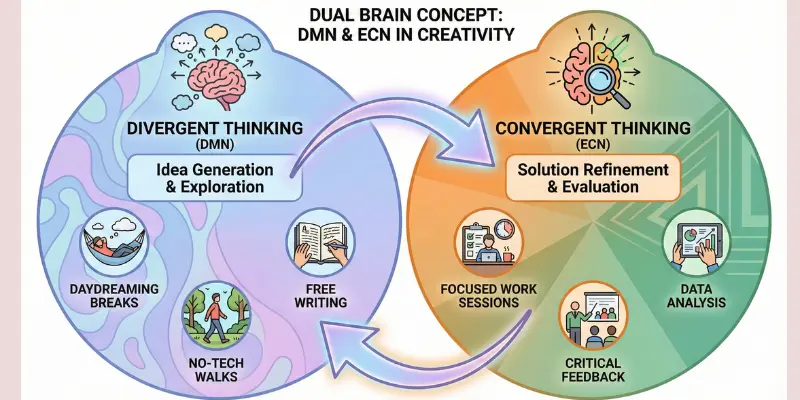
GAP 1 is all about understanding the Neuro-Strategic Creative Cycle—the relationship between the brain’s default mode network (DMN) and executive control network (ECN). These two networks play a critical role in the divergent (idea generation) and convergent (rigor and execution) phases of creativity.
- DMN (Divergence/Idea Generation): This is the network responsible for open-ended thinking, free associations, and idea generation. It’s where daydreaming, brainstorming, and creative exploration happen.
- ECN (Convergence/Rigor): This network takes the ideas generated by the DMN and applies discipline and focus to transform them into actionable solutions. The ECN ensures that creativity is not just an exercise in imagination but results in practical outcomes.
To harness the full potential of creativity, you need to train both networks in harmony. Too much focus on the DMN can lead to unfocused thinking and too little progress, while excessive use of the ECN can stifle creative flow.
Actionable Habit: Scheduling “Daydreaming Breaks” to Feed the DMN
A critical habit to train the DMN and facilitate creativity is scheduling “daydreaming breaks”—periods where you intentionally step away from tasks and allow your mind to wander. During these breaks, let your brain free-associate, explore new ideas, and make unexpected connections. This is how you feed the DMN, sparking the divergent thinking needed for creative problem-solving.
Additional Habit: Diversify sensory input. Exposing yourself to different environments, art forms, or disciplines can stimulate new ways of thinking and introduce fresh perspectives into your creative process.
The Innovation Safety Net: Cultivating Psychological Safety for Creative Resilience
One of the biggest barriers to creative innovation is the fear of failure. In many workplaces, failure is viewed as a sign of weakness or incompetence, which stifles creativity and risks pushing innovative ideas aside. However, the mindset shift required for creative success involves reframing failure as disciplined learning, not a setback.
In environments that encourage psychological safety, failure is seen as a stepping stone to success, not an end. By embracing a culture that rewards risk-taking, teams can experiment with new ideas without the fear of retribution. This encourages creativity to flow freely, knowing that each failure is simply a step toward a more refined solution.
To implement this in your work, focus on fostering open communication, allowing everyone to contribute ideas without judgment. Encouraging a growth mindset helps individuals see challenges as opportunities to learn and evolve their creative processes.
Summary: Mastering the Creative Mindset
The first pillar, Mindset, is about reshaping how you approach creativity. It’s about training your brain to oscillate between divergent and convergent thinking, embracing failure as a learning opportunity, and developing strategic thinking as a hard skill that powers all your creative efforts. The right mindset helps you generate ideas that aren’t just imaginative but also grounded in real-world applications.
In the next section, we’ll explore Pillar 2: The Methodology, which provides the frameworks and tools to structure creativity into a repeatable, disciplined process.
Pillar 2: The Methodology: Frameworks for Intentional Idea Generation
In the previous section, we focused on the importance of mindset—how to cultivate the right mental framework to unleash creative potential. Now, it’s time to move to the second pillar: Methodology. Creativity is not just about coming up with ideas, but about structuring the process of idea generation in a way that is consistent, intentional, and results-driven.
In this section, we’ll explore frameworks that take creative thought from an abstract concept to a tangible, actionable solution. These methodologies will help you move from divergence (idea generation) to convergence (execution) in a disciplined manner that maximizes impact and drives innovation ROI.
The Iterative Engine: Mastering Divergence and Convergence
The first step in mastering creativity is understanding the importance of both divergent and convergent thinking in the creative process. These two modes work in tandem to ensure that your creativity is both unlimited and focused.
- Divergence (Idea Generation): This is the phase where you explore as many ideas as possible, no matter how unconventional. The goal is to expand possibilities and let the mind wander without constraint. This is the “brainstorming” stage, where quantity matters over quality. It’s about exploring every avenue without judgment or limitation.
- Convergence (Execution): Once you’ve explored a wide range of ideas, you move into the convergence phase, where you focus, filter, and refine those ideas. This is where the rigor of strategic thinking comes in. You analyze each idea for feasibility, cost-effectiveness, and potential impact, and you choose the ones that will drive the most significant results.
By structuring your creative process to include these two stages in tandem, you ensure that you are both broadening your scope and focusing on the best opportunities for execution.
Thinking Inside the Box: Leveraging Constraints to Fuel Creativity
One of the most powerful methods to generate creative ideas is working within constraints. When faced with a lack of resources—whether time, budget, or materials—creativity thrives. Constraints push the mind to innovate and find unconventional solutions. The key is to see these limitations as opportunities rather than roadblocks.
For example, in design, being limited by a set budget may force you to think creatively about how to use existing resources in a new way. In marketing, having a short timeline can prompt more agile, creative solutions that might not have been considered in a longer planning process.
This principle is encapsulated in the concept of “Reverse Thinking.” Instead of asking, “What can we do with an unlimited budget and unlimited time?” you ask, “How can we do the most with the least?” By rethinking problems under tight constraints, you can often come up with the most innovative and cost-effective solutions.
The Toolkit for Structured Novelty: SCAMPER and Six Thinking Hats
Creativity needs tools, and having the right methodology helps you apply creativity in a structured way. Here are two powerful frameworks to guide your creative process:
- SCAMPER: This is a technique for generating new ideas by modifying existing ones. SCAMPER stands for:
- Substitute: What can be substituted in this idea or product?
- Combine: How can I combine different ideas to create something new?
- Adapt: What can be adapted to improve this concept?
- Modify: What can be modified or exaggerated to make it better?
- Put to another use: Can this be used in a different way?
- Eliminate: What can be eliminated to streamline the idea?
- Reverse: What would happen if we reversed the idea?
Using SCAMPER helps break down complex problems into more manageable components, encouraging novelty and innovation in a structured manner.
- Six Thinking Hats: Developed by Edward de Bono, this method asks you to consider an issue from six different perspectives:
- White Hat: Focus on facts and data.
- Red Hat: Look at the issue from an emotional perspective.
- Black Hat: Analyze potential risks and obstacles.
- Yellow Hat: Focus on the positive aspects and benefits.
- Green Hat: Think creatively and explore new ideas.
- Blue Hat: Manage the process and ensure that all hats are used appropriately.
This methodology encourages structured thinking from multiple perspectives, ensuring that no stone is left unturned in the creative process.
Strategic Idea Arbitrage: The Art of Cross-Domain Transfer (GAP 3)
GAP 3 focuses on an advanced creative technique called strategic idea arbitrage—the process of borrowing ideas from one domain and applying them to another. The best ideas often come not from invention, but from adaptation.
For example, the mobile app design principles used in gaming can be applied to automotive interfaces to create more user-friendly dashboards. Similarly, concepts in telecommunications can be adapted to improve insurance models.
By intentionally seeking and applying knowledge from outside your immediate industry, you can break down cognitive silos and create solutions that others may overlook. This is a critical skill for the Innovation Architect, who must be able to synthesize knowledge from diverse domains to craft innovative solutions.
Optimizing Absorptive Capacity: To engage in strategic idea arbitrage effectively, you must cultivate a high absorptive capacity—the ability to recognize, assimilate, and apply knowledge from outside your immediate domain. This requires continuous learning and a mindset that sees value in ideas from disparate fields.
Summary: Methodology as the Bridge from Creativity to Innovation ROI
The Methodology pillar is the bridge between creative thought and actionable innovation. By mastering the frameworks of divergent and convergent thinking, leveraging constraints to fuel innovation, and using tools like SCAMPER and the Six Thinking Hats, you can consistently produce high-impact ideas that drive measurable results. Additionally, by tapping into strategic idea arbitrage, you will expand your creative horizon and apply insights from outside your field to generate truly disruptive innovations.
In the next section, we’ll explore Pillar 3: Metrics, focusing on how to quantify creativity and prove its value in the business world through Innovation ROI and other key metrics.
Pillar 3: The Future-Proofing Strategy: Quantifying Value and Collaborating with AI
As we reach the final pillar of the 3-Pillar System, it’s time to shift from creative process to outcome. Creativity is only as valuable as the results it produces, and in the world of business, those results must be measurable. This is where Pillar 3: Metrics comes in—focusing on how to quantify innovation and demonstrate the return on creative efforts through both operational and financial metrics.
But, creativity isn’t just about producing ideas; it’s about creating value. And as AI becomes an increasingly integral part of the innovation process, the human role must evolve. Instead of seeing AI as a threat, it should be viewed as a collaborative partner—one that handles repetitive tasks, leaving humans to focus on what machines cannot: strategic thinking, ethical judgment, and the emotional intelligence required to create superior, human-centered designs.
The New Partnership: Why AI Doesn’t Replace Creative Skills
Debunking Misconception 3: AI Automates Efficiency, Not Creativity
It’s easy to fall into the trap of thinking that AI will replace creativity, but that’s a fundamental misunderstanding of what AI can and cannot do. AI excels at automating tasks that are repetitive and data-intensive. From content generation to data analysis, AI handles the tedious 80% of work, freeing up human creativity to focus on high-leverage activities that require strategic thought, emotional intelligence, and ethical decision-making.
Here’s why AI can’t replace creativity:
- AI can analyze data but can’t understand context or make value-driven decisions based on human needs.
- AI can generate content, but it lacks the human touch—the ability to infuse work with meaning, emotion, or aesthetic value that resonates with people.
- AI can predict trends, but it can’t craft the visionary ideas that disrupt industries and shape the future.
The key to thriving in an AI-driven world is not to compete with AI, but to collaborate with it. This partnership will allow you to focus on innovative thinking and problem-solving while AI takes care of the mundane tasks, amplifying your creative output.
Prompt Engineering as Cognitive Control (GAP 2): Shaping AI to Serve Your Needs
One of the most important new roles in the future of creativity is that of Prompt Engineer. Prompt engineering refers to the art and science of crafting queries and instructions that guide AI to produce specific, high-quality outputs. However, prompt engineering goes beyond just writing clever prompts. It’s about systematically shaping AI’s output to fit your creative vision and ensuring that its results meet the standards of rigor and excellence you demand.
In GAP 2, we focus on cognitive control—the ability to control and direct AI’s capabilities in a way that supports human creativity. Prompt engineering is about being the architect of the creative process, designing prompts and frameworks that guide AI to produce relevant, effective, and innovative solutions.
This doesn’t mean writing “better” prompts; it means thinking strategically about how AI can be integrated into the creative process in a way that enhances efficiency while maintaining high standards of human creativity. In this way, AI becomes a tool—a collaborator that extends human creative capacity rather than replacing it.
The New Role: Becoming the Innovation Architect
The future belongs to the Innovation Architect—a professional who designs and guides the creative process with precision, using both human intelligence and AI collaboration. As an Innovation Architect, your role is to:
- Build scalable AI toolchains that assist in idea generation, data analysis, and project execution.
- Integrate AI into continuous improvement processes (CI/CD workflows) to ensure that results are reliable, reproducible, and optimized for efficiency.
- Manage the intersection of human judgment and AI analysis, leveraging AI for its efficiency while applying strategic thinking, ethical considerations, and emotional intelligence to create truly innovative solutions.
By mastering this role, you don’t just use AI; you shape AI to support your creative process, ultimately driving your professional indispensability in a world increasingly shaped by automation.
Proving Value: Measuring Your Innovation ROI
To ensure that your creativity is seen as a strategic asset, you need to measure its impact. The key to proving the value of creative skills in the business world lies in Innovation ROI (Return on Investment). Here are the primary metrics to track:
Operational Metrics:
- Time to Market (TTM): How quickly can creative ideas be transformed into actionable solutions that reach the market? A streamlined, efficient creative process significantly reduces TTM, giving businesses a competitive edge.
- Cycle Time Reduction: By applying creative methodologies such as Design Thinking, businesses can reduce the time it takes to iterate on solutions and achieve better outcomes faster.
Financial Metrics:
- Return on Ad Spend (ROAS): Creative ideas are often tied to marketing efforts. Measuring how creative campaigns translate into sales and revenue is essential to proving the value of creativity in driving profits.
- Cost Savings from Rework: Creative approaches that reduce the need for constant revisions or rework are financially valuable. Effective problem-solving can prevent costly mistakes and save time across teams.
Attitudinal Metrics:
- Net Promoter Score (NPS): Measuring customer satisfaction and the likelihood of recommending a product is a powerful way to gauge the success of a customer-centric, creative strategy.
- Customer Satisfaction (CSAT): Ultimately, creativity should lead to better user experiences, and CSAT scores can help quantify the long-term impact of innovative, human-centered solutions.
By tracking these metrics, you can demonstrate the quantifiable value of creativity, making it clear that creative skills drive both financial and operational success.
Summary: Measuring Creativity, Collaborating with AI, and Future-Proofing Your Career
In this pillar, we’ve explored how creativity is no longer just about generating ideas; it’s about proving that creativity leads to tangible results. Through the strategic collaboration between human intelligence and AI, you can drive measurable innovation that directly impacts the bottom line. As an Innovation Architect, you’ll use AI not as a competitor but as a partner that amplifies your creative process and helps you achieve Innovation ROI.
In the next section, we’ll wrap up the 3-Pillar System, highlighting the integration of Mindset, Methodology, and Metrics as the foundation for mastering creative skills and ensuring professional indispensability in the age of automation.
Conclusion: The Integrated Human Operating System
As we reach the end of the 3-Pillar System for mastering creative skills, driving innovation ROI, and becoming AI-proof, it’s clear that creativity is no longer just a “nice-to-have” trait. In the modern world, creativity is a strategic asset, essential for solving complex problems and driving business success in an age where AI and automation are transforming industries.
The 3-Pillar System—Mindset, Methodology, and Metrics—lays the foundation for turning creative potential into a high-income, measurable, and sustainable skill that keeps you indispensable. By shaping your mindset, applying structured methodologies, and using metrics to prove value, you transform creativity from an unpredictable spark into a highly strategic and strategically measurable competency.
Key Takeaways:
- Mindset: Creativity is a skill that can be developed and trained. The right mindset—focused on strategic thinking, resilience, and psychological safety—enables you to approach creativity as a core professional competency.
- Methodology: Creativity thrives when it’s structured. By mastering frameworks like SCAMPER, Six Thinking Hats, and divergent and convergent thinking, you ensure that creativity is both intentional and results-driven.
- Metrics: Creativity isn’t just about coming up with ideas—it’s about proving that creativity drives tangible business outcomes. By tracking operational, financial, and attitudinal metrics, you can quantify your innovation ROI and demonstrate the strategic value of creativity.
Final Call to Action: Your Unique Voice and Disciplined Curiosity are Your New Currency
As the Innovation Architect, you are positioned to lead the charge in the future of work. In a world dominated by AI and automation, your creative judgment and strategic thinking are the skills that will set you apart. AI can’t replace your ability to see connections, make decisions based on ethical judgment, and craft human-centered solutions that speak to the needs and desires of your audience.
The biggest challenge for you now is to take the 3-Pillar System and apply it to your own strategic problems. What is the next big problem you’ll solve with your creativity? Whether it’s in marketing, design, product development, or leadership, the tools and frameworks outlined here can help you become the Innovation Architect of your career and organization.
Your journey to mastering creativity and becoming AI-proof starts now. Take the first step today, and transform your creative skills into a strategic, measurable asset that ensures career success in the age of automation. The future of work is not about competing with AI; it’s about collaborating with it and harnessing your creativity to shape the world of tomorrow.
FAQs: Mastering Creative Skills, Driving Innovation ROI, and Becoming AI-Proof
The 3-Pillar System is a structured framework designed to help you master creativity as a strategic, measurable skill. It focuses on:
- Mindset: Developing the right attitude to approach creativity as a trainable discipline.
- Methodology: Using proven frameworks like divergent and convergent thinking, SCAMPER, and Six Thinking Hats to systematically generate ideas.
- Metrics: Measuring the impact of your creativity using operational, financial, and attitudinal metrics to demonstrate real value to your business or career. By mastering these pillars, you can transform creativity into a high-income, professional competency.
To become a more creative thinker, start by adopting a growth mindset. Recognize that creativity is a skill, not a gift, and can be developed through practice. Focus on psychological safety—don’t fear failure; instead, view it as a learning opportunity. Engage in structured daydreaming breaks and actively expose yourself to new experiences to feed your brain’s default mode network (DMN), the part responsible for creative ideation. Over time, this helps you become more comfortable with generating and executing innovative ideas.
To measure Innovation ROI, focus on both operational and financial metrics:
- Operational Metrics: Track time to market (TTM) and cycle time reduction to show how creativity speeds up processes.
- Financial Metrics: Measure Return on Ad Spend (ROAS) and cost savings from reduced rework or iteration.
- Attitudinal Metrics: Use Net Promoter Score (NPS) and Customer Satisfaction (CSAT) to gauge the long-term impact of your creative solutions on your customer base. By tracking these metrics, you can prove that creative strategies directly contribute to business success.
AI can’t replace creativity, but it can significantly enhance it. While AI excels at automating repetitive tasks, such as data analysis and content generation, human creativity is irreplaceable when it comes to strategic thinking, ethical decision-making, and emotional intelligence. The key is to collaborate with AI by using it as a tool for efficiency, allowing you to focus on high-leverage tasks that require human judgment and vision. Think of AI as a partner that amplifies your creative capacity, not a competitor.
- Mindset: Start by embracing the concept that creativity is a skill you can improve. Allocate time for daydreaming and idea exploration to stimulate your DMN.
- Methodology: Incorporate structured tools like SCAMPER and the Six Thinking Hats into your daily routine for generating and refining ideas.
- Metrics: Set clear measurable goals for your creative efforts (e.g., reduce TTM by 20%, improve customer satisfaction scores by 10%) and track progress regularly. This approach will help you consistently demonstrate the impact of creativity on business outcomes.
- Operational Metrics: Track time to market (TTM) and cycle time reduction to show how creativity speeds up processes.
- Financial Metrics: Measure Return on Ad Spend (ROAS) and cost savings from reduced rework or iteration.
- Attitudinal Metrics: Use Net Promoter Score (NPS) and Customer Satisfaction (CSAT) to gauge the long-term impact of your creative solutions on your customer base. By tracking these metrics, you can prove that creative strategies directly contribute to business success.
AI can assist in the creative process by handling repetitive, time-consuming tasks such as data analysis, content generation, or design iterations. This allows you to focus on the more strategic aspects of creativity, such as problem-solving, ideation, and innovation. AI-driven tools like prompt engineering or AI-assisted design platforms help streamline workflows and increase productivity while still relying on human judgment for high-level creative direction. The real value comes from collaborating with AI rather than competing with it, using its capabilities to enhance your own creative vision.






- Be Respectful
- Stay Relevant
- Stay Positive
- True Feedback
- Encourage Discussion
- Avoid Spamming
- No Fake News
- Don't Copy-Paste
- No Personal Attacks
- Be Respectful
- Stay Relevant
- Stay Positive
- True Feedback
- Encourage Discussion
- Avoid Spamming
- No Fake News
- Don't Copy-Paste
- No Personal Attacks
