How to Improve Focus and Concentration: The Science-Backed 2026 Guide
Published: 27/12/2025
In today’s world, it can feel like focus is a fleeting luxury. You’re not alone in this struggle—many of us feel like our attention is constantly slipping away. Have you ever found yourself checking your phone every few minutes, even when you’re in the middle of something important? Or trying to concentrate, only to be distracted by the constant ping of notifications?
Here’s the thing: It’s not you, it’s the world around you. Studies show that the average person’s attention span has decreased dramatically, with some estimates claiming we now only focus on something for about 47 seconds at a time. That’s less than a minute. And it’s getting worse.
Why? Digital distractions have hijacked our brains. We’re constantly bombarded with quick, easy-to-digest bits of information, whether it’s social media, text messages, or the endless stream of content designed to keep us scrolling. Our attention pathways are being rewired in ways that make it harder to sustain focus on any one thing for long periods.
But here’s the good news: Improving your focus is not a matter of willpower. It’s about working with your brain’s natural tendencies—not fighting against them. Focus is a skill that can be trained and strengthened, and in this guide, you’ll learn how to harness science-backed strategies and practical habits to sharpen your attention in 2026 and beyond.
Why Your Focus is Slipping (And It’s Not Your Fault)
If you’ve found yourself struggling to focus in recent years, you’re not alone. But here’s something you might not realize: It’s not entirely your fault. While personal habits play a role, the world around us is designed to actively undermine our attention. The truth is, our brains weren’t built for the constant onslaught of modern distractions.

Let’s break down the main culprits:
Internal Saboteurs: Stress and Self-Doubt
You’ve probably noticed how stress can wreak havoc on your ability to concentrate. When you’re anxious or overwhelmed, your brain is preoccupied with survival—an ancient mechanism that makes focusing on anything else nearly impossible. Thoughts of “I’m behind” or “I’m not good enough” can hijack your focus, too. Self-doubt puts a serious dent in cognitive performance, making it harder to stay present and sharp.
External Saboteurs: Notifications and Clutter
Now, let’s talk about the world around you. Your phone is a master at stealing attention. Whether it’s an urgent work email, a social media notification, or a random news alert, your brain is constantly being pulled away from the task at hand. Each ping triggers a release of dopamine, a feel-good chemical that reinforces the desire to check your phone again and again.
But it’s not just your phone. Physical clutter in your environment can also create mental clutter, making it hard to stay focused. Studies show that messy, disorganized spaces increase stress and reduce cognitive performance. This means that even if you’re trying to concentrate, your brain is subconsciously distracted by the chaos around you.
The Digital Distraction Spiral
In addition to these external distractions, the rise of short-form content—think TikTok, Instagram, or endless YouTube videos—has dramatically altered the way our brains process information. Each time we consume these bite-sized pieces of content, our brains get a quick dopamine hit, reinforcing the habit of seeking more. This trains us to expect constant novelty, making it harder to engage in deep, sustained focus on one task.
Common Myths That Hold You Back
Here’s the kicker: A lot of people think the problem is simply a lack of willpower. “If I just try harder,” they might think, “I can focus better.” But that’s not the case. Trying to force focus without addressing the underlying factors is like trying to push a car uphill—it’s exhausting and ultimately counterproductive.
Another common myth is that multitasking increases productivity. In reality, multitasking is a focus killer. Your brain can only truly focus on one thing at a time, and switching between tasks causes something called “cognitive switching costs,” which actually makes you less efficient.
So, while it may seem like your inability to focus is all on you, the truth is that modern life is designed to pull your attention in multiple directions. The good news? You can take back control by understanding how these forces work against you, and then learning to create the right conditions for focus.
The Five Bubbles – A Neurologist’s Framework for Peak Concentration
If you’ve ever tried to force focus in a chaotic environment, you know how quickly it can feel like your mind is pulling in a thousand directions. But what if you could shift the odds in your favor by creating the right conditions for focus?
That’s where the Five Bubbles framework comes in—an easy-to-remember system that can help protect and build your focus. Developed by neuroscientists who study the brain’s attention systems, these five “bubbles” target the core areas that impact your ability to concentrate.
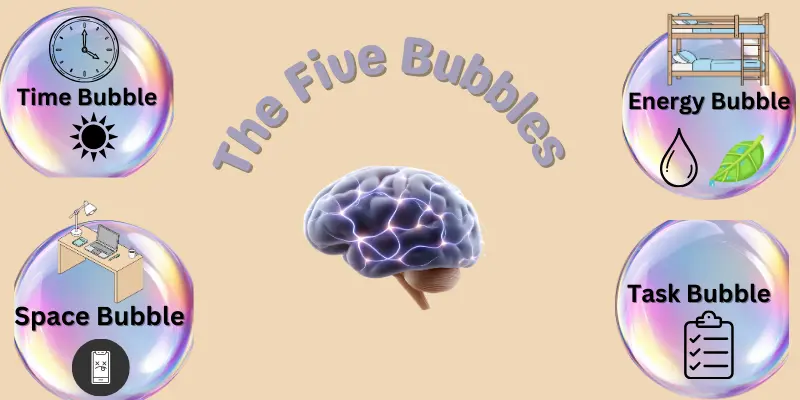
1. The Time Bubble: Work with Your Brain’s Natural Rhythms
Your brain isn’t a machine—it has natural peaks and valleys of energy throughout the day. The Time Bubble encourages you to sync your tasks with your brain’s natural rhythms, working with your body’s built-in cycles instead of against them.
For example, many people experience a mid-morning focus surge, often around 9–11 a.m. During this time, your brain is primed for deep work. In contrast, cognitive energy typically dips in the early afternoon. Instead of trying to push through fatigue, use that time for less demanding tasks, like responding to emails or brainstorming ideas. This can significantly reduce mental fatigue and increase overall productivity.
2. The Space Bubble: Create a Calm, Clutter-Free Environment
Ever tried to focus in a messy room? It’s hard. That’s because physical clutter creates mental clutter, which diverts your attention. The Space Bubble emphasizes the importance of curating your environment to support your focus.
Start by clearing away distractions from your immediate workspace. This means silencing your phone, closing unnecessary tabs on your computer, and organizing your desk. Creating a dedicated, clutter-free space signals to your brain that it’s time to focus.
Even small tweaks, like choosing a room with good lighting or adding plants for a calming touch, can make a difference. A study by the Princeton Neuroscience Institute found that “visual clutter” significantly reduces your brain’s processing efficiency, so a tidy workspace will help your mind feel clearer.
3. The Energy Bubble: Fuel Your Brain with Sleep, Nutrition, and Hydration
Focus isn’t just a mental game—it’s also a biological one. Your brain needs proper fuel to work at its best. The Energy Bubble ensures that your body is well-prepared to support sustained concentration by prioritizing sleep, nutrition, and hydration.
- Sleep: Aim for 7–9 hours of quality sleep each night. Sleep is when your brain consolidates memories and clears out mental clutter. A well-rested brain is far more capable of focus and problem-solving.
- Nutrition: Brain-boosting foods like leafy greens, omega-3-rich fish, and antioxidants help protect against cognitive decline and improve memory. Avoid heavy meals or high-sugar snacks before working—these can lead to energy crashes that make focus harder.
- Hydration: Dehydration can impair focus and cognitive function. Even mild dehydration can affect your ability to think clearly, so keep water on hand throughout the day.
4. The Task Bubble: Embrace Single-Tasking
Multitasking may seem like an effective way to get more done, but it actually reduces your productivity and focus. The Task Bubble emphasizes the power of single-tasking—giving your full attention to one task at a time.
Each time you switch tasks, your brain has to “reset,” which costs both time and energy. Instead of jumping between multiple tasks, dedicate blocks of time to work on one project. Use techniques like the Pomodoro Technique (25 minutes of focused work followed by a 5-minute break) to stay engaged without feeling overwhelmed.
Focusing on a single task also allows you to enter a flow state, where time seems to disappear and you’re completely immersed in the task at hand. This state is where creativity and productivity thrive.
5. The Thought Bubble: Quiet Mental Noise for Flow
Ever tried to focus, only to be interrupted by a constant stream of thoughts? These distractions—whether it’s worries, self-doubt, or random ideas—can derail your concentration. The Thought Bubble encourages you to quiet your mind using techniques that help reduce mental chatter and improve focus.
Simple practices like deep breathing, mindfulness, or meditation can calm your mind and prepare it for deep work. You don’t need hours of meditation to achieve this; even a few minutes of focused breathing can help clear mental noise and prepare your brain for flow.
One simple technique is the 4-7-8 breathing method: Inhale for 4 seconds, hold for 7 seconds, and exhale for 8 seconds. This can quickly lower your stress levels and help you return to a calm, focused state.
Neuroscience Secrets – How Visual Focus Drives Real Concentration
We’ve all experienced that moment where we’re trying to concentrate, but our mind keeps drifting. Maybe it’s a thought about the past, an idea for a future project, or a worry about something completely unrelated. But did you know that mental focus follows visual focus? In other words, where your eyes go, your brain follows.
This powerful connection between vision and focus is rooted in neuroscience. When you concentrate visually on something, your brain activates a specific chemical called acetylcholine—often referred to as the brain’s “spotlight” chemical. This neurotransmitter helps you zoom in on important details, allowing you to block out distractions and concentrate deeply on one task.
Let’s break it down:
The 90-Second Gaze Primer: Triggering Acetylcholine for Deep Focus
One simple, yet highly effective technique to prime your brain for deep work is a 90-second gaze. The idea is simple: Spend 90 seconds focusing intently on one object—whether it’s a pen on your desk, a spot on the wall, or a focal point in the distance.
As you focus on that object, take slow, deep breaths. With each breath, allow yourself to relax and let go of any distractions. This short but powerful exercise activates acetylcholine, signaling your brain that it’s time to hone in and begin focused work. It’s a way to reset your attention and train your brain to enter a state of flow.
The Role of Acetylcholine: Your Brain’s Focus Chemical
Here’s the cool part: Acetylcholine isn’t just involved in visual concentration; it also plays a key role in memory, learning, and attention. When you’re in a focused state, your brain is not only better at remembering information, but it’s also able to process that information more deeply.
If you’ve ever tried to study for hours, only to feel mentally drained without retaining much, it’s likely because you haven’t activated enough acetylcholine. By using the 90-second gaze primer (or other visual focus techniques), you can enhance the production of this chemical, making it easier to concentrate for longer periods.
Why Stimulants Boost Alertness, Not Focus
You might be thinking, “What about caffeine? Doesn’t that help me focus?” While stimulants like caffeine can temporarily increase alertness, they don’t actually improve deep focus. In fact, they can sometimes make things worse. When you rely on stimulants, your brain is in a constant state of hyper-alertness, but it’s not necessarily focusing on one thing at a time.
To enter a true state of focus, it’s not about pushing your brain to be alert; it’s about using tools like acetylcholine to direct your attention where it needs to go. While caffeine can give you a quick burst of energy, it doesn’t help you sustain that focus for long periods.
Reframing Agitation: A Sign You’re Building Real Concentration
Have you ever felt agitated while trying to focus? Maybe you’ve been staring at a task for a while, but you’re unable to settle into it. Many people think this means they’re failing to concentrate. But actually, this agitation might be a sign that you’re building real concentration.
When you push yourself to concentrate, your brain fights against distractions. This internal struggle is part of the process of strengthening your focus muscles. It’s like lifting weights for your brain. The more you practice focusing, the easier it becomes to override the distractions. So, next time you feel that agitation, don’t fight it. Lean into it, knowing it’s a sign that your brain is working hard to strengthen your attention.
Counter-Intuitive Strategies That Actually Work
You’ve likely heard the usual advice for improving focus: “Just push through,” “Stop checking your phone,” or “Try harder.” But here’s the thing—some of the most effective focus strategies are the exact opposite of what you might expect. Sometimes, doing less actually helps you do more. Let’s dive into a few counter-intuitive strategies that can significantly improve your concentration.
1. Strategic Pauses: Why Short, Planned Breaks Beat Pushing Through
It sounds counter-productive, right? You’re in the zone, and the last thing you want to do is take a break. But research has shown that short, planned pauses actually improve focus and productivity. Here’s why: When you work for extended periods without a break, your brain’s cognitive resources get depleted. This leads to diminishing returns, and you end up less focused, not more.
Instead of trying to work through fatigue, take a strategic pause—like a 5-minute break every 25–30 minutes of focused work (a technique used in the Pomodoro Method). Use this time to stretch, walk, or just breathe deeply. These short breaks recharge your brain and improve your ability to focus when you return to work.
2. Dopamine Front-Loading: Get Your Reward First
We all know the feeling of finishing a task and rewarding ourselves with a coffee, snack, or some screen time. But what if you could reverse this? Dopamine front-loading is the strategy of rewarding yourself before starting a task, rather than after.
By giving yourself a small reward or treat before diving into a task, you give your brain a dopamine boost—without the procrastination. For example, you could start your work session by watching a funny video, having a snack, or enjoying a short break. This rewards your brain with a positive stimulus, making it easier to dive into focused work afterward. Once you’ve started working, you’ll feel motivated to keep going to earn your next reward.
3. The Peripheral Vision Trick: Instant Calm During Overwhelm
When you’re feeling overwhelmed or anxious, your focus tends to narrow. The more stressed you feel, the more your brain gets trapped in a fight-or-flight mode, making concentration even harder. Here’s where a simple trick comes in: use your peripheral vision.
Try this next time you’re feeling tense: sit up straight, take a deep breath, and soften your gaze. Instead of staring at one point, let your peripheral vision take in the space around you. This helps activate the parasympathetic nervous system (the body’s “rest and digest” system), which reduces stress and anxiety. As a result, you’ll feel more centered and able to focus on the task at hand.
4. Building One-Pointedness Through Simple Daily Rituals
In a world filled with constant distractions, one of the most powerful things you can do to improve focus is to train your mind to focus on a single task—even for just a few minutes a day. This is the essence of one-pointedness, a practice rooted in ancient wisdom and supported by modern neuroscience.
Start by incorporating simple daily rituals into your life. For example, you could:
- Spend 5 minutes each morning focusing on your breath (no distractions, no devices).
- Read one chapter of a book without checking your phone.
- Focus on a single task during your workday without multitasking.
These small acts of single-tasking help strengthen your ability to concentrate and build mental resilience against distractions.
5. Using Purpose (Five Whys) to Anchor Your Attention
Sometimes, the hardest part of staying focused is simply knowing why you’re doing what you’re doing. When you’re unclear about the purpose behind a task, it’s easy to get distracted. That’s where the Five Whys technique comes in.
Start by asking yourself “Why” five times about the task you’re working on. For example:
- Why do I need to complete this report? (Because it’s due tomorrow.)
- Why is it important to finish it on time? (Because it will impact the team’s performance.)
- Why does the team’s performance matter? (Because it affects our company’s bottom line.)
- Why does the company’s bottom line matter? (Because our success depends on hitting financial targets.)
- Why is that important? (Because achieving these targets allows the company to grow, creating more opportunities for everyone.)
By the time you reach the fifth “Why,” you’ll have a clear sense of purpose, which can help ground your focus and make it easier to stay engaged.
Practical Habits to Train and Sustain Your Focus
Improving focus isn’t just about learning new techniques—it’s about consistently practicing habits that support and reinforce your ability to concentrate over time. The good news? You don’t need to overhaul your entire life to build better focus. In fact, small, consistent habits can have a profound impact. Here’s how you can train and sustain your focus in daily life.

1. Morning Rituals to Set a Strong Foundation
How you start your day sets the tone for the rest of it. A morning ritual that prioritizes focus can help you hit the ground running, mentally prepared for the tasks ahead. Here’s a simple morning routine to boost your focus:
- Wake up at the same time each day: Consistency is key to regulating your circadian rhythm, which influences alertness and cognitive performance.
- Hydrate first thing: Your brain is 75% water, so dehydration can impair focus. Drink a glass of water as soon as you wake up.
- Move your body: A few minutes of stretching or light exercise will increase blood flow to your brain, helping you feel more alert.
- Meditate or practice mindfulness: Even 5 minutes of mindfulness can set a calm, focused mindset for the day.
Starting your day with intention and structure helps you stay focused on what matters, without the mental chaos of rushing or indecision.
2. Single-Tasking Routines and Boundary-Setting
In a world that glorifies multitasking, single-tasking might seem like an old-fashioned concept. But the truth is, multitasking actually decreases efficiency and makes it harder to sustain focus. To build better focus, set clear boundaries for each task:
- Block out time for specific tasks: Instead of juggling multiple things at once, allocate time to focus solely on one activity—whether it’s writing, reading, or brainstorming.
- Create a distraction-free environment: Turn off notifications, close unnecessary browser tabs, and let others know when you need uninterrupted focus.
- Use a timer: Implementing techniques like the Pomodoro Method (work for 25 minutes, then take a 5-minute break) can help create a rhythm and encourage full engagement during work sessions.
By committing to single-tasking and setting boundaries, you’ll reduce the cognitive overload that comes from constantly switching between tasks.
3. Brief Mindfulness Practices That Strengthen Attention Over Time
Mindfulness isn’t just a trendy buzzword—it’s a proven way to improve focus. Mindfulness practices train your brain to stay present and resist distractions. Try incorporating these mini mindfulness practices into your day:
- Focused breathing: Take 5 minutes to practice deep, slow breathing. Inhale for 4 seconds, hold for 7 seconds, and exhale for 8 seconds. This will help you calm your mind and reset your focus.
- Mindful walking: Take a short walk around your home or office, focusing on your steps and breath. This will help you clear your mind and bring your attention back to the present.
- Body scan: Spend a few minutes each day doing a body scan, where you focus on each part of your body, from head to toe. This practice can reduce stress and improve your mental clarity.
These quick mindfulness exercises train your brain to stay grounded in the present moment, helping you maintain better focus throughout the day.
4. Quick Resets Using Nature, Movement, or Playful Drills
Sometimes, even the best focus habits can be interrupted by mental fatigue or stress. When this happens, a quick reset can restore your concentration. Here are a few ideas:
- Nature breaks: Take a few minutes to step outside. Research shows that being in nature, even briefly, can lower stress levels and improve mental clarity.
- Movement: Engage in light physical activity like stretching, yoga, or a quick walk. Physical movement increases blood flow to the brain, enhancing focus.
- Playful drills: Engage in short, enjoyable activities like puzzles or brain games that challenge your brain in a fun, low-pressure way. This gives your mind a break while still strengthening focus.
These quick resets can recharge your brain, helping you return to tasks with renewed energy and concentration.
Debunking the Biggest Focus Myths
If you’ve ever felt frustrated by your focus struggles, chances are you’ve fallen victim to some of the most common focus myths. These myths often mislead us, leaving us thinking that focus is either an innate ability or something that can be forced with sheer willpower. In reality, focus is a skill that can be trained and sustained with the right tools and strategies. Let’s bust some of the most persistent myths that hold us back.
Myth 1: Focus is Just About Trying Harder
One of the most pervasive myths is that you can improve focus simply by trying harder. This mindset suggests that if you just push yourself enough, you’ll be able to tune out distractions and power through your work. But here’s the truth: Trying harder doesn’t necessarily make you more focused—in fact, it can lead to burnout and mental fatigue.
The real key to improving focus isn’t about forcing yourself to stay engaged, but about creating the right conditions for your brain to work efficiently. By applying strategies like the Five Bubbles framework, you can train your brain to concentrate more effectively without burning yourself out.
Myth 2: Caffeine or Stimulants Directly Sharpen Concentration
We’ve all relied on coffee, energy drinks, or other stimulants to give us a quick burst of energy. But while stimulants like caffeine might make you feel more alert in the short term, they don’t necessarily improve true concentration. In fact, over-relying on caffeine can interfere with your brain’s ability to focus long-term.
While caffeine can temporarily enhance alertness, it doesn’t provide sustained focus. Instead of relying on external stimulants, focus on strategies like acetylcholine activation (through techniques like the 90-second gaze primer) or ensuring your brain is properly fueled with sleep, hydration, and nutrition.
Myth 3: Multitasking Gets More Done
We’ve all been told that multitasking is the key to getting more done. The idea is simple: if you juggle multiple tasks at once, you can accomplish more in less time. But the reality is that multitasking is a productivity killer.
When you multitask, your brain is actually switching between tasks, which can lead to a phenomenon called “cognitive switching costs.” Every time you switch tasks, your brain has to adjust and reorient itself, costing valuable time and mental energy. Research shows that multitaskers are less efficient and more prone to mistakes compared to those who focus on one task at a time.
Instead of multitasking, focus on single-tasking—the practice of dedicating your full attention to one task at a time. By single-tasking, you can enter a state of deep work, where you’re fully immersed in the task and achieve better results.
Myth 4: Focus is a Trait You’re Born With
Many people believe that focus is something you’re either born with or not. You might have heard someone say, “I just can’t focus; it’s not in my nature.” The truth is, focus is a skill—and like any skill, it can be developed with practice and the right techniques.
While some people may have an easier time concentrating, everyone can improve their ability to focus by implementing proven strategies like mindfulness practices, visual focus techniques, and creating the right environment. Focus isn’t a fixed trait; it’s a muscle that can be strengthened over time.
Myth 5: You Need to Be in the “Flow” to Be Productive
Many people believe that in order to be productive, they need to be in a state of “flow”—that deep, almost effortless state of concentration where time seems to disappear. While flow is an incredibly productive state, you don’t need to be in flow all the time to get things done.
Productivity is about consistency, not perfection. While it’s great to strive for flow, don’t beat yourself up if you’re not in that zone all the time. Even without being in flow, you can still achieve meaningful progress by sticking to focused work sessions and taking advantage of techniques like strategic pauses and single-tasking.
Your Personalized 30-Day Plan to Improve Focus and Concentration
Now that you have the tools, the science, and the strategies, it’s time to put everything into action. The key to improving your focus and concentration isn’t about quick fixes—it’s about making gradual, sustainable changes over time. That’s why we’ve designed this 30-day plan to help you train and sustain your focus.
This plan combines the principles of the Five Bubbles, visual focus techniques, and counter-intuitive strategies you’ve learned. Each day is designed to reinforce the habits that will make focus easier and more natural, so you can steadily build your concentration over the course of a month.
How Better Focus Boosts Career Output and Decision-Making
Before diving into the plan, let’s take a moment to talk about why this is worth your time. Improving your focus doesn’t just make you more productive—it directly impacts the quality of your work and your decision-making skills.
By consistently practicing focus techniques, you’ll:
- Make quicker, clearer decisions: A focused mind processes information more efficiently, leading to better judgment calls.
- Produce higher-quality work: With sustained attention, you’ll produce work that’s more thoughtful and accurate, reducing errors.
- Increase productivity: Focused work sessions help you get more done in less time, leading to greater efficiency and fewer distractions.
Whether you’re a student, a professional, or an entrepreneur, improving focus means more opportunities, faster results, and more free time for what matters.
Your 30-Day Focus Challenge
Each week of the challenge will focus on one key area: environment, time management, mental training, energy, and habits. The tasks in each section will build upon one another, helping you gradually master focus while creating sustainable habits.
Week 1: Creating the Right Environment
- Day 1: Set up your focus-friendly workspace. Clean up clutter, turn off notifications, and ensure you have the tools you need for a distraction-free environment.
- Day 2: Implement the Space Bubble. Create a dedicated “focus zone” where you only work. Organize your workspace to keep it tidy and calming.
- Day 3: Try the 90-second gaze primer and see how it helps reset your focus.
- Day 4–7: Focus on setting clear boundaries for your time. No multitasking—commit to single-tasking during work hours. Try using the Pomodoro Method for structured work and breaks.
Week 2: Managing Your Time and Energy
- Day 8: Track your energy rhythms for a day. Note when you feel most alert and plan your most important tasks during these high-energy periods.
- Day 9: Begin using time blocks for work. Set aside 25-minute sessions for deep work, followed by a 5-minute break.
- Day 10–14: Add in strategic pauses throughout your day. Take a 5-minute break every hour to recharge and avoid burnout.
Week 3: Strengthening Your Focus
- Day 15: Implement the Task Bubble. Dedicate yourself to single-tasking during work sessions. Notice how your efficiency increases.
- Day 16–17: Practice mindfulness. Spend 5 minutes a day in quiet meditation or focused breathing to clear mental noise.
- Day 18–21: Add a 5-minute mindful walk during your breaks. This will help reset your mind and improve your ability to focus on your next task.
Week 4: Building Long-Term Habits
- Day 22: Create a morning ritual that includes hydration, movement, and mindfulness. Set the tone for the day by starting with focus-enhancing habits.
- Day 23–25: Focus on your nutrition. Eat brain-boosting foods (like leafy greens and omega-3-rich fish) and stay hydrated throughout the day.
- Day 26: Review your progress and reflect on how your focus has improved. Adjust your environment or routine based on what’s working for you.
- Day 27–30: Commit to tracking your progress with a focus habit tracker. Set goals for the next 30 days to continue improving your attention.
Tailored Variations for Different Audiences
This 30-day plan is adaptable to fit your specific needs, whether you’re a student, a professional, or a parent. Here’s how you can personalize the challenge:
- For Students: Focus on applying the plan to study sessions and homework tasks. Prioritize breaks and time management to balance academic demands with focus-building activities.
- For Professionals: Implement this plan during work hours, particularly during meetings, deep work sessions, and project planning. The Time Bubble will be especially helpful for managing energy and maintaining focus through long workdays.
- For Entrepreneurs: Build focus into your daily routine, especially during moments of strategy planning, content creation, and client work. Use the Energy Bubble to align your tasks with peak performance times.
- For Parents: Adapt this plan by scheduling moments of focus during the day, even if they’re short (e.g., while kids are napping or after bedtime). Focus on creating a manageable environment and setting boundaries with technology.
Conclusion: Reclaiming Your Focus in a Distracted World
The world is more distracting than ever, and it’s easy to feel like you’re constantly battling your own attention. But what if, instead of fighting distractions, you could create the right conditions for focus? What if you could work with your brain, not against it, to reclaim your attention and concentrate with ease?
The strategies in this guide aren’t about forcing yourself to focus through sheer willpower. They’re about understanding how your brain works and making simple, science-backed changes that support your natural ability to concentrate. By creating a distraction-free environment, aligning your tasks with your body’s natural rhythms, and building powerful focus habits, you can train your brain to focus more effectively and consistently.
Key Shifts to Make
- From fighting distractions to creating the right conditions for focus.
- From struggling with willpower to working with your brain’s natural tools—like acetylcholine and visual focus.
- From feeling overwhelmed to feeling empowered, knowing that focus is a skill you can improve over time.
These shifts might feel small at first, but they’ll add up quickly. The more you practice these techniques, the easier it will become to maintain focus, even in the most distracting environments.
Take Action Now
The first step toward reclaiming your focus starts today. Don’t wait for the “perfect moment” or try to change everything at once. Choose one small strategy from this guide and commit to implementing it today. Whether it’s setting up a distraction-free workspace, trying the 90-second gaze primer, or taking a 5-minute mindfulness break—just start.
You’ll be amazed at how much progress you can make with even small, consistent changes.
Share Your Plan
Now that you have the tools to improve your focus, it’s time to put them into practice. Which strategy will you try first? Share your plan in the comments below, or let us know how you’ve started to incorporate these techniques into your daily routine. We’d love to hear about your progress and the small wins you’re experiencing along the way.
Remember, focus isn’t something you either have or don’t have. It’s a skill, and like any skill, it improves with practice. Start today, and over time, you’ll build the concentration you need to succeed in any task you take on.
Frequently Asked Questions (FAQs)
1. How can I improve my focus if I’m constantly distracted by my phone?
It’s a common challenge! The constant flow of notifications can hijack your attention and make focusing feel impossible. Here are some actionable steps to regain control:
- Turn off non-essential notifications: Disable alerts for apps that aren’t directly related to work or your focus task. This reduces the temptation to check your phone.
- Set boundaries: Create phone-free time blocks where you put your phone in another room or use apps like Focus@Will to help you stay focused.
- Use the “Do Not Disturb” mode: During work or study periods, activate your phone’s “Do Not Disturb” feature to silence calls, messages, and app notifications.
These changes may feel small, but they can make a huge difference in your ability to stay focused. The key is intentional use of technology rather than allowing it to dictate your focus.
2. Is it true that multitasking helps me get more done?
TRASH: Fluff – Multitasking is actually a productivity killer.
When you multitask, your brain has to constantly switch gears, which costs both time and energy. Studies show that multitasking reduces efficiency and increases the likelihood of errors. Instead, practice single-tasking. Dedicate blocks of time to a single task and focus entirely on it. Techniques like the Pomodoro Method (working for 25 minutes followed by a 5-minute break) can help you stay engaged and productive without overwhelming your brain.
3. How long does it take to build better focus and concentration?
Building lasting focus is a gradual process, but you can start seeing improvements quickly. Within 2–3 weeks of consistently practicing focus-enhancing techniques, like the 90-second gaze primer or strategic pauses, you’ll notice a clearer mental state and longer periods of focused work. True mastery of focus may take a few months, but the key is consistent practice. Start small and gradually build up your focus muscle, just like you would with physical exercise.
4. Can my diet affect my ability to focus?
Yes! What you eat directly impacts your brain function. To improve focus, prioritize foods that support brain health:
- Omega-3 rich foods like salmon, walnuts, and flax seeds help boost brain function and memory.
- Leafy greens like spinach and kale are rich in antioxidants that protect brain cells.
- Stay hydrated: Dehydration can significantly impair focus. Aim to drink water throughout the day to keep your brain functioning at its best.
Avoid excessive sugar or heavy, greasy meals before work, as these can cause energy crashes and impair concentration.
5. How can I avoid mental fatigue and stay focused for longer periods?
Mental fatigue is a major barrier to focus, but it can be managed. Here’s what you can do:
- Take regular breaks: Use techniques like the Pomodoro Method (work for 25 minutes, then take a 5-minute break). This allows your brain to recharge without overwhelming it.
- Switch up tasks: After a focused work session, shift to a less mentally demanding task (like responding to emails or organizing files). This will give your brain a mental “reset.”
- Practice mindfulness: Even a 5-minute session of focused breathing or meditation can restore energy and focus. This is key to sustaining high levels of productivity throughout the day.
6. Why do I feel distracted when trying to focus on a task?
Distraction is often a sign of mental overload or lack of clarity. Here are a few possible causes:
- Stress or anxiety: If your mind is preoccupied with worries, it’s hard to stay focused. Try deep breathing or a quick mindfulness exercise to calm your mind.
- Lack of clear goals: If you’re unsure of what you should be doing, your brain will naturally drift. Break your tasks down into smaller, achievable steps. This provides clarity and helps your brain stay engaged.
- Physical environment: A cluttered or noisy workspace can also be a huge distraction. Tidy up your environment and create a dedicated “focus zone” for optimal concentration.
7. Can I really train my focus, or is it something I’m just born with?
BULLET-PROOF ANSWER: Focus is absolutely a skill that can be developed, not an innate trait. It requires practice and consistency, much like building strength or learning a new language. By implementing strategies like the Five Bubbles (Time, Space, Energy, Task, Thought), you can train your brain to focus for longer periods and reduce distractions. With regular practice, you’ll improve both the quality and duration of your focus over time.






- Be Respectful
- Stay Relevant
- Stay Positive
- True Feedback
- Encourage Discussion
- Avoid Spamming
- No Fake News
- Don't Copy-Paste
- No Personal Attacks
- Be Respectful
- Stay Relevant
- Stay Positive
- True Feedback
- Encourage Discussion
- Avoid Spamming
- No Fake News
- Don't Copy-Paste
- No Personal Attacks
