100+ Skills to Put on Your Resume in 2026: The Complete Guide to Beat ATS and Get Hired
Published: 12/04/2026
Last Updated: 2026 | Data sourced from LinkedIn Workforce Report, WEF Future of Jobs, and Forbes Career Insights
Here is a number that should stop you cold.
75% of resumes never reach a human recruiter.
Not because the candidates were underqualified. Not because their experience was weak. But because an Automated Tracking System — a piece of software most job seekers do not even know exists — filtered them out before anyone had a chance to read their name.
You have probably felt this. You spend an hour tailoring your resume. You hit submit. Then silence. No callback. No email. Just nothing.
Here is the thing — it is almost never about your experience. It is almost always about your skills section.
In 2026, the skills section of your resume is no longer just a neat little list at the bottom of the page. It is the single most scanned part of your entire application. ATS systems rank you by it. Recruiters skim for it. Hiring managers make split-second decisions based on it.
And most people are getting it completely wrong.
This guide fixes that.
You will get 100+ verified resume skills for 2026 — organized by category, by industry, and by experience level. You will learn exactly which skills to put on your resume in 2026 that ATS systems reward, which ones to delete immediately, and how to present what you know in a way that makes recruiters stop scrolling.
Whether you are a fresher with no work experience, a professional switching careers, or someone who just wants their resume to finally work — this guide was built for you.
Let’s get into it.
Key Takeaways:
- 75% of resumes are filtered by ATS before a human sees them
- Your skills section is now the #1 thing both ATS and recruiters scan first
- This guide covers 100+ skills, ATS strategies, industry tables, and a 5-step framework — all in one place
Why Resume Skills Matter More Than Ever in 2026
Think about what happened to the job market in the last three years.
AI tools exploded into every industry. Remote and hybrid work became permanent for millions of people. Companies started doing more with smaller teams. And recruiters — already overwhelmed — started leaning even harder on software to help them filter hundreds of applications down to a manageable shortlist.
The result? Your resume now has to impress two audiences before you ever get a call.
First, it has to pass the machine. Then it has to impress the human.
And the machine does not care about your personality, your work ethic, or that impressive project you led in 2023. It scans for keywords. Specifically, it scans for skills — and it either finds them or it does not.
The ATS Reality Most Job Seekers Miss
Here is exactly how it works.
You apply for a job. Before any recruiter opens your resume, an Applicant Tracking System scans it automatically. It looks for specific words and phrases that match the job description. If your resume contains enough of the right keywords — particularly in your skills section — it moves forward. If it does not, it gets buried or rejected outright.
According to LinkedIn’s 2026 Workforce Report, most Fortune 500 companies — and a growing number of smaller ones — use ATS software to manage applications. The odds of a human reading your resume cold — without it first passing through software — are getting smaller every year.
Your skills section is your first line of defence. Get it right and you move forward. Get it wrong and the best resume in the pile sits unseen.
Why 2026 Is Different From Every Year Before It
The rules did not just shift slightly. They shifted fundamentally.
Three years ago, listing “Microsoft Office” and “strong communication skills” was considered perfectly acceptable. Recruiters expected it. ATS systems rewarded it.
Not anymore.
In 2026, those phrases are noise. Every candidate lists them. They carry almost zero weight with ATS systems and even less with recruiters who see hundreds of resumes a week.
What actually moves the needle now is a combination the WEF Future of Jobs 2026 report calls “the dual skill stack” — technical fluency paired with distinctly human capabilities.
You need skills that prove you can work alongside AI tools — not be replaced by them. And you need human skills that AI cannot replicate — judgment, empathy, communication, adaptability.
Companies are not looking for people who fear AI or people who blindly depend on it. They want people who understand it, use it well, and bring something human to the table that no algorithm can.
That combination is what wins jobs in 2026.
What Recruiters Actually Do in the First 7 Seconds
You may have heard that recruiters spend about 7 seconds on an initial resume scan. That number has been cited for years — and it is still accurate according to eye-tracking studies referenced in LinkedIn’s hiring research.
So what do they actually look at in those 7 seconds?
Not your summary. Not your job titles. Not your education.
They scan for recognizable, relevant skill words that match what they are hiring for.
If those words jump out clearly and quickly — you stay in the pile. If they have to hunt for them — you do not.
This is why your skills section needs to be clean, specific, and positioned where the eye naturally lands. Not buried at the bottom. Not hidden inside long paragraph descriptions. Visible, clear, and immediately readable.
Key Takeaways:
- ATS software filters resumes at most Fortune 500 companies — and increasingly at smaller companies too
- 2026 hiring rewards a “dual skill stack” — technical fluency plus distinctly human capabilities
- Recruiters spend roughly 7 seconds scanning a resume — your skills need to be visible and immediate
Hard Skills vs. Soft Skills — What Actually Moves the Needle in 2026
Let’s clear something up right away.
For years, career advice has treated hard skills and soft skills like two separate teams competing against each other. “Hard skills get you hired.” “No wait — soft skills are what really matter.” Back and forth, endlessly.
Here is the truth in 2026.
Both matter. But they matter at different stages of the hiring process — and understanding that difference is what gives you the edge.
What Hard Skills Actually Are
Hard skills are specific, teachable, and measurable abilities. They are the things you learned in a course, practiced on the job, or built through deliberate study.
Think: SQL, Python, project management, financial modeling, video editing, prompt engineering.
You either have them or you do not. You can prove them with a certificate, a portfolio, a test score, or a work example. And ATS systems can scan for them by keyword.
This is why hard skills are your ticket past the machine. When a job description says “proficiency in Tableau” and your resume says “Tableau” — the ATS finds a match. When it does not find that match — you do not move forward, no matter how talented you are.
Hard skills are the gate. You need them to get in.
What Soft Skills Actually Are
Soft skills are harder to teach and impossible to fully automate. They are the human qualities that determine how well you work, communicate, adapt, and lead.
Think: emotional intelligence, cross-functional collaboration, adaptability, executive communication, mentorship.
Here is what makes 2026 different from every previous year.
AI can now do a huge number of tasks that used to require hard skills — writing first drafts, analyzing data, generating code, summarizing reports. The technical barrier to entry is dropping fast.
But AI cannot read a room. It cannot build real trust with a client. It cannot mentor a junior colleague through a tough moment. It cannot navigate office politics or rally a demoralized team.
Those are human skills. And right now, they are more valuable than they have ever been.
This is exactly why the WEF Future of Jobs 2026 report found that soft and hybrid skills are the fastest-growing category in job descriptions globally. Companies know AI is handling more technical work. So they are doubling down on hiring humans who bring what AI cannot.
The 2026 Hiring Filter — How Both Work Together
Here is the clearest way to think about it.
Hard skills get you past the ATS. Soft skills get you past the recruiter. And together — they get you the offer.
A candidate with strong hard skills but weak human skills looks replaceable. A candidate with great soft skills but no technical foundation looks unqualified for modern roles. But a candidate who shows both?
That person looks like exactly what every hiring manager in 2026 is searching for.
Hard vs. Soft Skills — 2026 Comparison Table
| Hard Skills | Soft Skills | |
|---|---|---|
| What they are | Specific, teachable abilities | Human qualities and interpersonal strengths |
| How you prove them | Certificates, portfolios, test scores | Examples, stories, references |
| ATS value | Very high — directly keyword matched | Low — harder for ATS to detect |
| Recruiter value | High — confirms you can do the job | Very high — confirms you will thrive in the role |
| AI threat level | Medium — AI is replacing some hard skills | Low — AI cannot replicate true human skills |
| 2026 examples | SQL, Prompt Engineering, Power BI | Adaptability, Emotional Intelligence, Mentorship |
| Where to list them | Skills section + bullet points | Skills section + interview stories |
What Forbes Says About the Top Skills for 2026
Forbes Career Insights 2026 identified five skills that employers are actively prioritizing this year across almost every industry and role level:
1. Adaptability — The ability to shift quickly when priorities, tools, or circumstances change. In a world where AI tools evolve monthly, this is non-negotiable.
2. Data Literacy — You do not need to be a data scientist. But you do need to read a dashboard, interpret a chart, and make decisions based on numbers rather than gut feeling alone.
3. Tech Fluency — Specifically AI and cloud tools. Not deep engineering knowledge — but enough comfort with AI-powered platforms to use them confidently in your daily work.
4. Emotional Intelligence — The ability to understand your own emotions and respond to others with empathy and awareness. This is the skill AI will never credibly replicate.
5. Cross-Cultural Collaboration — Remote and hybrid work means global teams. The ability to work effectively across time zones, cultural backgrounds, and communication styles is now a core professional skill — not a bonus.
Notice something about that list.
Three of the five are soft or hybrid skills. That is not a coincidence. That is the signal the market is sending right now.
Where Hybrid Skills Fit In
There is a third category worth knowing about — and most resume guides completely ignore it.
Hybrid skills sit right at the intersection of technical and human. They require both a technical foundation and strong human judgment to execute well.
Examples include:
- Data Storytelling — using data analysis skills plus communication skills to translate numbers into decisions
- AI Ethics — understanding how AI tools work plus the human judgment to use them responsibly
- UX Research — combining technical research methods with deep human empathy
- Agile Facilitation — understanding project methodology plus the people skills to lead a team through it
Hybrid skills are the fastest-growing subcategory in 2026 job postings — and listing them strategically can genuinely set you apart from candidates who only list pure hard or pure soft skills.
What This Means for Your Resume Right Now
Do not choose between hard and soft skills. You need both — listed clearly, positioned strategically, and backed by proof.
In the sections that follow, you will get the exact skills to list in each category — organized by industry, experience level, and ATS priority. You will also learn how to present them so both the machine and the human on the other side of the screen take notice.
Key Takeaways:
- Hard skills pass ATS filters — soft skills win over recruiters — you need both to get the offer
- AI is lowering the technical barrier, making human and hybrid skills more valuable than ever
- Forbes 2026 top picks: Adaptability, Data Literacy, Tech Fluency, Emotional Intelligence, Cross-Cultural Collaboration
The Most In-Demand Hard Skills for 2026 (ATS-Optimized)
Let’s get specific.
This is the section most resume guides get completely wrong. They give you a generic list of 50 skills with zero context — no explanation of why each one matters, which industries want them most, or how to list them so ATS systems find them.
We are doing this differently.
Every skill in this section is organized by category, explained in plain terms, and flagged for ATS priority. Use this as your reference list — then in Section 7, you will learn exactly how to match these to any job description you are targeting.
Category 1: AI & Automation Skills
(The fastest-growing category in 2026 job postings)
This is the category that did not exist on most resumes three years ago — and is now appearing in job descriptions across virtually every industry.
You do not need to be an AI engineer to list these skills. You need to show you can work with AI tools confidently and responsibly.

The skills ATS systems are scanning for right now:
Prompt Engineering — The ability to write clear, structured instructions for AI tools like ChatGPT, Claude, or Gemini to get useful, accurate outputs. This is the #1 new hard skill recruiters searched for in 2025 according to LinkedIn data — and demand is still rising.
AI Workflow Automation — Using AI-powered tools to automate repetitive tasks — think Zapier, Make, or Microsoft Copilot. Companies want people who can save time and reduce manual work using these platforms.
Responsible AI Practice — Understanding the ethical boundaries of AI use — data privacy, bias awareness, output verification. This matters especially in healthcare, finance, legal, and education roles.
Machine Learning Basics — You do not need to build models. But understanding how ML tools work, what they can and cannot do, and how to interpret their outputs is increasingly expected in data-adjacent roles.
AI-Powered Analytics — Using AI features within tools like Google Analytics 4, HubSpot, or Salesforce Einstein to generate insights faster than manual analysis allows.
Category 2: Data Skills
(Still the backbone of almost every professional role)
Data skills did not go anywhere in 2026. If anything, they got more important — because AI tools generate more data than ever, and companies need people who can actually interpret it.
SQL — The most widely requested data skill across industries. Marketing, finance, operations, product — they all use SQL to query databases. If you only learn one technical skill this year, make it this one.
Python — Key for data analysis, automation, and AI work. Even a basic working knowledge of Python puts you ahead of most non-technical candidates applying for data-adjacent roles.
Microsoft Excel / Google Sheets (Advanced) — Not just formulas. Pivot tables, VLOOKUP, data validation, and dashboard building. Most roles still require this — and most candidates overestimate how well they actually know it.
And yes — advanced Excel still matters in 2026. Do not let anyone tell you otherwise.
Power BI — Microsoft’s data visualization tool. Huge demand in finance, operations, and corporate roles. If your target industry uses Microsoft products heavily, Power BI is a must.
Tableau — The leading data visualization tool in tech, consulting, and marketing. More visual and flexible than Power BI — preferred in industries that present data to external clients.
Google Analytics 4 (GA4) — Key for any marketing, e-commerce, or digital role. GA4 replaced Universal Analytics in 2023 and many candidates still have not updated their skills to reflect the new platform.
Category 3: Cloud & Technical Infrastructure Skills
(Now expected beyond just IT roles)
Three years ago, cloud skills belonged exclusively on IT resumes. Not anymore.
Project managers, operations leads, marketing technologists, and finance professionals are all expected to have at least working familiarity with cloud platforms and tools.
Microsoft Azure — The dominant cloud platform in enterprise and corporate environments. Knowing how to navigate Azure, manage files, and use its productivity integrations is increasingly expected in non-technical roles.
Amazon Web Services (AWS) Basics — The leading cloud platform in tech and startup environments. Even a foundational AWS certification signals technical confidence to recruiters.
Google Cloud Platform (GCP) — Especially relevant for roles in data, marketing technology, and companies that run on Google Workspace.
Cloud Collaboration Tools — Microsoft 365, Google Workspace, Notion, Slack. These tools show up constantly in job descriptions. List them — but always with context about how you used them, not just that you know they exist.
Category 4: Cybersecurity Basics
(Rising fast as a cross-industry requirement)
You do not need to be a security engineer. But as data breaches become more frequent and regulations tighten globally, employers across industries want to know their staff understand basic security principles.
Data Privacy Compliance — GDPR, CCPA, and regional data protection laws. Anyone handling customer data in marketing, HR, finance, or operations needs to know this.
Secure Data Handling — Knowing how to store, share, and protect sensitive information safely. More and more job descriptions are asking for this — even in roles that have never been technical before.
Two-Factor Authentication & Access Management — Basic but increasingly listed in job descriptions as companies tighten internal security protocols.
Category 5: Industry-Standard Software & Tools
(The skills that vary most by role — but matter everywhere)
These tools appear constantly in job descriptions for specific role types. Match these to your target role carefully.
Project Management: Asana, Monday.com, Jira, Trello, Microsoft Project
Design & Creative: Adobe Creative Suite, Figma, Canva Pro
CRM & Sales: Salesforce, HubSpot CRM, Zoho
Finance & Accounting: QuickBooks, SAP, Xero, Oracle Financials
HR & People Operations: Workday, BambooHR, ADP
Marketing & SEO: SEMrush, Ahrefs, Google Ads, Meta Ads Manager, Mailchimp
When to Create a Separate Technical Skills Section
Most resumes do fine with a single skills section. But if you are applying for tech-heavy roles — software engineering, data science, cybersecurity, DevOps — a dedicated Technical Skills section is worth adding.
Recruiters for technical roles scan specifically for tech stacks. They want to see your languages, tools, platforms, and frameworks grouped clearly — not scattered through a general skills list.
Format it like this:
Technical Skills
- Languages: Python, SQL, JavaScript
- Platforms: AWS, Azure, Google Cloud
- Tools: Tableau, Power BI, Docker, Git
- AI Tools: ChatGPT API, LangChain, Prompt Engineering
For non-technical roles — keep everything in one clean skills section.
A Quick Word on Listing These Skills the Right Way
Do not copy this entire list onto your resume.
That is keyword stuffing — and modern ATS systems are getting better at detecting it. More importantly, a recruiter who sees 35 hard skills listed with no context will not be impressed. They will be skeptical.
The rule is simple: Only list skills you can genuinely speak to in an interview. Pick the ones most relevant to the specific job you are applying for. Then in Section 8, you will learn how to back each one up with proof that makes recruiters believe you.
Quality over quantity. Every single time.
Key Takeaways:
- Prompt Engineering, AI Workflow Automation, and Responsible AI are the top new hard skills ATS systems are scanning for in 2026
- SQL and Python remain the most widely requested data skills across almost every industry
- Only list hard skills you can speak to confidently — quality and relevance beat a long generic list every time
The Most In-Demand Soft & Hybrid Skills for 2026
Here is something most resume guides will not tell you.
Soft skills are no longer the “nice to have” section that recruiters glance at and move past. In 2026, they are actively searched for, specifically screened during interviews, and in many cases — the deciding factor between two candidates with identical technical backgrounds.
Why now? Because of AI.
As AI tools take over more technical tasks, the skills that remain distinctly human are becoming the most valuable thing you can bring to a workplace. Companies are not just hiring for what you can do with a tool. They are hiring for what you can do that no tool can replicate.
That is where soft and hybrid skills live.
And that is exactly why LinkedIn’s 2026 Workforce Report found that soft skill mentions in job postings are growing faster than any technical skill category — driven directly by AI’s rise in the workplace.
Let’s break down exactly which ones matter most right now.
The Most In-Demand Soft Skills for 2026
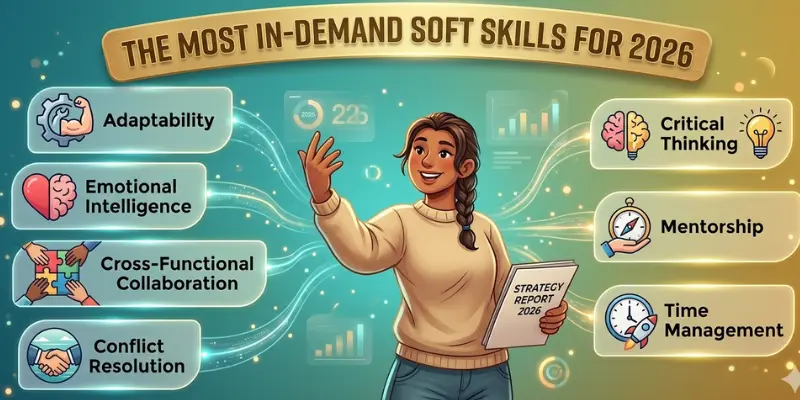
1. Adaptability
This is the #1 soft skill employers are prioritizing in 2026 — and it is not hard to see why.
AI tools change monthly. Company strategies shift quarterly. The candidates who thrive are not the ones with the most experience — they are the ones who adjust fastest when circumstances change.
Adaptability on your resume is not just listing the word. It is showing a moment when you pivoted successfully. A project that changed direction. A role that expanded unexpectedly. A tool you had to learn on the fly.
How to list it: “Adapted marketing strategy mid-campaign when platform algorithm changed — maintained 94% of projected reach within two weeks”
2. Emotional Intelligence
Emotional intelligence — or EQ — is your ability to understand your own emotions, manage them under pressure, and respond to others with genuine empathy and awareness.
AI can simulate empathy. It cannot actually feel it or exercise real judgment based on it. This is why EQ is one of the fastest-rising skills in leadership, customer-facing, healthcare, and team management roles.
How to list it: “Led cross-functional team through organizational restructure — maintained team morale and reduced voluntary turnover by 30% during transition period”
3. Cross-Functional Collaboration
Remote and hybrid work permanently changed how teams operate. You are now expected to work effectively with people across departments, time zones, cultures, and communication styles — often without ever meeting them in person.
This skill appears in LinkedIn’s top 5 most searched soft skills for 2026 — across industries from tech to healthcare to finance.
How to list it: “Coordinated product launch across four departments and three time zones — delivered on schedule with zero critical miscommunications”
4. Executive Communication
This is not just “good at communicating.” Every candidate claims that.
Executive communication means you can take something complex — a data report, a technical problem, a strategic challenge — and present it clearly to people who do not have your level of expertise. You can write a crisp email to a senior leader. You can present confidently to a room. You can get to the point.
In 2026, with information overload at an all-time high, the ability to communicate with clarity and brevity is genuinely rare — and genuinely valued.
How to list it: “Presented monthly performance reports to C-suite — reduced average meeting time by 20 minutes through structured data storytelling format”
5. Critical Thinking & Problem Solving
AI can generate options. It cannot always choose the right one — especially in ambiguous, high-stakes situations where context, ethics, and human judgment all matter.
Critical thinking is your ability to analyze a situation, question assumptions, weigh evidence, and arrive at a sound decision — even when the answer is not obvious.
How to list it: “Identified root cause of recurring client complaint that three previous teams had missed — resolved issue and reduced complaint rate by 67% within one quarter”
6. Mentorship & Knowledge Sharing
This one surprises people.
Mentorship is now a listed skill in job descriptions — particularly for mid-level and senior roles. Companies that are scaling fast need people who actively develop those around them, not just those who perform well individually.
How to list it: “Onboarded and mentored four junior team members — all four reached independent productivity within six weeks versus company average of ten”
7. Time Management & Prioritization
This one sounds basic. It is not.
In 2026, most professionals are managing more competing priorities than ever — across more tools, more communication channels, and more groups of people than any previous generation of workers.
How to list it: “Managed simultaneous delivery of five client projects with zero missed deadlines across a six-month period”
8. Conflict Resolution
Teams disagree. Priorities clash. Deadlines create pressure. The people who can navigate conflict calmly, fairly, and productively — without letting it damage relationships or derail projects — are worth a lot to any organization.
How to list it: “Mediated ongoing conflict between two senior team members — reached sustainable resolution that improved team output by 25% in the following quarter”
The Most In-Demand Hybrid Skills for 2026
Hybrid skills — the ones that blend technical ability with human judgment — are the fastest-growing subcategory in job postings right now. Here are the ones appearing most frequently.
1. Data Storytelling
You can analyze data. Great. But can you explain what it means to someone who does not live in spreadsheets?
Data storytelling is the ability to translate numbers, charts, and trends into clear narratives that drive decisions. It requires both data literacy and communication skill — which is exactly what makes it a hybrid.
2. AI Ethics & Responsible Tech Use
As AI becomes embedded in daily work, companies need people who understand not just how to use it — but when not to, and why.
AI ethics covers data privacy, output verification, bias awareness, and responsible automation decisions. It is increasingly listed as a requirement in HR, legal, finance, healthcare, and any role that handles sensitive data.
3. Agile Project Facilitation
Agile is no longer just a software development methodology. It has spread into marketing teams, HR departments, finance functions, and operations roles.
Agile facilitation means you understand the framework — sprints, retrospectives, backlogs — and you have the people skills to actually run them effectively.
4. UX Thinking & Human-Centered Design
You do not have to be a designer to list this.
UX thinking means you approach problems by starting with the human experience. Who is using this? What do they need? Where does the current process frustrate them? How do we design something better?
This mindset is now valued in product, marketing, operations, customer success, and even HR roles.
5. Change Management
Organizations are restructuring, adopting new tools, and shifting strategies faster than ever. Change management is the ability to guide people through those transitions — communicating clearly, managing resistance, and keeping teams productive during uncertainty.
How to List Soft & Hybrid Skills Without Sounding Generic
Here is the biggest mistake people make with soft skills.
They list the word. Just the word. “Communication. Teamwork. Leadership.”
That tells a recruiter nothing they have not seen a thousand times today.
Every soft skill on your resume needs one of two things next to it — either a brief context phrase or a bullet point elsewhere in your resume that proves it.
Weak: Communication
Strong: Executive Communication — presented weekly insights to senior leadership across three business units
Weak: Leadership
Strong: Team Leadership — managed cross-functional team of 12 through 18-month product development cycle
The skill plus the proof. That is the combination that works.
In Section 8, you will see exactly how to build these proof points — including before and after examples for the most common resume bullet mistakes.
Key Takeaways:
- Soft skill mentions in job postings are growing faster than any technical skill category in 2026 — driven directly by AI’s rise in the workplace
- The top soft skills recruiters are actively searching for: Adaptability, Emotional Intelligence, Cross-Functional Collaboration, Executive Communication, Critical Thinking
- Never list a soft skill without a proof point — the skill plus the evidence is what makes recruiters believe you
Industry-Specific Skills Tables (2026 Edition)
Here is where most resume guides completely lose the plot.
They give you one giant generic skills list and tell you to pick what fits. But a data analyst in healthcare needs a completely different skills profile than a data analyst in marketing. A project manager in logistics operates in a different world than a project manager in fintech.
The skills that get you hired are industry-specific. And the closer your resume matches the exact language your target industry uses — the higher your ATS score climbs.
This section gives you six clean industry tables. Find yours. Copy the skill names exactly as written. Use them in your resume — because the specific phrasing matters to ATS systems just as much as the skill itself.
Each table includes:
- Top 6 hard skills for 2026
- Top 4 soft skills for 2026
- Why each skill matters specifically in 2026 for that industry
🖥️ Industry 1: Technology & Software
| Skill | Type | Why It Matters in 2026 |
|---|---|---|
| Python | Hard | Core language for AI, automation, and data work across every tech role |
| Cloud Architecture (AWS/Azure/GCP) | Hard | Cloud-first infrastructure is now the default — not the exception |
| DevOps & CI/CD Pipelines | Hard | Faster deployment cycles demand engineers who understand the full pipeline |
| Prompt Engineering & LLM Integration | Hard | AI features are now embedded in almost every product — teams need people who can build with them |
| Cybersecurity Fundamentals | Hard | Every tech product now has security requirements baked into development |
| Agile & Scrum Methodology | Hard | Standard workflow framework across product and engineering teams globally |
| Cross-Functional Collaboration | Soft | Tech teams now work directly with marketing, sales, and operations — silos are gone |
| Adaptability | Soft | Tech stacks and tools change constantly — rigidity is a liability |
| Executive Communication | Soft | Engineers and PMs must present technical work clearly to non-technical leadership |
| Mentorship & Knowledge Sharing | Soft | Scaling tech teams need senior members who actively develop junior talent |
2026 Signal: AI integration skills are now listed in the majority of senior tech job postings according to LinkedIn data. If you work in tech and are not building AI fluency — start now.
🏥 Industry 2: Healthcare & Medical
| Skill | Type | Why It Matters in 2026 |
|---|---|---|
| Electronic Health Records (EHR/EMR) | Hard | Digital patient records are standard — proficiency is a baseline requirement |
| Clinical Data Analysis | Hard | Value-based care models require data-driven decision making at every level |
| Telehealth Platform Proficiency | Hard | Remote patient care is permanent — comfort with digital health tools is expected |
| Medical Coding (ICD-10, CPT) | Hard | Accurate coding directly affects reimbursement and compliance |
| HIPAA & Data Privacy Compliance | Hard | Patient data protection is a legal requirement — not optional knowledge |
| AI-Assisted Diagnostics Awareness | Hard | AI diagnostic tools are entering clinical workflows — awareness is increasingly expected |
| Empathy & Patient Communication | Soft | Patient outcomes are directly linked to communication quality and trust |
| Critical Thinking Under Pressure | Soft | Clinical environments require fast, sound decisions in high-stakes moments |
| Cross-Cultural Communication | Soft | Diverse patient populations require culturally sensitive, inclusive care |
| Adaptability | Soft | Healthcare protocols, tools, and regulations change constantly — flexibility is a must |
2026 Signal: Telehealth and AI diagnostics have permanently reshaped healthcare delivery. Candidates who show both clinical competence and digital fluency are winning the most competitive roles.
💰 Industry 3: Finance & Accounting
| Skill | Type | Why It Matters in 2026 |
|---|---|---|
| Financial Modeling & Forecasting | Hard | Core competency for FP&A, investment, and corporate finance roles |
| SQL for Financial Data | Hard | Finance teams increasingly query their own data — SQL is now expected beyond IT |
| Power BI / Tableau | Hard | Data visualization is replacing static spreadsheet reports at every level |
| IFRS / GAAP Compliance | Hard | Regulatory standards remain non-negotiable across all financial reporting |
| Risk Assessment & Management | Hard | Economic volatility and AI-driven market shifts demand stronger risk frameworks |
| Blockchain & Digital Asset Awareness | Hard | Crypto regulation and digital finance tools are reshaping the industry landscape |
| Analytical Thinking | Soft | Numbers tell stories — finance professionals must interpret and act on them accurately |
| Attention to Detail | Soft | Errors in financial work carry legal and reputational consequences |
| Ethical Judgment | Soft | Financial scandals and AI-generated reports demand stronger human integrity checks |
| Stakeholder Communication | Soft | Finance professionals increasingly present directly to boards and senior leadership |
2026 Signal: AI is automating basic bookkeeping and report generation — which means finance professionals who add strategic interpretation and communication skills on top of technical accuracy are much more valuable.
📣 Industry 4: Marketing & Communications
| Skill | Type | Why It Matters in 2026 |
|---|---|---|
| SEO & Content Strategy | Hard | Organic search remains the highest ROI channel for most businesses |
| Paid Media Management (Google/Meta Ads) | Hard | Performance marketing is core to every growth-focused marketing role |
| Marketing Automation (HubSpot/Marketo) | Hard | Automated nurture sequences and CRM integration are now standard practice |
| Data Analytics (GA4, Looker) | Hard | Marketing decisions are data-driven — gut feeling alone does not cut it anymore |
| AI Content Tools (Prompt Engineering) | Hard | AI-assisted content creation is now part of most marketing workflows |
| Video Content Production | Hard | Short-form video dominates every platform — production skills are in high demand |
| Data Storytelling | Soft/Hybrid | Marketers must translate campaign data into clear business narratives for leadership |
| Creative Problem Solving | Soft | Oversaturated markets demand fresh thinking — not just execution of proven playbooks |
| Cross-Channel Collaboration | Soft | Marketing now integrates with sales, product, and customer success constantly |
| Adaptability | Soft | Platform algorithms, audience behaviors, and tools shift faster in marketing than anywhere else |
2026 Signal: The marketers winning in 2026 combine creative instinct with data fluency and AI tool proficiency. Pure creatives without analytical skills and pure analysts without creative judgment are both struggling to compete.
🎓 Industry 5: Education & Training
| Skill | Type | Why It Matters in 2026 |
|---|---|---|
| Learning Management Systems (LMS) | Hard | Canvas, Moodle, Blackboard — digital delivery platforms are standard in every education setting |
| Instructional Design | Hard | Building effective learning experiences requires structured methodology — not just content knowledge |
| AI-Assisted Curriculum Development | Hard | AI tools are reshaping how educators build and personalize learning materials |
| Data-Driven Student Assessment | Hard | Tracking learning outcomes with data tools is increasingly expected at every level |
| Accessibility & Inclusive Design | Hard | Legal and ethical requirements for accessible learning are tightening globally |
| Virtual Classroom Facilitation | Hard | Remote and hybrid learning is permanent — comfort with digital facilitation is a must |
| Empathy & Active Listening | Soft | Effective teaching starts with genuinely understanding where each learner is struggling |
| Adaptability | Soft | Curricula, tools, and student needs change constantly — rigid educators fall behind |
| Mentorship & Coaching | Soft | Education is fundamentally about developing people — this skill is the core of the profession |
| Cross-Cultural Communication | Soft | Diverse student populations require culturally aware, inclusive communication approaches |
2026 Signal: EdTech adoption accelerated dramatically post-pandemic and has not slowed. Educators who combine pedagogical expertise with digital tool fluency and AI awareness are the most competitive candidates in 2026.
🚚 Industry 6: Logistics, Supply Chain & Operations
| Skill | Type | Why It Matters in 2026 |
|---|---|---|
| Supply Chain Management Software (SAP/Oracle) | Hard | Enterprise logistics runs on these platforms — proficiency is a baseline requirement |
| Inventory Management & Demand Forecasting | Hard | AI-powered forecasting tools are replacing manual planning — human oversight is still key |
| Data Analysis & Reporting (Excel/Power BI) | Hard | Operations decisions are increasingly data-driven at every level of the supply chain |
| Lean & Six Sigma Methodology | Hard | Process efficiency frameworks remain core to operations optimization globally |
| Logistics Technology (TMS/WMS) | Hard | Transport and warehouse management systems are standard across the industry |
| Sustainability & Green Logistics | Hard | ESG requirements and consumer pressure are making sustainable supply chain practice a hard skill |
| Problem Solving Under Pressure | Soft | Supply chain disruptions happen — calm, fast, effective problem solving is a must |
| Cross-Functional Collaboration | Soft | Logistics teams coordinate with procurement, sales, warehousing, and finance constantly |
| Attention to Detail | Soft | Errors in logistics — wrong quantities, missed shipments, incorrect documentation — are costly |
| Adaptability | Soft | Global disruptions, regulatory changes, and technology shifts demand flexible operators |
2026 Signal: Supply chain resilience became a boardroom priority after global disruptions — and it has stayed there. Candidates who combine operational expertise with data skills and sustainability awareness are commanding top salaries in 2026.
How to Use These Tables on Your Resume
Do not copy every skill from your industry table. That is not the goal.
Here is exactly what to do:
Step 1: Find your industry table above.
Step 2: Cross-reference it with the specific job description you are targeting. Which skills from the table appear in that job posting?
Step 3: List those matched skills — using the exact phrasing from the table — in your resume skills section.
Step 4: Make sure at least 2–3 of those skills also appear naturally in your bullet points under your work experience — with context and proof.
The closer your resume language matches both the industry standard and the specific job description — the higher your ATS ranking climbs.
Key Takeaways:
- Industry-specific skill language matters to ATS systems — use the exact phrasing from your industry table, not generic alternatives
- Every industry now has at least one AI-related skill in its top hard skills — digital fluency is no longer optional in any field
- Cross-reference your industry table with the specific job description — only list skills that appear in both
Skills for Special Situations — No Experience, Career Changers & Freshers
Let’s talk about the section of the resume process that nobody addresses honestly.
What do you do when you feel like you have nothing to list?
You are fresh out of university. Or you spent the last five years in a completely different industry. Or you have been out of the workforce raising a family, caring for someone, or dealing with life. And now you are staring at a blank skills section wondering what on earth you are supposed to write.
Here is what nobody tells you.
You have more skills than you think. The problem is not that you lack them. The problem is that you have not learned how to recognize them, name them, and present them in the language that employers understand.
That changes right now.
The Transferable Skills Framework
Transferable skills are exactly what they sound like — abilities you built in one context that apply directly to a completely different role or industry.
Every job you have ever had. Every volunteer role. Every team sport. Every side project. Every time you organized something, solved something, taught something, or led something — you were building transferable skills.
The key is learning to translate them into professional language.
Retail → UX Research
What you did: Spent three years working a shop floor, talking to customers, handling complaints, figuring out why people could not find what they were looking for, and reorganizing displays to improve flow.
What that actually is: Customer research, user behavior observation, pain point identification, experience optimization.
How to list it: “Conducted informal customer journey analysis across high-traffic retail environment — identified three recurring friction points and redesigned floor layout, increasing average basket size by 18%”
That is UX thinking. It happened in a shop. It counts.
Fast Food → Project Management
What you did: Managed lunch rush at a fast food restaurant — coordinating six people, tracking inventory in real time, resolving customer complaints while keeping orders moving, and hitting speed targets consistently.
What that actually is: Team coordination, real-time resource management, process optimization, performance under pressure, conflict resolution.
How to list it: “Coordinated team of six during peak service periods — maintained average order completion time of under four minutes while managing inventory, customer escalations, and staff allocation simultaneously”
That is project management. It happened at a counter. It absolutely counts.
Teaching → Corporate Training & Development
What you did: Spent years designing lesson plans, adapting your approach for different learning styles, managing a classroom, assessing progress, and finding creative ways to explain complex concepts simply.
What that actually is: Instructional design, adult learning principles, performance assessment, communication, adaptability, mentorship.
How to list it: “Designed and delivered differentiated learning programs for groups of 25–30 — adapted curriculum based on ongoing assessment data, achieving 94% course completion rate”
That is corporate L&D language. It came from a classroom. It transfers perfectly.
The No-Experience Resume — What to List When You Are Just Starting Out
If you are a fresher with zero professional experience, here is the honest truth.
Recruiters who hire entry-level candidates know you do not have years of experience. They are not expecting it. What they are evaluating is your potential, your attitude, and your transferable foundation.
Here is exactly what to mine for skills:
Academic Projects — Did you complete a research project, a group assignment, a thesis, or a capstone? Data collection, analysis, report writing, presentation, team coordination, deadline management — all of these belong on your resume if you demonstrated them academically.
How to list it: “Led four-person research team for final-year thesis project — collected and analyzed data from 200+ respondents, presented findings to faculty panel, received distinction grade”
Internships & Part-Time Work — Even if it was unpaid. Even if it was only three months. Any professional environment where you showed up, contributed, and delivered something has resume value.
Volunteer Work & Community Involvement — Organized a community event? Ran social media for a student club? Coached a junior sports team? These demonstrate real skills — event management, digital marketing, coaching, leadership, communication.
Online Courses & Certifications — This is where freshers can close skill gaps fast — and signal ambition at the same time.
The most valuable certifications for freshers in 2026:
- Google Data Analytics Certificate — Coursera
- Google Digital Marketing & E-commerce Certificate — Coursera
- Microsoft Azure Fundamentals (AZ-900) — Microsoft Learn
- HubSpot Content Marketing Certification — HubSpot Academy (free)
- IBM Data Science Professional Certificate — Coursera
- Meta Social Media Marketing Certificate — Coursera
How to List “In Progress” Certifications
Yes — you can absolutely list certifications you have not finished yet. But you must label them honestly.
The right way:
Google Data Analytics Certificate — Coursera (In Progress, Expected Completion: March 2026)
That phrasing does three things. It shows initiative. It shows you are actively building skills. And it is completely transparent about where you are in the process.
How to Use Proficiency Levels
Proficiency levels — Beginner, Intermediate, Advanced — add credibility without overclaiming.
| Skill | Proficiency |
|---|---|
| SQL | Intermediate |
| Python | Beginner |
| Google Analytics 4 | Intermediate |
| Prompt Engineering | Beginner |
| Microsoft Excel | Advanced |
Beginner — You understand the fundamentals and can perform basic tasks with guidance.
Intermediate — You use this skill independently and can solve most problems without help.
Advanced — You are highly proficient, have used this skill extensively, and could teach it to others.
Be honest. Recruiters appreciate it. And interviewers will test you.
Hobbies That Legitimately Count as Skills
Certain hobbies genuinely demonstrate professional skills and belong on your resume when you are light on experience.
- Gaming → Strategic thinking, team coordination, community management
- Blogging or Content Creation → Content strategy, SEO, digital marketing, writing
- Photography or Videography → Adobe Creative Suite, visual storytelling, attention to detail
- Coding Projects → Programming languages, problem solving, self-directed learning
- Sports (captain or coaching role) → Leadership, team building, performance under pressure
- Language Learning → Cross-cultural communication, cognitive flexibility, dedication
The rule is simple. If the hobby required a skill relevant to the role — and you can speak to it honestly in an interview — it belongs on your resume.
The Career Changer’s Approach
If you are switching industries entirely, your biggest challenge is not a lack of skills. It is a perception problem.
Here is the three-step approach that works:
Step 1: Audit your current skills against your target industry table from Section 5. Circle every skill you genuinely have — regardless of which industry you built it in.
Step 2: Identify the gaps. What is in the industry table that you do not currently have? Those are your priority certifications for the next 60–90 days.
Step 3: Reframe every bullet point in your work experience using the language of your target industry. Not fabricating — translating. The same achievement described in retail language versus marketing language tells a completely different story to a recruiter.
Once you have your skills identified and translated — the next challenge is making sure the ATS actually finds them. That is exactly what the next section covers.
Key Takeaways:
- Transferable skills are real skills — every job, project, volunteer role, and academic experience contains them — your job is to translate them into professional language
- Freshers should mine academic projects, part-time work, volunteer roles, online certifications, and relevant hobbies for legitimate resume skills
- “In progress” certifications are absolutely acceptable — label them honestly with expected completion date and they signal initiative rather than weakness
ATS-Optimized Strategies That Actually Work in 2026
Let’s get one thing straight before we dive in.
ATS optimization is not about tricking the system. It is not about stuffing your resume with every keyword you can find and hoping the algorithm rewards you. That approach worked five years ago. In 2026, it actively hurts you.
Modern ATS systems are much smarter than their predecessors. They do not just scan for keyword presence anymore. They evaluate keyword context, skill relevance, and the overall coherence of your resume. Stuff it with irrelevant keywords and the system flags it. A recruiter then sees a resume that reads like a keyword list rather than a professional profile.
The goal is not to game the system. The goal is to speak its language — naturally and strategically.
Here is exactly how to do that in 2026.
First — Understand How ATS Actually Works in 2026
Most people imagine ATS as a simple keyword scanner. Find the word, score a point, pass the filter. That was largely true a few years ago.
Today’s systems are more sophisticated. Here is what they actually do:
Step 1 — Parse your resume. The ATS breaks your resume into sections — contact information, work experience, education, skills. If your formatting confuses the parser — unusual fonts, graphics, tables, text boxes — it cannot read your content accurately. Your skills become invisible even if they are there.
Step 2 — Extract and match keywords. The system compares your resume content against the job description. It looks for direct matches, close variations, and semantic matches. So “people management” and “team leadership” may both match a requirement for “managing teams.”
Step 3 — Score and rank. The ATS gives your resume a relevance score. The higher your score relative to other applicants — the more likely a human recruiter sees your application first.
Step 4 — Flag for review. High-scoring resumes move to the recruiter’s shortlist. Low-scoring ones get buried — sometimes automatically rejected without a human ever seeing them.
Understanding this process changes everything about how you build your resume.
Strategy 1: Mirror the Job Description Language — Naturally
This is the single most effective ATS strategy available to you. And it costs nothing except attention.
Open the job description for the role you are targeting. Read it carefully. Highlight every skill, tool, qualification, and responsibility they mention. Then look at your resume — specifically your skills section and your bullet points.
Where the job description uses specific language — use that same language on your resume.
Not paraphrased. Not synonymized. The same words.
If the job description says “proficiency in Salesforce CRM” — your resume should say “Salesforce CRM” — not “customer relationship management software” or “CRM tools.” The ATS is matching strings of text. Synonyms do not always score the same as exact matches.
Here is a practical example:
Job description says: “Experience with agile project management, cross-functional team leadership, and stakeholder communication”
Weak resume response: “Managed projects using flexible methodologies, worked with different departments, communicated with various parties”
Strong resume response: “Agile Project Management | Cross-Functional Team Leadership | Stakeholder Communication”
Same skills. Completely different ATS score.
Strategy 2: Use the Right Resume Format for ATS Parsing
Your resume could have every right keyword — and still fail ATS if the formatting prevents the system from reading it correctly.
✅ DO these things:
- Use a clean, single-column layout for your skills section
- Use standard, readable fonts — Arial, Calibri, Georgia, or Times New Roman
- Use standard section headings — “Work Experience,” “Skills,” “Education”
- Save your resume as a PDF or Word document
- List your skills section clearly and separately
- Use bullet points for work experience — clean, consistent, and simple
❌ NEVER do these things:
- Put your skills inside a table or text box — ATS parsers frequently cannot read content inside these elements
- Use graphics, icons, or visual skill bars — they look great to humans but are completely invisible to ATS
- Use headers and footers for important information — many ATS systems skip header and footer content entirely
- Use columns for your main content sections — multi-column layouts confuse most ATS parsers
The hard truth about creative resume templates:
Those beautifully designed resume templates you see on Pinterest and Etsy — with colorful sidebars, skill progress bars, and stylish icons — are almost universally terrible for ATS. They look impressive to a human eye. They are largely unreadable to a machine.
Save the creative design for your portfolio. Keep your resume clean.
Strategy 3: Optimize Your Skills Section Placement and Structure
Where your skills section lives on your resume matters more than most people realize.
For most roles — place your skills section near the top of your resume, immediately after your professional summary.
For highly technical roles — consider leading with a dedicated Technical Skills section before anything else.
Structure your skills section like this:
For general roles:
SKILLS
Project Management | SQL | Power BI | Agile Methodology |
Cross-Functional Collaboration | Stakeholder Communication |
Data Analysis | Microsoft Excel (Advanced)
For technical roles:
TECHNICAL SKILLS
Languages: Python, SQL, JavaScript
Platforms: AWS, Microsoft Azure
Tools: Tableau, Power BI, Docker, Git
AI Tools: Prompt Engineering, LangChain, ChatGPT API
Clean. Scannable. ATS-friendly. Human-readable.
Strategy 4: Tailor Every Application — Not Just Once
Every job description is different. Every company uses slightly different language for the same skills.
A single generic resume sent to 50 jobs will almost always underperform a tailored resume sent to 10 targeted applications.
Build a master resume first. Include every skill, achievement, and experience you have — the full picture. This is your source document. You never send it as-is.
For each application — create a tailored version. Take 15 minutes to cross-reference the job description against your master resume. Adjust your skills section to mirror their language. Move the most relevant bullet points higher.
Keep a simple tracker. A basic spreadsheet with the company name, role, date applied, and which version of your resume you sent.
Fifteen minutes of tailoring per application can move your ATS score from 40% to 85%. That difference determines whether a human ever sees your name.
Strategy 5: Use a Free ATS Checker Before You Submit
Before you hit submit on any application — run your resume through a free ATS checker.
Reliable free options in 2026:
- Jobscan — paste your resume and job description, get an instant match score
- Resume Worded — detailed feedback on ATS compatibility and overall resume quality
- Teal — job tracking plus ATS optimization in one free tool
- LinkedIn Resume Builder — basic ATS feedback integrated with your LinkedIn profile
The 3 Most Common ATS Failures — And How to Fix Them
Failure 1: Using the wrong file format Fix: Save as PDF or DOCX. When in doubt — DOCX is the safest universal choice.
Failure 2: Putting skills inside tables or graphic elements Fix: Move all skills into plain text. No tables. No icons. No visual skill bars.
Failure 3: Using job titles that do not match industry standard language Fix: If your actual job title was something creative or company-specific — add the standard industry equivalent in brackets. Example: Growth Ninja (Digital Marketing Manager)
Key Takeaways:
- Mirror job description language exactly in your skills section — synonyms do not always score the same as direct keyword matches
- Never put skills inside tables, text boxes, or graphic elements — ATS parsers frequently cannot read them
- Tailor every application to the specific job description — 15 minutes of tailoring can move your ATS score from 40% to 85%
How to Quantify and Present Skills So Recruiters Believe You
Here is the uncomfortable truth about resume skills.
Anyone can list them.
Literally anyone. A person who used Excel once in 2019 can write “Microsoft Excel” on their resume. Someone who attended a single Agile workshop can list “Agile Methodology.” Someone who watched a YouTube tutorial on SQL can put “SQL” in their skills section.
Recruiters know this. They have seen thousands of resumes. They are deeply skeptical of skill lists — because skill lists without proof are just words.
So how do you make them believe you?
You prove it. Every single time.
The Golden Rule of Resume Skills
Never list a skill without a proof point somewhere on your resume.
Here is the framework that makes this work:
Skill + Action + Result = Proof Point
- Skill — what you used
- Action — what you did with it
- Result — what happened because of it
Every strong resume bullet follows this formula. Every weak one is missing at least one of these three elements.
The Before & After Method — 6 Real Examples
Example 1: Data Analysis
❌ Before: “Responsible for analyzing data and producing reports”
✅ After: “Used SQL and Power BI to analyze customer purchase data across 12 product lines — identified three underperforming segments and presented findings to leadership, resulting in a pricing strategy shift that recovered $240K in quarterly revenue”
Example 2: Project Management
❌ Before: “Managed multiple projects simultaneously”
✅ After: “Managed simultaneous delivery of six client projects across two time zones using Asana — maintained 100% on-time delivery rate over 14 months while coordinating teams of four to eight people per project”
Example 3: Communication Skills
❌ Before: “Excellent communication skills”
✅ After: “Designed and delivered monthly executive briefings to C-suite leadership team of eight — condensed complex operational data into 10-minute presentations, reducing average decision turnaround time from five days to same-day”
Example 4: Customer Service
❌ Before: “Provided excellent customer service in a fast-paced environment”
✅ After: “Handled 80+ customer interactions daily across phone, email, and live chat — maintained 4.8/5 customer satisfaction rating over 18 months and reduced average resolution time by 22% through implementation of a personal issue-tracking system”
Example 5: Leadership
❌ Before: “Strong leadership skills and ability to motivate teams”
✅ After: “Led cross-functional team of 14 across product, engineering, and marketing during 18-month platform rebuild — delivered on schedule despite two major scope changes, with zero voluntary team departures throughout the project”
Example 6: Digital Marketing
❌ Before: “Experience with digital marketing and social media”
✅ After: “Managed paid social campaigns across Meta and LinkedIn with monthly budget of $15K — optimized targeting and creative based on weekly performance data, reducing cost per lead by 34% over six months while increasing lead volume by 28%”
How to Add Numbers When Your Role Was Not Numbers-Heavy
Ask yourself these questions for every role you have held:
- How many people did I work with, manage, serve, or teach?
- How many tasks, cases, calls, or projects did I handle — daily, weekly, or monthly?
- Did anything improve while I was there — speed, quality, satisfaction, cost, retention?
- Did I save time — for myself, my team, or my customers? How much?
- Did I train or onboard anyone? How many? How fast did they reach productivity?
- Was I promoted or given additional responsibilities earlier than expected?
Every yes is a number waiting to be used.
What to Do When You Genuinely Do Not Have Numbers
Use scope and scale instead of hard metrics.
Instead of: “Helped customers with their queries” Write: “Supported 50+ customers daily across a high-volume retail environment — resolved product, payment, and complaint issues independently without escalation”
Instead of: “Wrote content for the company blog” Write: “Produced two long-form blog articles per week across six topic categories — maintained consistent publishing schedule for 11 months with zero missed deadlines”
Scope and scale are not as powerful as hard metrics. But they are much stronger than vague, unquantified descriptions.
The Credibility Stack — Building Trust Layer by Layer
The strongest resumes build what experienced recruiters call a credibility stack — multiple layers of evidence for the same skill appearing in different parts of the resume.
Skill claimed in skills section: SQL
Proof in work experience: “Used SQL to query customer database of 2M+ records — built automated weekly report that reduced manual reporting time from four hours to 12 minutes”
Proof in education/certifications: Google Data Analytics Certificate — Coursera (2025)
Proof in achievements section: “Recognized by Head of Data as top performing analyst for Q3 2025 based on report automation initiative”
Three layers of evidence for one skill. A recruiter reading this resume does not just see the word SQL. They see a person who genuinely knows it, has used it at scale, has been formally trained in it, and has been recognized for it.
That is what belief looks like on a resume.
A Quick Word on Skill Bars and Rating Systems
Delete them.
They are entirely self-assessed and completely unverifiable. Worse — they often work against you. If you rate yourself 4 out of 5 in SQL and then struggle to answer a mid-level SQL question in the interview — you have damaged your credibility far more than if you had simply listed SQL without a rating.
Replace every skill bar on your resume with one strong bullet point that demonstrates that skill in action.
Key Takeaways:
- Every skill on your resume needs proof — the formula is Skill + Action + Result, and all three elements must be present
- You can quantify almost any role — look for volume, frequency, improvement, time saved, people managed, and recognition received
- Skill bars and star ratings are self-assessed and unverifiable — replace them with concrete proof points that actually build recruiter trust
Skills to Avoid on Your Resume in 2026
Let’s have an honest conversation.
Most resume guides tell you what to add. Very few tell you what to ruthlessly cut. And the truth is — what you remove from your resume can be just as powerful as what you keep.
A bloated, outdated, or vague skills section does not just fail to impress recruiters. It actively works against you. It dilutes the strong skills you do have. It signals poor judgment about what matters. And in some cases — it triggers an ATS to rank you lower because irrelevant keywords are reducing your overall relevance score for the role.
Here is exactly what to delete — and why each one hurts you.
The Deadweight Skills List — Cut These Immediately
1. “Team Player”
This is the single most overused phrase in the history of resume writing.
Every candidate claims it. It has been on resumes since resumes existed. It carries exactly zero weight with any recruiter anywhere in 2026 — because it is self-assessed, unverifiable, and expected of literally every professional in every role.
Delete it. Replace it with a specific example of cross-functional collaboration with a measurable outcome.
2. “Hard Worker”
Same problem. Self-assessed. Expected. Universally claimed.
Delete it. Let your quantified achievements speak for your work ethic.
3. “Microsoft Office” — Without Context
Listing “Microsoft Office” as a standalone skill in 2026 is roughly equivalent to listing “can use a telephone.” It adds no value to your profile whatsoever.
Specific, advanced Microsoft skills absolutely belong on your resume. The difference is context and specificity.
❌ Too vague: Microsoft Office
✅ Specific and valuable: Microsoft Excel (Advanced — pivot tables, VLOOKUP, Power Query, dashboard building)
✅ Specific and valuable: Microsoft Power BI (interactive dashboard creation, DAX formulas, real-time data modeling)
The tool name alone means nothing. What you can do with it — at what level — is everything.
4. “Good Communication Skills”
Communication is genuinely one of the most valuable skills in 2026. But listing it as a vague self-assessment completely wastes that value.
❌ Weak: Good communication skills
✅ Strong: Executive Communication — delivered weekly performance briefings to C-suite leadership, reducing decision turnaround from five days to same-day through structured data storytelling format
Same skill. Completely different impact.
5. “Fast Learner”
Self-assessed, unverifiable, universally claimed.
The candidates who are genuinely fast learners never need to say it. Their resume shows it. Delete the claim. Show the evidence instead.
6. “Detail-Oriented”
The cruel irony of listing “detail-oriented” on a resume is that recruiters immediately look for errors in the same document. One typo, one formatting inconsistency — and your claim is destroyed before the interview even happens.
Delete it. Prove it through the quality and precision of your bullet points instead.
7. Standalone AI Tool Names — Without Context
Listing “ChatGPT” or “Midjourney” as a standalone skill tells a recruiter almost nothing useful. Using an AI tool is table stakes in 2026. The question is not whether you have used them — it is how you use them and what results you achieved.
❌ Weak: ChatGPT, Midjourney, Claude
✅ Strong: AI Workflow Automation — used ChatGPT API and Zapier to build automated content brief system, reducing brief creation time from 45 minutes to 8 minutes per brief
The tool plus the application plus the result. That is what turns an AI skill from noise into signal.
8. Outdated Technical Skills
Watch out for these specifically:
- Adobe Flash — discontinued, irrelevant
- Internet Explorer optimization — obsolete
- Windows XP / Vista administration — signals you have not updated your skills
- Google Universal Analytics — replaced by GA4 in 2023
Remove them immediately. List current versions instead.
9. Irrelevant Personal Skills
Skills that have no connection to professional performance do not belong on a resume.
Every line on your resume is real estate. Use it for skills that directly support your candidacy. Everything else is noise — and noise reduces your signal.
10. Vague Language Skills
❌ Too vague: “Basic Spanish”
✅ Right way: Use internationally recognized proficiency standards or clear descriptors.
Example: Spanish — B2 (Business Proficient) | Arabic — Native Speaker | French — A2 (Basic)
Clear. Honest. Immediately useful to a recruiter.
The Quality Over Quantity Rule
The most impressive skills sections are tight, specific, and clearly relevant to the role being applied for.
The sweet spot in 2026 is 8–12 skills maximum.
Eight strong, proven, relevant skills will outperform twenty-five vague, generic, unsubstantiated ones every single time.
The Myth vs. Reality Check
Myth: The more skills I list, the more impressive my resume looks. Reality: Recruiters are trained to spot padding. A long skills list with no proof points signals insecurity, not competence.
Myth: Soft skills like “team player” show I am a well-rounded candidate. Reality: Generic soft skills with no evidence show you ran out of real things to say.
Myth: Listing every AI tool I have ever opened shows I am tech-forward. Reality: Tool names without context signal surface-level familiarity. Application and results signal genuine capability.
Myth: If it is true, it belongs on my resume. Reality: Relevance matters more than truth. A true skill that is irrelevant to the role wastes valuable space and dilutes your stronger skills.
Now that you know what to cut — it is time to build what stays. Here is the complete 5-step system for putting it all together.
Key Takeaways:
- Delete immediately: “team player,” “hard worker,” “good communication skills,” “fast learner,” “detail-oriented” — these are self-assessed, unverifiable, and universally ignored by recruiters
- Never list standalone AI tool names without showing how you used them and what results you achieved
- Keep your skills section to 8–12 maximum — tight, specific, relevant skills always outperform long generic lists
Your 5-Step Framework to Build Your Skills Section in Under 10 Minutes
You now have everything you need.
You know which skills ATS systems scan for. You know which industries want what. You know how to prove your skills with real evidence. You know what to delete. And you know how to format everything so both the machine and the human on the other side actually see it.
Now it is time to put it all together.
This 5-step framework takes everything covered in this guide and turns it into a simple, repeatable process you can use for every single job application you submit — starting today.
Ten minutes. Five steps. A skills section that actually works.
Ready? Let’s build it.
Step 1: Scan the Job Description and Highlight Every Skill Mentioned
Time needed: 2 minutes
Open the job description for the role you are targeting. Read it once all the way through. Then read it again — this time with a highlighter or the notes app on your phone.
Highlight every skill, tool, qualification, and competency they mention. Hard skills. Soft skills. Specific software. Methodologies. Certifications. Everything.
Pay special attention to:
- Skills mentioned more than once — repetition signals high priority
- Skills listed near the top of the requirements — placement signals importance
- Skills in both “Required” and “Preferred” sections
- The exact language used — not the concept, the specific words
Pro tip: Copy the job description into Jobscan or Resume Worded before you start. It will automatically extract the most important keywords — saving time and ensuring you miss nothing.
Step 2: Match Your Real Skills to Those Keywords
Time needed: 2 minutes
Go through your highlighted job description list. For every skill they mention — ask yourself honestly: Do I actually have this?
Sort your answers into three groups:
Group A — Strong match: You have this skill, used it recently, and can speak to it confidently. These go on your resume.
Group B — Partial match: You have some experience but it is limited or dated. These go on your resume with honest proficiency levels — and potentially an “in progress” certification.
Group C — No match: You do not have this skill. These do not go on your resume. But if they appear repeatedly across multiple job descriptions — they go on your learning list for the next 60–90 days.
Be ruthlessly honest in this step. Overclaiming gets you into interviews you cannot perform in.
Step 3: Prioritize — Lead With Your Most Relevant and Strongest Skills
Time needed: 1 minute
From your Group A and Group B lists — prioritize using this ranking:
Priority 1 — Skills in the job description that you have strongly: ATS-critical and genuinely yours.
Priority 2 — Industry-standard skills from your industry table that you have strongly: Add professional credibility even if not explicitly mentioned.
Priority 3 — Hybrid skills that differentiate you: If you have a strong hybrid skill relevant to the role — it earns a spot.
Cut everything else. If a skill does not fit Priority 1, 2, or 3 — it does not go in this version.
Step 4: Phrase Each Skill With Precision and Back It Up With Proof
Time needed: 3 minutes
For each skill in your final list — do two things:
First: Write the skill using the exact language from the job description and your industry table.
Second: Make sure there is a proof point for that skill somewhere in your work experience bullet points using the Skill + Action + Result formula.
Quick format check:
✅ Skills listed in plain text — no tables, graphics, or skill bars
✅ Exact job description language used where possible
✅ Proficiency levels added where relevant
✅ Every listed skill has a proof point in your experience section
✅ Total skills listed: between 8 and 12
Step 5: Run It Through a Free ATS Checker Before Submitting
Time needed: 2 minutes
Take your completed, tailored resume and run it through Jobscan, Resume Worded, or Teal.
Look for three things:
1. Your match score — Aim for 70% or above. Below 60% means you are at high risk of being filtered out before a human sees it.
2. Missing keywords — For each flagged keyword — decide honestly: do you have this skill? If yes — add it. If no — leave it out.
3. Formatting issues — Fix every one before submitting.
Your 10-Point Final Checklist
(Screenshot this — check it before every application)
Content:
- [ ] Skills section contains 8–12 skills maximum
- [ ] Every skill uses exact job description and industry-standard language
- [ ] Every skill has a proof point in your experience bullet points
- [ ] Proficiency levels added for partial or developing skills
- [ ] “In progress” certifications labeled honestly with expected completion date
ATS & Format:
- [ ] Skills listed in plain text — no tables, graphics, or skill bars
- [ ] Standard fonts used throughout — Arial, Calibri, or Georgia
- [ ] Resume saved as PDF or DOCX
- [ ] Skills section positioned near the top of the resume
- [ ] ATS checker score is 70% or above for this specific application
The Free Downloadable Template
To make this process even faster — use the free Google Sheet template built specifically for this guide.
The template includes:
- Master Skills Inventory — all your skills organized by category and proficiency level
- Job Description Keyword Extractor — paste any job description and highlight priority keywords automatically
- Application Tracker — track every application, resume version sent, and ATS score
- Skills Gap Tracker — monitor skills you are building with target completion dates
→ Download the free template here: (Insert live Google Sheet link before publishing)
Making This a Habit — Not a One-Time Fix
Your resume is not a document you finish once and send forever.
Your skills evolve. Job markets shift. New tools emerge. The candidates who consistently get interviews treat their resume as a living document — updated on purpose, tailored deliberately, and refined continuously.
Set a reminder every three months to review your master resume. Add new skills. Update proof points. Remove outdated skills. Check your target industry table for any shifts in what is being prioritized.
Three months is enough time for the job market to shift meaningfully. It is also enough time to build a new skill, complete a certification, or achieve something worth adding.
Stay current. Stay competitive.
Key Takeaways:
- Follow all five steps in order for every application — scan, match, prioritize, phrase with proof, then verify with an ATS checker before submitting
- Aim for an ATS match score of 70% or above before submitting any application
- Treat your resume as a living document — review and update it every three months to stay current and competitive
Frequently Asked Questions
1. What skills should I list if I have no work experience?
Start with transferable skills from academic projects, part-time work, volunteer roles, and extracurricular activities. Then add any online certifications you have completed or are currently working toward. Finally — look at hobbies and personal projects that genuinely demonstrate relevant skills.
The key is translation. A university group project demonstrates teamwork, deadline management, and presentation skills. A part-time retail job demonstrates customer communication, inventory management, and performance under pressure.
You have skills. They just need to be named, framed, and proven in professional language.
Where to start: Go back to the Special Situations section of this guide and work through the transferable skills framework. By the end of it you will have more to list than you thought.
2. Should I still include soft skills on my resume in 2026?
Yes — but only if you list them correctly.
Soft skills matter more in 2026 than they ever have. LinkedIn data shows soft skill mentions in job postings are growing faster than any technical skill category — driven directly by AI’s rise in the workplace.
But generic soft skills listed without evidence — “team player,” “good communicator,” “fast learner” — are worse than useless. They dilute your resume and signal poor judgment.
Every soft skill needs a proof point. List the skill with a brief context phrase — and back it up with a quantified achievement in your experience bullets.
Listed right: Cross-Functional Collaboration — coordinated product launch across four departments and three time zones, delivered on schedule with zero critical delays.
That is a soft skill a recruiter remembers.
3. How do I use keywords without keyword stuffing?
Keyword stuffing — cramming as many keywords as possible regardless of relevance — used to work. In 2026 it actively hurts you.
The right approach is natural mirroring. Read the job description carefully. Identify the 10–15 most important skills and requirements. Use those exact words — naturally and in context — in your skills section and experience bullets.
Every keyword should appear because it genuinely describes something you can do — not because you are trying to game a system. If a keyword fits naturally into a proof point bullet — use it. If it only fits by forcing it awkwardly — leave it out.
Natural relevance beats artificial density. Every time.
4. Which AI skills should freshers learn and list first?
If you are starting from zero — focus on these three first.
Prompt Engineering is the highest-priority starting point. It requires no coding background, can be learned through free resources in weeks, and is currently the most searched AI skill by recruiters across industries.
AI Workflow Automation using tools like Zapier or Make is the second priority. Employers across marketing, operations, HR, and sales are actively looking for people who can build these workflows.
Data Literacy with AI Tools is the third. Learning to use AI-assisted analytics features within platforms like Google Analytics 4, HubSpot, or Power BI gives you a skill that is immediately applicable in almost any business role.
All three can be learned through free or low-cost platforms. Start with one. Build a real example of it working. Then list it with that example as your proof point.
5. Can I list certifications I have not finished yet?
Yes — with one condition you must follow. Label them honestly.
“In progress” certifications are not just acceptable in 2026 — they are genuinely valued by recruiters, especially for entry-level and career-changing candidates. They signal initiative, self-awareness, and active skill development.
The correct format:
Google Data Analytics Certificate — Coursera (In Progress, Expected Completion: March 2026)
What you must never do is list an incomplete certification without the “in progress” label. Honest and ambitious beats dishonest and impressive. Every single time.
6. How many skills should I put on my resume?
The sweet spot is 8–12 skills in your primary skills section.
Below 8 — your profile may look thin for mid-level and senior roles.
Above 12 — you risk looking unfocused and diluting your strongest skills with weaker ones.
When in doubt — cut the weakest skill on your list. Your resume gets stronger every time you do.
Conclusion
You now know exactly which skills to put on your resume in 2026 — and more importantly, how to prove every single one of them.
Not just a list of skills — but a complete system for identifying the right ones, proving them convincingly, formatting them for ATS, and tailoring them for every role you target.
The job market in 2026 is more competitive than it has ever been. ATS systems are smarter. Recruiters are busier. And the candidates winning interviews are not necessarily the most experienced — they are the most strategic about how they present what they know.
You are now one of those candidates.
Take the 5-step framework. Apply it to your resume today. Run your ATS check. Hit that 70% match score. And submit with the confidence of someone who knows their resume is actually built to be found, read, and remembered.
One last thing.
Download the free template, bookmark this guide, and share it with one person you know who is job hunting right now. Because the best career advice is only useful if it actually reaches the people who need it.
Your next opportunity is closer than you think. Go get it.

Work Generations in 2026: Managing Boomers to Gen Alpha – Fresh Stats, AI Insights & Practical Strategies for Global Teams





- Be Respectful
- Stay Relevant
- Stay Positive
- True Feedback
- Encourage Discussion
- Avoid Spamming
- No Fake News
- Don't Copy-Paste
- No Personal Attacks
- Be Respectful
- Stay Relevant
- Stay Positive
- True Feedback
- Encourage Discussion
- Avoid Spamming
- No Fake News
- Don't Copy-Paste
- No Personal Attacks
