Your Attention Span Is Now 47 Seconds – 7 Proven Ways to Fix It in 2025
Published: 21/11/2025
47 seconds. That’s how long your focus lasts on average. Think about that. A few decades ago, you could concentrate for hours. Now, you’re lucky if you make it through an email without your mind wandering.
But here’s the truth—this isn’t just a harmless statistic. It’s costing you. Every single time your focus breaks, you’re losing precious hours that could have been spent on building your future, hitting your goals, and living up to your potential.
Let me tell you a story. Nir Eyal, behavior design expert, once watched his daughter pull out her phone in the middle of a conversation. She checked her notifications, got sucked into an endless scroll, and lost track of their chat. That moment hit Nir like a ton of bricks. If even he, an expert on human behavior, was trapped by this, then we all are.
In this post, I’m going to show you 7 proven ways to fix your attention span and reclaim control. These strategies aren’t fluff. They’re designed to retrain your brain, rebuild your focus, and turn you into a productivity powerhouse in 2025. Ready to fight back against distraction? Let’s dive in.
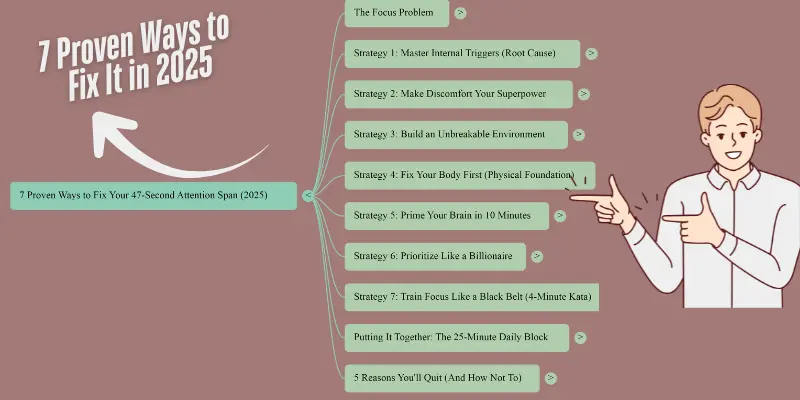
Strategy #1: Master Your Internal Triggers (Root Cause)
When it comes to focus, it’s not just about cutting distractions. That’s surface-level thinking. The real issue lies within—it’s in how we react to internal triggers.
Internal triggers are the emotions or states—like impatience, restlessness, or boredom—that push you to escape from your current task. They make you grab your phone, check social media, or start thinking about something else. These aren’t just random distractions—they’re emotional reactions that make it hard to stay focused.
Here’s the problem: Your brain is designed to avoid discomfort. When you feel bored, anxious, or frustrated, your brain screams, “Get out of here! Do something that feels better.” But here’s the twist: Discomfort is not the enemy.
In fact, discomfort is your greatest tool for focus. The more you train yourself to stay with that discomfort, the more resilient your focus becomes. Think about it: Every time you resist the urge to check your phone or leave a difficult task, you’re strengthening your mental muscles.
The Solution: Mindful Awareness & Reframing
The first step to mastering your internal triggers is to become mindfully aware of them. When you feel the urge to check your phone, pause for a second and ask: What’s really going on here? Why do I feel like escaping this task?
Once you identify the trigger (impatience, boredom, etc.), it’s time to reframe it. Instead of seeing the discomfort as something to avoid, remind yourself that it’s actually a sign of growth. You’re building resilience, learning, and expanding your ability to stay focused.
Here’s how it works in practice:
Real-Life Example: Let’s say you feel restless while working on a challenging project. Instead of reaching for your phone or mentally checking out, reframe the feeling: “This discomfort means I’m pushing myself. I’m doing something hard, and that’s exactly why I need to keep going.”
Why This Works:
- Deep Focus Comes from Training Your Mind: Just like physical muscle training, focus improves when you expose yourself to discomfort and build resilience.
- It Replaces the Need for Quick Fixes: You don’t need to rely on tools or hacks to block distractions if you can control what’s happening inside your head.
When you stop running from internal triggers and embrace discomfort, you’ll experience a deeper sense of control over your focus—and ultimately, your life.
Strategy #2: Make Discomfort Your Superpower
The second you learn to embrace discomfort, you unlock infinite potential. But here’s the twist: most people avoid discomfort. They see it as something to run away from, something that hurts or gets in the way. But in reality, discomfort is your superpower. It’s the key to deep focus and long-term success.
The Truth About Discomfort
Think of your brain like a muscle. The more you train it to endure discomfort, the stronger it gets. Every time you sit with that feeling of frustration, impatience, or boredom, you’re building resilience.
When you’re working on a task and you feel the urge to check your phone, it’s not the phone that’s the problem—it’s the feeling of discomfort you’re trying to avoid. Most people give in to it because it’s easier. But the real secret is in staying with that discomfort, training yourself to stay present.
The Solution: Discomfort Conditioning
To make discomfort your superpower, you need to condition yourself to sit with it. Here’s how:
- Acknowledge It: The next time you feel uncomfortable during a task, instead of running from it, acknowledge it. Say, “I feel uncomfortable, and that’s okay.”
- Shift Your Mindset: Rather than viewing discomfort as a barrier, reframe it as a sign of growth. Remind yourself that it’s exactly why you need to stay focused. You’re not avoiding something unpleasant—you’re embracing progress.
- Start Small: Conditioning yourself to endure discomfort doesn’t happen overnight. Start by doing small, uncomfortable tasks—like sitting in silence for 5 minutes, doing something you’d normally avoid, or working on a tough project for just 10 minutes straight. Gradually, increase your tolerance.
Why This Works:
- Discomfort is the Seed of Progress: Every time you stick with the discomfort, you’re training your brain to focus more effectively. This creates long-term habits that make focus easier.
- It Builds Mental Toughness: Just like lifting weights builds muscle, embracing discomfort builds mental toughness. Over time, the feeling of discomfort won’t faze you.
When you make discomfort your ally, you’re not just learning to focus—you’re learning to thrive under pressure. You’ll find yourself more productive, more present, and more resilient in the face of challenges.
Strategy #3: Build an Unbreakable Environment (Sacred Space + Declutter)
Your environment is everything. It’s not just about avoiding distractions—it’s about creating a space where focus can thrive. The moment you step into a space that’s clean, organized, and designed for productivity, you immediately set yourself up for success.
The Power of Sacred Space
A sacred space isn’t just a physical place; it’s an environment that supports your focus and productivity. It’s where you can leave behind distractions, clear your mind, and dedicate yourself entirely to the task at hand.
Here’s how you can build your own sacred space:
- Eliminate Unnecessary Clutter: Clutter doesn’t just look messy—it clutters your mind. It makes you feel anxious, distracted, and overwhelmed. Start by getting rid of anything unnecessary on your desk, in your office, or in your immediate workspace. A minimalist environment is one where only essential items are in sight.
- Design for Focus: Your workspace should cater to the task you want to focus on. A desk with just the essentials for your current project, a chair that promotes good posture, and natural lighting that helps your brain stay alert—these are all simple but powerful steps to improve your focus.
- Limit External Interruptions: Whether it’s noise, people, or digital distractions, external interruptions can destroy your focus in seconds. Set up barriers—like noise-canceling headphones, a closed door, or even a “Do Not Disturb” sign if needed.
- Incorporate Rituals: Every time you sit down to work, create a small ritual that primes you for focus. Whether it’s a cup of coffee, a quick stretching routine, or a brief meditation, these rituals signal to your brain that it’s time to go into work mode.
Why This Works:
- External Environment Shapes Internal Focus: Your surroundings influence your mindset. When you create a space that’s designed for focus, your brain knows it’s time to perform. You won’t need to fight distractions because you’ve set yourself up for success.
- Reduces Mental Overload: A cluttered environment leads to mental clutter. Decluttering helps your brain stay clear and focused on the task at hand.
By dedicating time to designing your sacred space, you’re creating a physical and mental environment where focus becomes effortless. Every time you walk into that space, your brain will automatically associate it with work—and nothing else.
Why This is Next-Level:
- Comprehensive Approach: This strategy addresses both the mental and physical aspects of focus. It’s not just about what’s on your desk; it’s about creating a holistic environment that nurtures concentration.
- Simple Yet Powerful: The action steps are easy to implement, but they pack a huge punch in terms of long-term productivity and focus improvement.
- Actionable: You can create your sacred space immediately. It’s something readers can put into practice right now.
Strategy #4: Fix Your Body First (Physical Foundation + Morning Light)
Before you can fix your mind, you need to fix your body. If you’re not taking care of your physical health, your ability to focus will be compromised. Think of your body as the foundation of your mental clarity. The stronger the foundation, the easier it is to build focus.
The Power of Physical Health
It’s simple: a healthy body equals a sharper mind. When you take care of your physical health, your brain has the energy, clarity, and resilience to focus longer and better. But here’s the truth: Most people overlook their body when trying to boost focus. They think focus is all mental, but in reality, your brain relies on your body to function at its best.
Here’s how you can create a physical foundation for your focus:
- Prioritize Sleep: If you’re not getting enough quality sleep, your focus is going to suffer. Sleep is the time when your brain recharges and processes information. Aim for 7-9 hours a night, and make sure your sleep environment is dark, quiet, and cool.
- Get Moving: Physical exercise isn’t just for fitness—it’s for brain health. Regular exercise increases blood flow to the brain, improves memory, and boosts focus. Aim for at least 30 minutes of moderate exercise a day, whether it’s walking, yoga, or weight training.
- Expose Yourself to Morning Light: One of the best ways to set your body’s internal clock is by getting exposure to natural light early in the day. This helps regulate your circadian rhythm and improves your mood, energy, and ability to focus. Aim for 15–20 minutes of natural light in the morning, preferably within an hour of waking up.
- Stay Hydrated and Eat for Focus: Hydration and nutrition directly affect cognitive function. Drink plenty of water throughout the day, and fuel your body with foods that enhance brain performance, like whole grains, healthy fats, and lean proteins. Avoid the blood sugar crashes that come with processed sugars and junk food.
Why This Works:
- Body and Mind are Inseparable: Your brain needs a healthy, well-fueled body to operate efficiently. When you take care of your physical health, your mind will follow.
- Sustained Energy for Long-Lasting Focus: Sleep, exercise, and morning light all help maintain your energy levels, preventing mental fatigue and making it easier to focus for longer periods.
By prioritizing your physical foundation, you’re giving your brain the tools it needs to perform at its best. You won’t be able to focus effectively if you’re running on low energy, poor sleep, or a lack of movement. Your body directly fuels your focus.
Strategy #5: Prime Your Brain in 10 Minutes (Dopamine + Optional Merge)
If you want to master focus, you need to prime your brain to get into the right state before you even start working. Think of it like warming up before a workout—getting your brain ready to perform at its best.
The Science of Brain Priming
Your brain is wired to seek out rewards, which is where dopamine comes in. Dopamine is the neurotransmitter responsible for motivation, pleasure, and goal-directed behavior. When you’re about to start a task, your brain releases dopamine to prepare you for the “reward” of completing that task.
But here’s the problem: Many people don’t prime their brain properly before diving into work, and as a result, they’re mentally sluggish when it’s time to focus. If you’re not giving your brain the right kind of kickstart, you’ll struggle to engage and stay focused for long periods.
The Solution: Dopamine Activation + Morning Rituals
You can set your brain up for success by activating dopamine and getting it into a state of anticipation. Here’s how to prime your brain in just 10 minutes:
Dopamine Activation:
- Quick Win: Start with a small, easy task that you can complete in less than 2 minutes. It could be something simple, like making your bed, checking one email, or organizing your workspace. Completing this quick win activates dopamine and gives your brain the reward boost it needs to get started.
- Visualization: Spend 2 minutes visualizing the successful completion of the task you’re about to start. Picture yourself finishing it with focus and energy. This helps reprogram your brain to associate focus with positive outcomes.
Morning Rituals:
- Start your day with a ritual that helps trigger focus. This could be a 5-minute stretch, a quick meditation, or listening to your favorite motivational playlist. The key is to create a ritual that signals your brain that it’s time to focus.
Optional Merge with Strategy #4 (Physical Foundation):
- If you haven’t already, add a 5-minute walk outside in the morning sunlight. Exposure to natural light helps set your internal clock, boosting energy and focus for the day ahead.
Why This Works:
- Dopamine’s Role in Focus: By activating dopamine, you make your brain more motivated and ready to focus. This leads to higher engagement and faster task completion.
- Quick Wins: By starting with something small, you build momentum and shift your brain into task-mode, making it easier to tackle bigger, more complex projects.
- Consistency is Key: Doing this every day creates a habit of prime focus, so over time, it becomes a natural part of your workflow.
By priming your brain in just 10 minutes, you’re not only making it easier to focus, but you’re also setting the stage for a productive day.
Strategy #6: Prioritize Like a Billionaire (Buffett’s 2-List Strategy)
The key to focus isn’t doing more—it’s doing less. Specifically, it’s doing the things that matter most. Here’s the kicker: you don’t need to juggle dozens of tasks. In fact, the most successful people in the world don’t.
The Secret: Buffett’s 2-List Strategy
Warren Buffett, one of the most successful investors in history, isn’t known for doing everything under the sun. He’s known for prioritizing the few things that truly matter. His method? The 2-List Strategy.
Here’s how it works:
Write Down Your Top 25 Goals:
- Take a few minutes and list the 25 things you want to achieve in life. These could be career goals, personal milestones, or anything you want to accomplish.
Pick Your Top 5:
- From that list, choose your top 5 priorities—the things that are most important to you. These are the tasks that align with your long-term vision and values.
Avoid the Remaining 20:
- Here’s the tough part. Buffett’s strategy advises that you ignore the remaining 20 goals. They’re distractions. While they may seem important, they’re not aligned with your most critical goals. This means saying no to anything that isn’t directly related to those top 5 priorities.
Why This Works:
- Simplicity and Focus: By narrowing your focus to just a few key priorities, you eliminate the noise and free up energy to put all your effort into what truly matters. This laser focus leads to better results with less effort.
- Mental Clarity: By eliminating distractions and having a clear vision of your top 5 goals, you avoid decision fatigue and stay mentally sharp.
Imagine having a laser-focused, clear plan that cuts out the noise and allows you to concentrate only on what moves the needle. This is the power of prioritizing like a billionaire.
Strategy #7: Train Focus Like a Black Belt (The 4-Minute Kata)
Focus isn’t something you’re born with. It’s a skill, and like any skill, it requires training. Think of focus like martial arts: the more you practice, the sharper and more precise your focus becomes. This is where the 4-Minute Kata comes in.
The 4-Minute Kata: Focus Under Pressure
The 4-Minute Kata is a technique that will train your brain to focus under pressure, boosting mental clarity and teaching you how to stay present even in challenging situations. It’s not just about sitting still—it’s about fighting the urge to distract yourself.
Here’s how it works:
Set a Timer for 4 Minutes:
- Pick a task you want to focus on—anything from reading a chapter of a book to writing an email. Set a timer for exactly 4 minutes.
Commit to 4 Minutes of Complete Focus:
- During those 4 minutes, you must give your task 100% focus. No checking your phone, no jumping to another task. You are committed to that one thing.
If You Get Distracted, Start Over:
- If your mind wanders or you check your phone, start over. The goal is to practice total commitment and control. You can’t move forward until you’ve truly focused for 4 uninterrupted minutes.
Why This Works:
- Small Time Frame: Four minutes is short enough to prevent mental fatigue but long enough to make a meaningful impact on your focus.
- Mental Discipline: Each time you restart the timer, you’re building discipline and teaching your brain to stay on task for longer periods. Over time, you’ll be able to extend the focus duration to 10, 15, or even 20 minutes without breaking.
- Immediate Payoff: You’ll notice a quick improvement in your ability to stay focused for longer periods, leading to increased productivity and less mental fatigue.
The 4-Minute Kata works because it teaches focus in small, manageable increments, allowing you to build your mental endurance over time. Just like a black belt doesn’t start by mastering advanced techniques—they start with the basics—focus is trained in small doses that gradually grow stronger.
The 25-Minute Daily Block (Combining Environment + Kata + Pomodoro + Vagus Reset)
You’ve learned how to master your internal triggers, make discomfort your superpower, and build an environment that supports focus. Now, it’s time to put it all together into a concrete, repeatable system that you can use every day to unlock your full productivity potential.
Enter the 25-Minute Daily Block—your ultimate weapon against distractions and mental fatigue.
The Power of the 25-Minute Block
This system combines the best parts of focus training, environment design, and time management to give you a powerful routine that can transform your day. It’s based on the Pomodoro Technique, but with a custom twist.
Here’s how it works:
Set Your Environment for Success:
- Before you begin, declutter your space and set up your sacred workspace (from Strategy #3). Make sure your desk is clean, your phone is off, and there are no other distractions in sight. You’re now in “work mode.”
Prime Your Brain with the 4-Minute Kata:
- Just before the 25-minute block begins, do your 4-Minute Kata (from Strategy #7) to get your brain engaged and ready to focus. This quick ritual primes your brain, so when you start, you’re in a state of peak focus.
Start Your 25-Minute Block:
- Set a timer for 25 minutes. During this time, you’ll work with 100% focus on one task. No multitasking. No distractions. Just you and the task at hand.
Take a 5-Minute Vagus Nerve Reset:
- After your 25 minutes of focus, take a 5-minute break to reset. Use this time to activate your vagus nerve (responsible for relaxation) by doing some deep breathing, stretching, or a quick walk outside. This will help lower your stress levels, reset your focus, and prepare you for the next block.
Repeat the Process:
- After your break, repeat the 25-minute block and 5-minute reset. You can stack these blocks throughout the day, but don’t go past 4–5 blocks without taking a longer break (15–30 minutes). Over time, you’ll notice your mental stamina increases.
Why This Works:
- Focused Work + Recovery: The combination of focused work and restorative breaks helps your brain stay sharp without burning out. The Pomodoro + Vagus Reset combo makes sure you’re working at peak capacity during every block.
- Habitual Focus: By turning this into a daily ritual, you’re building consistency. The more you practice, the more your brain will naturally shift into a focused state when you start your 25-minute block.
- Sustainable Productivity: This system allows you to sustain focus for longer periods without the mental fatigue that comes with marathon sessions of work.
The 5 Reasons You’ll Quit (And How Not to)
Building focus is hard. It’s easy to get excited about a new strategy and then fall off track. Staying consistent is the real challenge. In this section, we’re going to dive into the top reasons people fail at improving their focus—and how you can avoid them.
Reason #1: You Don’t Address the Root Cause of Distraction
You might start with good intentions, but if you don’t address the internal triggers (Strategy #1), you’ll never be able to break free from distractions.
The Fix: Develop a habit of mindfully noticing when you’re distracted. The moment you feel your mind wandering, pause and identify what’s driving you away from the task. Is it boredom? Anxiety? Stress? Once you identify the trigger, you can reframe it and refocus.
Reason #2: You Try to Do Too Much at Once
When people try to take on everything, they end up accomplishing nothing. The multitasking myth is a productivity killer. Juggling tasks actually makes you less efficient and more prone to mistakes.
The Fix: Use Buffett’s 2-List Strategy (Strategy #6) to narrow your focus. Pick just a few goals that truly matter and put your energy into those. Don’t spread yourself too thin. It’s better to excel in one thing than be mediocre in five.
Reason #3: You Underestimate the Power of Your Environment
You might be working on great strategies, but if your environment isn’t supporting your focus, you’ll struggle. A messy, chaotic space is a breeding ground for distractions.
The Fix: Create a sacred space (Strategy #3) that promotes focus. Clean your workspace, eliminate distractions, and set up rituals that prepare your brain for deep work. Make your environment a focus zone.
Reason #4: You Forget to Prioritize Rest and Recovery
Focus is not about working non-stop. Overworking leads to burnout, and burnout kills focus. Without recovery, your brain cannot perform at its best.
The Fix: Implement Pomodoro + Vagus Reset (Strategy #7) to ensure you’re taking regular breaks. Use these breaks to reset your mind and body so you can return to your next focus block feeling refreshed and ready to dive in again.
Reason #5: You Don’t Have a System to Fall Back On
When you don’t have a clear, repeatable system, it’s easy to get overwhelmed and give up. Focus is a skill—and like any skill, it requires practice and a structured routine.
The Fix: Commit to the 25-Minute Daily Block (Strategy #7). This system provides you with a structure you can rely on to stay on track, even when distractions and challenges arise. It’s your daily foundation for success.
Conclusion
In the battle for focus, you’re up against more than just external distractions. The real challenge lies within—how you manage your internal triggers, how you embrace discomfort, and how you design your environment to nurture your best work.
The strategies you’ve learned today are not quick fixes; they’re long-term, sustainable habits that will retrain your brain and reshape your environment for success.
By now, you know that improving your focus isn’t about willpower alone—it’s about creating the right conditions for deep, uninterrupted work. With the 7 proven strategies in this guide, you have the tools to overcome your distractions, stay engaged, and achieve more in less time.
Focus is a skill. Train it. Master it. Own it.
Mindset Shifts: Common Questions on Focus & Discomfort
Start by using the 4-Minute Kata as your “mental primer” before attempting the full block. The Kata (Strategy #7) is designed specifically for this roadblock. Actionable: Do not start the 25-minute block immediately. First, sit down and commit to one task for only 4 minutes. If your mind wanders, stop, reset, and start the 4-minute timer again. This repetitive practice is your Discomfort Conditioning (Strategy #2), training your focus muscle in small, non-threatening doses. Once you can consistently complete the 4 minutes without interruption, you have earned the right to start the 25-minute block.
It’s hard because you are reacting to an internal trigger, and your brain is simply seeking the easiest path to comfort and a dopamine hit. Concise: The moment you feel restless, your brain fires a signal: “Escape this discomfort!” The phone is the quickest escape route. Actionable: Next time you feel the urge, don’t move. Instead, acknowledge the trigger out loud: “I am feeling bored, and I want a dopamine hit.” Then, use the 5-second rule to stay with the feeling. Realize that this discomfort is not a barrier—it’s a signal of growth that you must embrace to deepen your focus.
Yes, it is entirely normal, and it is a positive sign that you are training your brain. Just like lifting weights, deep concentration is a cognitively demanding process that causes mental fatigue. Evidenced: Sustained focus consumes significant energy in your brain, leading to that feeling of mental ‘burn’ or exhaustion. Actionable: When you feel this fatigue, do not quit. Instead, take your scheduled 5-minute reset break. Use this time to actively calm your mind with three minutes of deep, slow breathing or a quick stretch and eye break. This restorative action rapidly resets your brain, allowing you to return to the next block feeling refreshed.
You will see an immediate improvement in your control over distraction within 7 days, but building permanent focus takes consistent training over 6 to 8 weeks. Actionable: Within the first week of using the 25-Minute Daily Block, you will feel more in control and less anxious. However, true, permanent improvement in your mental resilience and stamina requires the brain to literally rewire, a process that takes about two months of daily practice. The key is consistency. Do not aim for perfection; aim for 5 blocks a day, 5 days a week.

Eat the Frog Is Broken in 2025 — Here’s the AI + Neurodivergent Fix That Actually Works





- Be Respectful
- Stay Relevant
- Stay Positive
- True Feedback
- Encourage Discussion
- Avoid Spamming
- No Fake News
- Don't Copy-Paste
- No Personal Attacks
- Be Respectful
- Stay Relevant
- Stay Positive
- True Feedback
- Encourage Discussion
- Avoid Spamming
- No Fake News
- Don't Copy-Paste
- No Personal Attacks
