Intrinsic Rewards That Actually Work in 2026: 9 Drivers Most Leaders Still Overlook
Published: 06/12/2025
You’ve tried it all — the ping-pong tables, the bonus increases, the “employee of the month” plaques. And yet, when it comes to real employee engagement, nothing seems to move the needle. You’re left wondering if there’s something wrong with you, or worse, with your team.
Here’s the truth: You’re not broken — the old model is. Employee motivation has evolved, and the cookie-cutter strategies from the past just aren’t cutting it anymore. In fact, they may be doing more harm than good.
In 2026, the focus isn’t on “motivating” employees with external perks or endless incentives. It’s about intrinsic rewards — the things that make people want to give their best, not because they have to, but because they genuinely feel fulfilled in their work.
So, what’s really motivating employees now? And how can you activate these motivators without falling into the same traps that most leaders still do? That’s exactly what we’ll explore in this post.
Let’s dive into the nine intrinsic rewards that actually work today — and how you can start activating them tomorrow.
Part 1: The Three Big Myths We Need to Kill First
Before we get into the 9 intrinsic rewards that actually work in 2026, let’s do some myth-busting. The biggest problem with motivation advice today is that it’s built on outdated and broken concepts. If you’ve tried these strategies and they didn’t work — don’t worry, you’re not the problem.
Here are the three biggest myths that are still holding leaders back:
Myth 1: Dopamine = Pleasure Chemical
This is a popular one — dopamine is often referred to as the “pleasure chemical.” You’ve probably read about it in books like Drive, which suggest that dopamine is what motivates people to work hard and achieve success. But here’s the kicker: dopamine is not about pleasure.
It’s about anticipation. That rush you get when you’re about to do something exciting? That’s dopamine at work, not when you’re actually experiencing pleasure. And because of this, using dopamine-based strategies (like offering immediate rewards) often only motivates people for a short burst — until they burn out. Motivation driven purely by external rewards leads to the overjustification effect, where employees lose their intrinsic drive. So, yes, rewarding employees constantly with perks might backfire.
Myth 2: Just Give Autonomy, Mastery, and Purpose
Ah, the “AMP” model — autonomy, mastery, and purpose. It sounds great, doesn’t it? We’ve all read the articles telling us to give employees more control over their work, help them grow their skills, and align their tasks with a higher purpose.
But here’s the truth: Autonomy, mastery, and purpose alone aren’t enough to sustain motivation in the long run. While these factors play a part in intrinsic rewards, they can’t do the heavy lifting on their own. In a world where employees are more distracted than ever (thanks to hybrid work, AI tools, and constant information overload), these “big three” need to be paired with other, more specific intrinsic rewards to truly get results.
Myth 3: Money Always Destroys Intrinsic Motivation
This one’s been thrown around for years — pay someone enough, and they’ll stop caring about the work itself. While there’s some truth to the overjustification effect, the idea that money always destroys motivation is a gross oversimplification.
Here’s the thing: Money doesn’t always kill intrinsic motivation, but the way it’s used can. If you’re using money as a baseline (competitive salaries, bonuses), it won’t dampen motivation. But if you rely solely on financial incentives, you’ll miss out on the deeper intrinsic rewards that sustain long-term engagement. The trick is using money wisely — as a foundation to support the real drivers of motivation.
Takeaway: The Real Problem Isn’t Your Team — It’s the Old Advice
The truth is, we’ve been fed a lot of well-meaning but outdated advice on how to motivate employees. These myths don’t just waste your time; they can actively undermine your efforts to improve engagement. The good news? You don’t have to keep following these old models. In the next section, we’re going to explore the 9 intrinsic rewards that actually move the needle today — and exactly how to activate them.
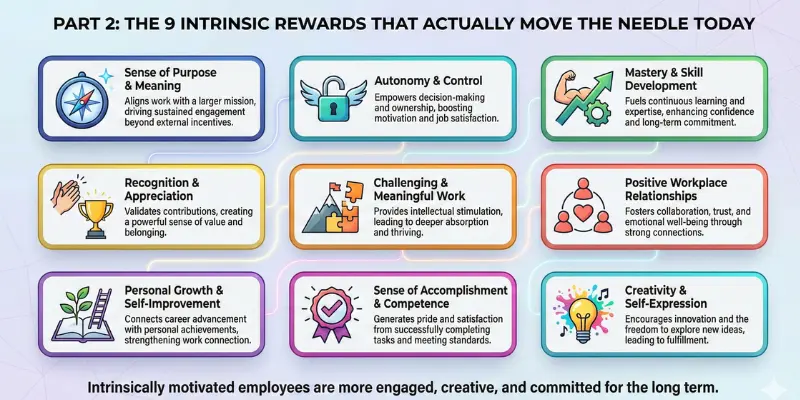
Part 2: The 9 Intrinsic Rewards That Actually Move the Needle Today
Now that we’ve debunked the myths that have been holding us back, let’s dive into the 9 intrinsic rewards that actually work in 2026. These are the motivators that will help you reignite employee engagement without having to rely on bonuses or meaningless perks. Each one of these rewards taps into deep, intrinsic needs that drive sustained motivation — and the best part? They’re simple to activate once you know what they are.
1. Personal Life-Event Support
Life happens. Employees go through major life events — weddings, births, illnesses, personal losses. A little empathy and support go a long way. Offering flexible time off, emotional support, and even simple gestures like sending flowers or cards shows employees that you care about their well-being beyond just the 9-to-5.
Takeaway: Create a policy for life-event support. Allow employees to take personal time when needed, without it feeling like a hassle or burden.
2. Being the Go-To Expert (Credibility)
People love being recognized as the expert in something — it boosts their self-esteem and gives them a sense of purpose. Whether it’s becoming the team’s go-to person for a specific tool or process, or a broader industry topic, employees thrive when they are trusted and relied upon for their expertise.
Takeaway: Give employees opportunities to share their expertise. Create peer mentoring programs or knowledge-sharing sessions where they can be the hero of the team.
3. Genuine Topic Passion
Work doesn’t feel like work when employees are passionate about the subject matter. Allowing employees to work on projects they care deeply about is a game-changer. People are motivated when they can see the direct impact of their work on something they genuinely love.
Takeaway: Align work with passions. When possible, match employees with projects that align with their personal interests and values. Don’t force everyone into the same mold.
4. Daily Progress & Closure
There’s nothing more motivating than seeing progress. Employees who feel like they are making tangible progress are more likely to stay engaged. The same goes for completing tasks and having a sense of closure at the end of the day. The small wins matter.
Takeaway: Help employees break down big tasks into smaller, manageable chunks. Ensure there’s a visible sense of accomplishment at the end of each day.
5. Flow-State Moments
We all know that feeling when we’re completely absorbed in something — that state of “flow.” It’s a state of peak performance, where time flies, and the work doesn’t feel like work. Helping employees get into flow is one of the best ways to keep them engaged.
Takeaway: Create environments that foster deep focus. Minimize distractions, and give employees the autonomy to immerse themselves in their work without constant interruptions.
6. Peer-to-Peer Recognition
We all want to be appreciated, but something powerful happens when recognition comes from a peer rather than a boss. Peer recognition can create stronger bonds between employees, improve team dynamics, and increase engagement.
Takeaway: Implement a peer recognition program where employees can acknowledge each other’s contributions. It can be as simple as a “thank you” card or a monthly peer-nominated award.
7. Individualized Purpose
Everyone has a unique reason for coming to work. Some people are motivated by career growth, while others are driven by helping the community or contributing to a cause. Understanding what drives each employee’s sense of purpose is key.
Takeaway: Take the time to understand each employee’s unique purpose. Tailor their goals and tasks to reflect that purpose, and connect their day-to-day work to the larger vision of the company.
8. Real Ownership (Not Just Flexibility)
Employees want more than just the flexibility to work from home — they want real ownership of their projects and decisions. Giving employees the freedom to make meaningful decisions will increase their sense of responsibility and engagement.
Takeaway: Offer ownership opportunities by involving employees in decision-making processes. Let them take charge of important projects or areas that align with their strengths.
9. Creativity & Self-Expression
Work is more than a task to be completed; it’s an outlet for creativity. People want to express themselves through their work. Whether it’s designing new products, solving problems, or brainstorming new ideas, creativity is a huge intrinsic motivator.
Takeaway: Encourage creative freedom by giving employees the opportunity to propose new ideas, experiment with different approaches, and take risks within a supportive environment.
Takeaway: These 9 Intrinsic Rewards Are the Key to Real Employee Engagement
These 9 intrinsic rewards aren’t just “nice-to-haves.” They’re the building blocks of a motivated, engaged, and high-performing team. The good news is that you don’t have to wait for a big budget or fancy perks to implement them. With small shifts in mindset and intentional actions, you can start making work feel rewarding again — for everyone involved.
In the next section, we’ll take a deeper dive into the 5 highest-impact rewards and show you exactly how to activate them for your team. These are the ones that’ll move the needle most dramatically.
Part 3: The 5 Highest-Impact Ones (and Exactly How to Activate Them)
Now that we’ve covered the 9 intrinsic rewards, let’s focus on the 5 highest-impact ones that are guaranteed to move the needle the most in 2026. These rewards are the heavy hitters — the ones that, when activated correctly, will drive the kind of sustained motivation and engagement that gets real results.
But here’s the thing: It’s not enough just to know what they are. You need a roadmap for how to activate them — and I’ve got that for you. So, let’s break these down and get to the good stuff: the exact actions you can take tomorrow.
1. Personal Life-Event Support
Why It’s Impactful: Personal life events affect everyone. Whether it’s a birth, illness, or family crisis, these moments demand your attention — and your team needs to feel like you’ve got their back during these tough times. When employees feel supported during personal life events, they’ll have a greater sense of loyalty and gratitude towards the company.
How to Activate It:
- Create a Life-Event Policy: Formalize the support you provide for employees going through personal events. Allow them to take time off when needed, without making them feel guilty. Have templates for life-event support, like a simple “compassionate leave” policy, ready to implement.
- Simple Gestures Go a Long Way: Send a card or flowers when an employee goes through a major event. The small things count — they show your employees that you care about them as people, not just workers.

2. Wanting vs Liking — Neuroscience of Real “Liking” at Work
Why It’s Impactful: The difference between “wanting” and “liking” is fundamental in employee motivation. People might want something (like a bonus or recognition), but they need to like the work itself to stay engaged long-term. This is a nuanced, neuroscience-backed concept that can dramatically improve how employees experience their work.
How to Activate It:
- Map Tasks to Interests: The key is to connect the work to real enjoyment. Use tools like interest surveys to understand what each employee genuinely likes, and then match those passions to projects or roles that give them autonomy.
- Create “Liking” Moments: Encourage employees to make personal connections with their tasks. Whether it’s finding a creative approach to a routine job or fostering peer recognition, these small moments will turn “wanting” into “liking.”

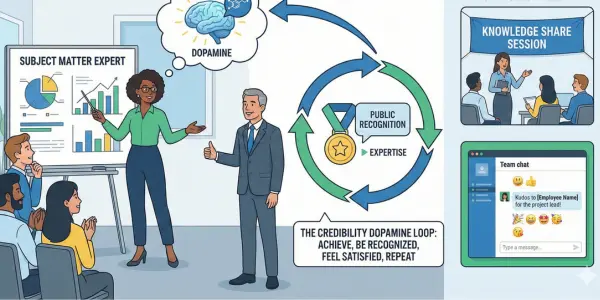
3. Credibility & The Go-To-Person Dopamine Loop
Why It’s Impactful: Employees thrive on recognition and credibility. When someone becomes the go-to person for a specific skill or knowledge, it’s like a dopamine loop of satisfaction. This creates an ongoing sense of achievement, boosts confidence, and drives motivation.
How to Activate It:
- Give Opportunities to Shine: Create opportunities for employees to be the expert in something. Whether it’s giving them the chance to lead a project or allowing them to host a knowledge-sharing session, the idea is to elevate them as the authority on something within the team.
- Provide Public Recognition: Recognize their expertise in front of the team. Acknowledge their skills in meetings, newsletters, or team chats. This will create that dopamine loop, making them feel recognized and motivated to continue excelling.
4. Overjustification-Proofing: 5 Rules to Give Money Without Killing Intrinsic Motivation
Why It’s Impactful: You might be thinking, “Wait, I thought money was the problem.” Here’s the twist: Money isn’t inherently bad for intrinsic motivation, but the way you use it is critical. When you give money in a way that feels like a reward for external motivation, it can kill the very drive you want to nurture.
How to Activate It:
- Rule #1: Use Money as a Foundation, Not the Reward: Ensure that compensation is competitive but not the driving force behind motivation. It should meet expectations, not exceed them excessively.
- Rule #2: Never Use Money as a Bribe: If you need to offer a bonus, make sure it’s not tied to specific behaviors like hitting sales numbers — it should be about acknowledging value.
- Rule #3: Focus on Long-Term Benefits: Offer long-term incentives, like stock options or retirement savings, that encourage employees to stay engaged for the long haul.
- Rule #4: Be Transparent: Make sure employees know why they’re receiving rewards, so they don’t feel it’s an artificial manipulation.
- Rule #5: Pair with Personal Growth: Whenever you offer financial incentives, tie them to personal development. Show employees how the money connects to their growth in the company.
5. Daily Closure Habit That Takes 4 Minutes
Why It’s Impactful: Employees who feel like they’re achieving progress daily are much more likely to stay motivated. This is where the concept of daily closure comes into play: ending each day with a feeling of completion and progress.
How to Activate It:
- Implement a 4-Minute Habit: At the end of each day, ask employees to spend 4 minutes writing down what they accomplished and what they’ll tackle next. This gives them a sense of closure and accomplishment before they log off.
- Use Daily Huddles: Hold brief, daily stand-up meetings where each employee shares what they’ve completed. This habit reinforces a sense of progress and ownership.
Takeaway: These 5 Rewards Are the Game-Changers for 2026
These 5 intrinsic rewards are the ones that have the power to transform your team. They’re the rewards that go beyond superficial perks and create deep, meaningful motivation. Implement them, and you’ll start seeing real engagement that sticks.
In the next section, we’ll dive into the dark side of intrinsic rewards — when they backfire and how you can avoid the pitfalls.
Part 4: The Dark Side – When Intrinsic Rewards Backfire (and How to Prevent It)
As much as we want to believe that intrinsic rewards are the golden ticket to employee engagement, they can backfire if not implemented carefully. There’s a reason why so many well-meaning leaders fail despite offering all the perks and rewards in the book: if you don’t understand how to balance intrinsic rewards, they can do more harm than good.
In this section, we’re going to dive into the dark side of intrinsic rewards, covering the overjustification effect, intrinsic burnout, and how to avoid these traps.
The Overjustification Effect: Why Rewards Can Backfire
The overjustification effect happens when you offer external rewards (even intrinsic ones) for activities that employees already enjoy. When this happens, employees can lose their intrinsic motivation because they begin to see the reward as the primary reason for doing the work.
Let’s be real: it’s not about giving employees a pat on the back for everything. The key is to use intrinsic rewards strategically and sparingly. If employees feel like you’re over-rewarding them, they’ll start to question the authenticity of their work.
How to Prevent It:
- Be Mindful of the Frequency: Don’t constantly reward small wins. Save your rewards for significant moments of achievement, growth, or contribution.
- Focus on the Process: Recognize the effort and journey, not just the outcome. This helps employees internalize the value of the work itself.
- Avoid Tangible Rewards for Intrinsic Tasks: Don’t offer money or prizes for activities that employees naturally enjoy. This can shift their motivation away from genuine passion.
Intrinsic Burnout: When Motivation Becomes a Pressure Cooker
Another danger of focusing solely on intrinsic rewards is intrinsic burnout. This happens when employees become so absorbed in achieving personal fulfillment or reaching goals that it creates excessive pressure. They start to feel like they have to stay motivated — and that’s when burnout creeps in.
Employees who experience intrinsic burnout often feel overwhelmed and emotionally drained, which defeats the purpose of motivating them in the first place.
How to Prevent It:
- Set Realistic Expectations: Encourage employees to take breaks and set boundaries around work. No one should feel like they need to be “on” all the time.
- Focus on Balance: Combine intrinsic rewards with rest and recovery periods. Make sure employees aren’t burning themselves out by giving them the time they need to recharge.
- Monitor Mental Health: Keep an eye on employees’ well-being. Providing mental health support and creating a safe space for employees to talk about stress and challenges will help mitigate burnout.
When Over-Recognition Becomes Overload
Recognition is an essential intrinsic reward, but overdoing it can dilute its impact. Excessive praise can lose its meaning if it’s handed out too frequently. Employees may begin to feel like they’re just going through the motions to get recognized, which defeats the purpose of recognition in the first place.
How to Prevent It:
- Keep Recognition Meaningful: Don’t hand out praise or rewards just for showing up. Make sure that recognition feels earned and tied to specific accomplishments that truly contribute to the team’s success.
- Be Specific in Your Praise: Generic compliments like “Great job!” don’t carry the same weight as recognition tied to a particular action. For example, “You did an excellent job managing that project from start to finish” feels more genuine and impactful.
Misalignment Between Rewards and Company Culture
If the intrinsic rewards you’re offering don’t align with your company culture, they can feel disingenuous and even backfire. For instance, if your company values autonomy but you’re constantly micromanaging employees, the rewards of autonomy won’t resonate.
How to Prevent It:
- Align Rewards with Values: Make sure that the rewards you offer align with your company’s core values and culture. Autonomy rewards should be given in environments where employees are trusted to take the lead. Recognition should be tied to contributions that align with the team’s mission.
- Be Transparent About Expectations: Make it clear what employees are being rewarded for, and ensure that these rewards fit into the bigger picture of the company’s vision.
Takeaway: Preventing the Dark Side of Intrinsic Rewards
Intrinsic rewards are a powerful tool, but they must be used with care. When done right, they can ignite engagement and motivation. But when mismanaged, they can lead to burnout, disengagement, and frustration.
The key is balance. Make sure rewards are meaningful, appropriate, and aligned with the company’s values. Don’t overdo it, and always be mindful of how your employees are responding to these rewards.
In the next section, we’ll dive into Quick Wins — simple, actionable steps that you can start implementing right away to get your team engaged and motivated without overthinking it.
Part 5: Quick Wins You Can Start Monday
Now that we’ve covered the big ideas and how to avoid the dark side of intrinsic rewards, it’s time to get to the quick wins — the actionable steps you can implement immediately. These are low-effort, high-impact changes that will get you results without overthinking or dragging your feet.
Ready to make your team feel more motivated, engaged, and productive? Here’s how to get started:
1. Free 15-Question “Your Team’s Intrinsic Rewards Score” Quiz
Before jumping into making changes, it’s important to understand where your team currently stands in terms of intrinsic rewards. The quickest way to get this insight? A simple quiz.
How to Activate It:
- Step 1: Send out a 15-question survey that asks your team members about their current work experiences and how they feel about their intrinsic rewards (e.g., “Do you feel recognized by your peers?” or “Do you feel passionate about the work you do?”).
- Step 2: Use the results to identify the biggest areas of improvement. This will give you a customized starting point for implementing the right rewards.
Takeaway: The quiz is a quick, easy tool to understand what motivates your team. Use the data to target specific rewards that will have the most impact.
2. 30-Day Printable Challenge Calendar
People like challenges because they make progress feel measurable. Giving your team a 30-day challenge will help them focus on daily actions that can lead to long-term changes in motivation.
How to Activate It:
- Step 1: Create a 30-day challenge calendar with small, daily actions that encourage intrinsic rewards. For example, one day could be dedicated to practicing gratitude, another could involve recognizing a peer for their contribution, or even setting personal work goals.
- Step 2: Give your team access to the challenge via a downloadable PDF or a shared document they can print out. Make it visually appealing to get them excited about participating.
Takeaway: A simple 30-day challenge can help create momentum and get your team into the habit of focusing on intrinsic rewards every day.
3. One-Page Starter Kit Download
Sometimes the most effective changes are the simplest ones. A one-page starter kit with a few key actions or reminders can be a great way to get the ball rolling.
How to Activate It:
- Step 1: Create a one-page document that outlines the 9 intrinsic rewards with a quick guide on how to activate each one. Focus on clear, easy-to-understand steps so that your team can start applying them immediately.
- Step 2: Distribute the starter kit to your team and encourage them to focus on one intrinsic reward each week. Use it as a discussion point in your next team meeting.
Takeaway: A one-page starter kit provides clarity and ensures that your team knows exactly what to do next, without overloading them with information.
Takeaway: Start Small, But Start Now
You don’t have to make sweeping changes to see improvements. These quick wins can be implemented immediately and will start generating real engagement within your team. As you build on these wins, you’ll begin to see the powerful impact of intrinsic rewards on your team’s motivation and productivity.
In the next section, we’ll wrap things up with One Change You Can Make This Week — a final piece of actionable advice that you can start applying right now.
Conclusion: One Change You Can Make This Week
You’ve made it this far, and you now have a toolbox full of actionable, real-world strategies for increasing employee engagement through intrinsic rewards. But here’s the real question: What’s the one thing you’re going to do this week to start making a difference?
Change doesn’t have to be massive to be meaningful. In fact, it’s often the small, consistent actions that have the biggest impact.
The One Change You Can Make Right Now: Implement the 4-Minute Daily Closure Habit
If you’re not sure where to start, here’s your first step: Implement the 4-minute daily closure habit. This simple, quick action will help your team feel a sense of accomplishment and closure at the end of each day. It takes just 4 minutes, but it has a big impact on motivation.
How to Activate It:
- At the end of each day, ask your team to spend 4 minutes reflecting on what they’ve accomplished. Have them jot down their wins and set one goal for the next day.
- As a leader, do this yourself and encourage your team to share their reflections in short daily stand-ups or via a shared document. You’ll quickly see how this small habit leads to bigger wins over time.
Takeaway: Start small, start now. The 4-minute habit will build momentum and lead to immediate improvements in how your team feels about their work. From there, you can expand to the other intrinsic rewards we’ve covered in this blog.
Final Thoughts: Intrinsic Rewards Are the Key to Employee Motivation in 2026
As we’ve explored, intrinsic rewards are the powerful, sustainable motivators that will drive employee engagement in 2026. By focusing on what truly matters to your team — their personal growth, passions, and sense of purpose — you can create an environment that not only motivates but empowers your employees to do their best work.
The journey to better employee engagement doesn’t have to be complicated. With the right focus on intrinsic rewards, you’ll create a team that’s motivated, engaged, and driven to achieve great things.
Call to Action (CTA):
Ready to see how intrinsic rewards can transform your team? Download the free “Your Team’s Intrinsic Rewards Score” quiz now and start implementing your first reward today.
Bullet-Proof FAQs for “Intrinsic Rewards That Actually Work in 2026”
Intrinsic rewards are non-tangible motivators that come from within the individual — things like personal growth, recognition, a sense of purpose, and meaningful work. In 2026, with the shift toward remote and hybrid work, intrinsic rewards are more important than ever. They help employees feel engaged, valued, and connected to their work without relying solely on external incentives like money or perks.
Extrinsic rewards are external motivators, such as pay raises, bonuses, or office perks, whereas intrinsic rewards are driven by internal satisfaction and fulfillment. For example, intrinsic rewards could be the sense of accomplishment from completing a challenging project, while extrinsic rewards would be a bonus given for achieving a target. In 2026, focusing on intrinsic rewards is key because they create long-term motivation and are more sustainable.
The top three intrinsic rewards that can have an immediate impact are:
- Personal Life-Event Support: Offering flexible leave for important personal events like family matters or health issues.
- Being the Go-To Expert: Recognizing and empowering employees for their expertise within the team.
- Daily Progress & Closure: Helping employees feel a sense of achievement daily by setting clear, manageable goals.
These rewards are simple to implement and can lead to improved motivation and engagement without heavy investment.
The key is balance. Overloading employees with too many rewards or expectations can lead to burnout, even if the rewards are intrinsic. To prevent this, make sure rewards are tied to genuine achievements and keep them meaningful. Encourage employees to set boundaries, focus on personal growth, and take breaks when needed. Recognition should be consistent but not excessive.
Yes, intrinsic rewards can be even more effective in hybrid or remote teams. In fact, remote employees often crave connection and a sense of purpose. Intrinsic rewards like autonomy, mastery, and purpose become critical in these settings. Focus on recognizing individual achievements, providing clear goals, and maintaining open communication to foster intrinsic motivation.
The success of intrinsic rewards can be measured through regular employee feedback and engagement surveys. Look for signs like increased job satisfaction, lower turnover, and higher productivity. You can also track employee morale by observing participation in projects and their willingness to take on new challenges. Measuring these factors will give you a clear sense of how well intrinsic rewards are working.
Both intrinsic and extrinsic rewards play important roles in motivation, but intrinsic rewards are often more sustainable in the long term. Extrinsic rewards can boost motivation short-term, but when it comes to creating lasting engagement and job satisfaction, intrinsic rewards (like a sense of purpose, autonomy, and recognition) have a much stronger impact. The key is to use both in balance, with a focus on intrinsic rewards for long-term engagement.

Beyond the Muse: The 3-Pillar System for Mastering Creative Skills, Driving Innovation ROI, and Becoming AI-Proof




- Be Respectful
- Stay Relevant
- Stay Positive
- True Feedback
- Encourage Discussion
- Avoid Spamming
- No Fake News
- Don't Copy-Paste
- No Personal Attacks
- Be Respectful
- Stay Relevant
- Stay Positive
- True Feedback
- Encourage Discussion
- Avoid Spamming
- No Fake News
- Don't Copy-Paste
- No Personal Attacks
