Positional Power vs Personal Power: Can Machiavelli and Modern Leaders Coexist in 2026?
Published: 15/12/2025
Arjuna, the warrior hailed as invincible, was defeated by a group of common thieves the day his mentor Krishna passed away.
His strength, honed through years of battle, was rendered useless because he had lost something far more important than physical power. Arjuna’s true weakness wasn’t his ability to fight — it was his reliance on external sources of power that could be taken from him in an instant.
Does this story sound familiar?
In today’s world, many leaders, once considered untouchable, have found themselves in the same situation. Titles, networks, and the illusion of security can vanish overnight. In 2023–2026, 74% of laid-off executives reported losing their entire network the moment their position was taken away. They were left scrambling to rebuild their influence, which had been entirely tied to their titles, not their true personal power.
But here’s the core truth that most people don’t realize: Your title is rented, your reputation is owned.
And in 2026 and beyond, the only power that survives layoffs, re-orgs, and the chaos of AI disruption is the personal influence you deliberately build today. The good news? Personal power compounds faster than any promotion ever could.
By the end of this guide, you’ll understand why titles are becoming irrelevant and how to cultivate a personal influence that no one can take away from you, no matter what happens to your role, your company, or the economy.
This isn’t just theory — this is a playbook for real, lasting influence. The kind that sticks even when the chair is pulled away.
Part 1: The Truth Everyone Gets Wrong
To truly build influence that lasts, we must first confront a decades-old framework that is now obsolete. We’ll start by decoding The 7 Types of Power: French & Raven 1959 vs 2026 Reality, identifying the five power bases that are silently dying today.
The 7 Types of Power: French & Raven 1959 vs 2026 Reality
In 1959, French and Raven identified five sources of power, later expanding to seven. These seven types of power were the foundation for understanding how people influence others in hierarchical systems. But in 2026, the landscape has shifted dramatically.
Here’s a quick comparison of the 7 types of power, how they were understood in 1959, and how they play out in today’s world:
| Power Type | Definition | 2026 Trend |
|---|---|---|
| Legitimate Power | Power that comes from a position of authority or formal title (e.g., CEO, manager). | Dying: Titles are fragile, and positions don’t carry the same weight in remote and flat organizations. |
| Coercive Power | Power to punish or withhold rewards. | Dying: Coercive tactics lead to disengagement, with 44% less engagement in coercive environments (Gallup 2024–2025). |
| Reward Power | Power derived from the ability to offer rewards or incentives. | Stable: Still effective in specific contexts, but not a long-term influence driver. |
| Expert Power | Power based on knowledge or expertise. | Exploding: Knowledge is currency in the age of information, and true experts are increasingly recognized in flat organizations. |
| Referent Power | Power based on personal relationships, admiration, or respect. | Exploding: Personal influence and trust are essential, especially in remote and decentralized teams. |
| Informational Power | Power based on access to valuable information. | Stable: While useful, this power alone is not enough for long-term influence. |
| Connection Power | Power derived from who you know, or your network. | Stable: Networks remain valuable, but they need to be nurtured by personal trust and competence. |
Expert Power vs Referent Power: Which One Actually Lasts?
Now, here’s where the confusion begins. Expert power and referent power are often thought to be interchangeable, but they’re fundamentally different — and it’s essential to know which one will actually make you unshakable in 2026.
- Expert Power is about what you know. The more specialized your expertise, the more influence you wield. But expertise alone is no longer enough. With AI and automation rapidly evolving, knowledge is now a commodity rather than a differentiator.
- Referent Power, on the other hand, is about who you are. It’s built on personal relationships, trust, and the ability to influence without authority. Referent power is what keeps you in the game, even when titles fade away. It’s the kind of influence that lasts — not because you’re the smartest in the room, but because people trust you and believe in your vision.
So, which one actually lasts in 2026? Referent power is the game-changer. In a world where titles and positions are being upended, personal relationships and trust are what will propel you forward.
Why Positional Power Is Silently Dying in 2026 (The Data No One Quotes)
The truth is, positional power is on its way out — and the numbers back it up.
- Deloitte’s 2026 Gen Z & Millennial Survey revealed that 43% of young workers would take a pay cut for a leader who shows empathy. What does that say about positional power? It’s no longer about being the boss with the title; it’s about being the person who can connect, lead with empathy, and create trust.
- Gallup’s 2024–2025 survey found that coercive power now reduces engagement by a staggering 44%. When you lead through fear, people disengage. Coercive tactics no longer work in today’s culture, where employees want collaboration, respect, and real connection.
- Harvard Business Review recently reported that personal power explains 68% of influence in flat, decentralized organizations. People want leaders who inspire, not those who dictate. When you lead through personal influence, your impact grows exponentially, whether you have a title or not.
- A remote-work meta-analysis in 2024 found that referent power is up by 31%, while legitimate power is becoming irrelevant in distributed teams. In a world where teams are working from all corners of the globe, your physical presence and formal title no longer hold the same weight. What matters now is how well you can build relationships and earn trust — no matter where you sit in the organization.
Actionable Insight:
If you’re relying on positional power to drive your influence, you’re building on shaky ground. True power — the kind that can’t be taken away — is personal power. It’s the power that comes from expertise, relationships, and trust. And in 2026, it’s the only kind of power that counts.
Part 2: The New Blueprint for Unbreakable Influence
Defining personal power is only the first step; building it requires a strategic framework that compounds influence rapidly. We reveal the formula: Personal Power = Expert + Referent + 4 Accelerators No One Combines, giving you the competitive edge in 2026.
Personal Power = Expert + Referent + 4 Accelerators No One Combines
By now, you know that the true power in 2026 comes from personal influence — a combination of expert power (what you know) and referent power (who you are). But the secret to unbreakable influence isn’t just having these two sources of power.
The real game-changer? The accelerators.
These are the factors that can make your personal power compound at a pace that leaves positional power in the dust.
Let’s break down the four accelerators you need to build and amplify your personal power:
Accelerator 1: The 3-C Braid (Character · Communication · Confidence)
To influence people, you must first believe in your own value — and that belief must be backed by integrity. This is where your Character comes in. Without it, your influence will be hollow.
- Character: People are more likely to trust you when they know you hold to your values. Integrity isn’t just a buzzword — it’s the bedrock of all lasting influence. When your actions align with your words, you build the foundation for trust.
- Communication: No one can influence without communicating well. Being clear, concise, and compelling is crucial. Your ideas will only gain traction if you can articulate them effectively and connect with others emotionally.
- Confidence: You can have the best ideas in the world, but without confidence, they won’t resonate. Confidence doesn’t mean being arrogant. It’s about believing in your ability to contribute and bringing that energy into every interaction.
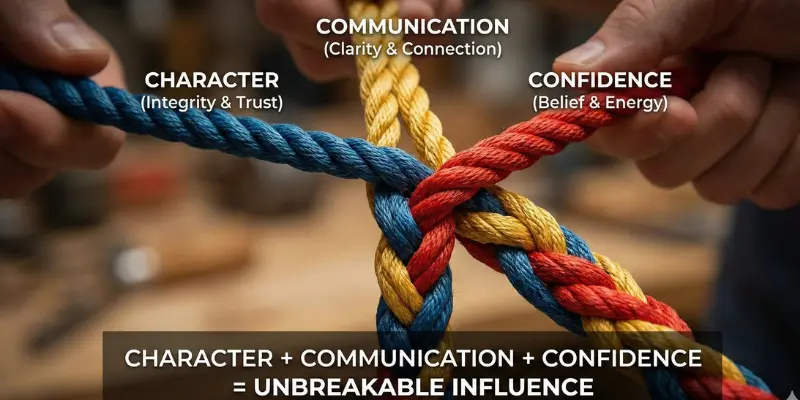
Together, these three elements braid together to form a powerful foundation for personal influence. Character + Communication + Confidence = the core of a leader who draws people in and inspires trust.
Accelerator 2: The 33% Rule for Networks That Compound
In today’s world, you can’t rely on just one network to sustain influence. You need multiple networks — and not just any networks. You need networks that compound.
Here’s the 33% Rule:
- 1/3 of your network should be people who need you. These are people you mentor or help. By lifting others, you automatically build influence.
- 1/3 of your network should be peers. These are people you collaborate with and share mutual respect. This is your go-to group for advice and new opportunities.
- 1/3 should be people who inspire you. These are mentors or people you look up to. Learn from them, and let their influence challenge and refine your own power.
When you keep this balance, your network becomes self-sustaining and continually grows. It compounds because each part of your network feeds into the others.
Accelerator 3: Junoon + Pagalpan (The Passion Multiplier from Panchatantra)
In 2026, passion isn’t optional — it’s the fuel for everything you do. But here’s the twist: passion alone is not enough. What you need is Junoon + Pagalpan — a concept from the ancient Indian text Panchatantra.
- Junoon: This is relentless passion. It’s when you pour your heart and soul into something. It’s the fire that keeps you going through tough times. When you are driven by Junoon, others notice your commitment and are drawn to your energy.
- Pagalpan: This is crazy, unshakable passion that others don’t always understand. It’s about being willing to step out of the norm, take risks, and sacrifice for what you believe in. Pagalpan makes people follow you because they see you have the courage to do what others won’t.
Together, Junoon + Pagalpan create an unstoppable force that attracts people to you. It’s the kind of passion multiplier that builds real influence in ways that titles never could.
Accelerator 4: Simon Sinek’s Circle of Safety (Machiavelli for Crises, Empathy for Growth)
Simon Sinek’s Circle of Safety is one of the most important leadership concepts for building trust and influence. Here’s how it works:
- In crises, your team looks to you to protect them from external threats. That’s where Machiavellian strategies — being shrewd, decisive, and protective — come into play.
- In growth, your role shifts. It’s about empathy — about creating an environment where people feel safe enough to take risks, innovate, and collaborate. Empathy builds trust, and trust compounds personal power.
By combining both — the strength of protection in crises and the warmth of empathy in growth — you create a Circle of Safety around your influence. People will not only follow you but will do so because they trust you with their growth and their well-being.
The Zero-Sum Rule Most Leaders Ignore
Here’s the critical lesson most leaders miss:
The more you rely on positional power, the less personal power you have.
Every time you use your title or position to control or demand, you weaken your personal power. The more you cling to your title, the more likely you are to build resentment and disengagement among your team.
Leaders who are overly dependent on their titles tend to face quiet quitting, sabotage, and a breakdown in trust. Personal power requires you to let go of control and instead, foster an environment where people follow you because of who you are — not because of the title you hold.
Actionable Insight:
To build unbreakable influence, you must actively work on combining your expert power and referent power with these accelerators. Focus on building networks that compound, embracing relentless passion, and leading with a combination of protection and empathy. Most importantly: let go of your title as your main source of power, and you’ll unlock a level of influence that outlasts any corporate structure.
Part 3: Proof from 2026’s Real World
If data isn’t enough to convince you, the real world provides irrefutable evidence that titles are optional for influence. We’ll now examine 12 Leaders Who Built Empires With Zero Positional Power, demonstrating exactly how personal influence trump’s rank.
12 Leaders Who Built Empires With Zero Positional Power
In today’s world, some of the most successful leaders don’t rely on titles, formal positions, or traditional authority to make an impact. They build unbreakable influence based on their personal power. Let’s look at 12 leaders who’ve proven that personal influence can build empires with no positional power whatsoever.
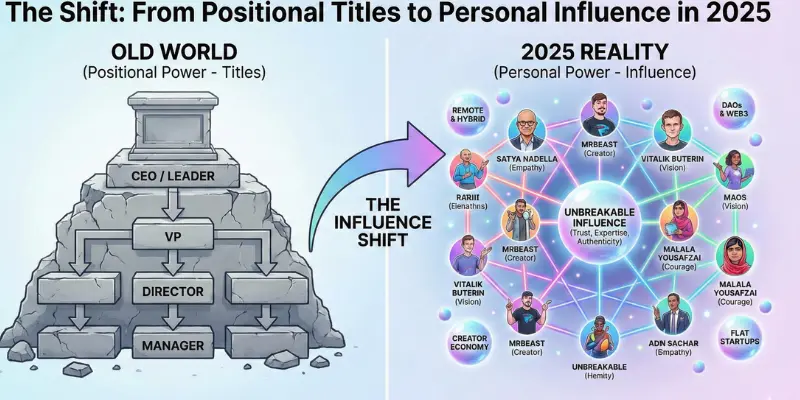
Satya Nadella (Microsoft)
- Satya transformed Microsoft not by wielding his title as CEO but by leading with empathy. When he took over as CEO, Microsoft was stuck in a hierarchical, rigid culture. Nadella’s shift toward emotional intelligence, teamwork, and inclusive leadership helped Microsoft become one of the most valuable companies in the world. His personal influence created trust and collaboration, not just within the company but with customers and partners alike.
MrBeast (Jimmy Donaldson)
- MrBeast has built a $700 million empire in the creator economy, all without a formal title or position. His influence comes from the content he creates and the way he inspires millions of people through his creativity, generosity, and vision. People follow him not because of a title, but because they admire his personal mission and the impact he has on the world.
Vitalik Buterin (Ethereum)
- Vitalik Buterin created Ethereum, one of the most influential decentralized blockchain platforms, with no formal title in any company. His influence comes purely from his vision for a decentralized internet and the trust he has earned from the Ethereum community. Buterin’s reputation as an innovator and a thought leader in the crypto space gives him far more influence than any CEO’s title.
Elon Musk (Tesla, SpaceX)
- Musk’s title as CEO may be well-known, but his true power comes from his vision, relentless drive, and ability to inspire others to believe in seemingly impossible goals. People follow Musk because of his visionary leadership and the way he challenges the status quo. His personal influence has attracted the best minds to his companies — not his position, but his ability to move people toward a shared goal.
Brené Brown (Researcher and Author)
- Brené Brown didn’t build a massive career on titles or positions of authority. Her influence stems from her vulnerability, research, and the way she’s reshaped how leaders approach topics like courage, empathy, and leadership. Brown’s personal power, particularly her referent power as a trusted voice in the field of leadership, has allowed her to impact millions worldwide.
Oprah Winfrey (Media Mogul)
Oprah built a media empire not based on a corporate title but on her authenticity, empathy, and ability to connect deeply with people. Her influence comes from how she made others feel seen and heard, which earned her loyalty and trust. People follow Oprah not because of her title but because of her personal authenticity and influence over decades.
Tim Ferriss (Author, Entrepreneur)
- Tim Ferriss may have written books like The 4-Hour Workweek, but his real power comes from his personal brand, his ability to connect people, and the networks he has built around his vision of life optimization. Ferriss doesn’t rely on a title to drive his influence; instead, his influence is compounded through the value he brings to others.
Gary Vaynerchuk (VaynerMedia CEO)
- Gary Vee’s personal power isn’t tied to his role as CEO. His influence comes from his authenticity, passion, and relentless hustle. People follow him because they believe in his vision and his ability to connect on a personal level with his audience. He doesn’t need a formal title — his influence is in his actions and his ability to consistently provide value.
Sheryl Sandberg (Facebook/Meta)
- While Sandberg’s role as COO is well-known, her real influence has always stemmed from her ability to empower others, particularly women in leadership. Her work on leaning in and promoting leadership through empowerment has cemented her as a thought leader, and her influence has extended beyond her title.
Richard Branson (Virgin Group)
- Richard Branson has built his empire around his personal brand and personal influence. His ability to connect with people, inspire loyalty, and create a culture of innovation and fun has made Virgin a global powerhouse. Branson’s power is rooted in personal relationships and his ability to connect with people on a human level — not his position.
Malala Yousafzai (Activist and Nobel Laureate)
- Malala’s personal power is unparalleled. She didn’t need a title to inspire millions. Her influence comes from her courage and commitment to education for girls around the world. Malala’s power is personal — it’s rooted in her story, her vision, and the authenticity she brings to every issue she tackles.
Tony Robbins (Motivational Speaker, Author)
- Tony Robbins’ empire was built not by a title or a position but by his ability to inspire, empower, and transform the lives of millions through his coaching, seminars, and books. Robbins’ influence is based on his personal ability to move people emotionally and motivate them to take action.
Where Titles Officially Became Meaningless in 2026
The post-2020 world has seen a radical shift, particularly in how power and influence are perceived. Titles — once seen as the ultimate indicator of authority — are now secondary to the impact a person can have. Let’s explore the areas where titles have officially become irrelevant in 2026.
Remote & Hybrid Teams
- In a world where remote work has surged, influence is no longer about who sits in the corner office. It’s about who can inspire trust, collaborate effectively, and move teams forward without physical presence. Leaders now earn influence through virtual leadership, not office hierarchy.
Creator Economy
- In the creator economy, people build their influence through content creation and authenticity rather than formal roles. Platforms like YouTube, Instagram, and TikTok allow people to gain massive influence independently of titles. Influence is earned through personal connection, not through a company position.
DAOs & Web3 Governance
- Decentralized Autonomous Organizations (DAOs) and Web3 technologies have redefined leadership. In DAOs, there are no traditional titles or hierarchies. Influence is based on reputation, contribution, and trust, not positions of authority. The decentralized nature of Web3 means that leadership is earned, not assigned.
Flat Startups
- Companies like GitLab, Valve, and Basecamp have embraced flat hierarchies, where everyone’s voice matters equally. In these organizations, your position doesn’t define your power — your ability to contribute, collaborate, and lead with personal influence does. Titles don’t matter when everyone is a leader in their own right.
Actionable Insight:
These 12 leaders show that titles are not necessary for influence. What matters is personal power — the influence you cultivate through trust, expertise, relationships, and authenticity. In the modern world, the most powerful people are those who build influence not through their titles but through their ability to connect, inspire, and lead with integrity.
Part 4: The Science That Changes Everything
You’ve seen the data and the real-world proof, but the most compelling evidence for personal power is biological. Let’s explore The 2026 Oxytocin Breakthrough: Why Personal Power Triggers 2.7× More Effort, proving trust is the ultimate performance driver.
The 2026 Oxytocin Breakthrough: Why Personal Power Triggers 2.7× More Effort
If you’ve ever felt like people are more willing to go the extra mile for a leader they trust, there’s a biological reason for that — it’s not just about motivation or charisma. It’s about oxytocin, often referred to as the “trust hormone.”
Recent research in 2026 has shed light on how oxytocin plays a key role in personal power and influence. Here’s the key finding:
**When leaders build trust, they trigger a release of oxytocin in their teams, which leads to *2.7 times more effort* from those teams.**
This is huge. It means that trust isn’t just a nice-to-have when it comes to leadership — it’s the biological foundation of high-performing teams.
What is Oxytocin?
- Oxytocin is a hormone produced in the brain that plays a significant role in bonding, trust, and social connections. It’s released when we feel safe, supported, and understood — and, crucially, when we feel that the person leading us has our best interests at heart.
The Science Behind Effort and Trust:
- Studies show that oxytocin increases collaboration and reduces self-interest in group settings. People who trust their leaders are more willing to take initiative, work harder, and go above and beyond to contribute to the group’s success. This isn’t just about a strong will; it’s about biological response — trust directly impacts effort.
This research doesn’t just support the idea that personal power (built on trust) is more effective than positional power. It shows that personal power is biologically more effective. Teams led by individuals who focus on building authentic relationships — those who lead with integrity, empathy, and trust — are more engaged, more productive, and more loyal.
Warmth + Competence = Biological Trust = Voluntary Effort
Warmth + Competence = Trust
It’s simple but powerful. If you want to influence and inspire others, you must strike the right balance between warmth (how approachable and empathetic you are) and competence (how skilled and capable you are). When these two factors combine, they create a biological trust — and trust is the foundation of personal power.
- Warmth: When people feel cared for, understood, and respected, oxytocin levels rise. This is why empathy and emotional intelligence are such critical components of personal power. Leaders who understand the emotions of their teams, who listen actively, and who show genuine care for their well-being will naturally trigger oxytocin.
- Competence: You also need to be competent. Without competence, warmth can feel disingenuous. Competence doesn’t mean being the smartest in the room, but it does mean showing that you are capable, knowledgeable, and can deliver on your promises. When you combine warmth with competence, you trigger trust — and when trust is in place, people will follow you. They’ll work harder for you, they’ll stay longer, and they’ll believe in your vision.
How This Breakthrough Changes Leadership in 2026
What does this breakthrough mean for leadership in 2026? It means that personal power isn’t just about influence, relationships, or even communication skills — it’s about creating an environment where people feel safe, trusted, and valued.
This biological aspect of influence has massive implications:
- Leaders who focus on building trust — not through fear, but through authentic connection — are more likely to inspire greater effort, longer loyalty, and more voluntary collaboration.
- In today’s world, where teams are more distributed than ever, virtual leadership has to focus even more on building trust. You can’t rely on in-person cues to foster relationships — you need to intentionally create trust online, which can be just as powerful.
- With the rise of AI and automation, leadership is also about human connection. The most successful leaders in 2026 will be those who can connect with others on a human level. Personal power based on trust will be the defining factor in whether an individual or company thrives or crumbles.
Actionable Insight:
You can build unbreakable influence by triggering oxytocin in your teams. How? Lead with both warmth and competence. Build relationships based on trust. Show empathy, be transparent, and demonstrate competence in what you do. When you combine these two, you’ll trigger a biological response that drives people to work harder, trust you more, and stay loyal to your leadership.
This isn’t just theory — this is science. And it’s exactly how you’ll build the kind of personal power that can’t be taken away in 2026 and beyond.
Part 5: Your Immediate Action Plan
Analysis is useless without action, so it’s time to stop guessing and start measuring your influence today. We begin with Your Personal Power Scorecard – Calculate Your Exact Ratio in 2 Minutes, pinpointing exactly where your influence stands.
Your Personal Power Scorecard – Calculate Your Exact Ratio in 2 Minutes
Building personal power is a deliberate process — it’s not something that happens overnight. But the first step is understanding exactly where you currently stand. To help you assess your starting point, we’ve created the Personal Power Scorecard.
This 12-question quiz will measure your expert power and referent power, and give you a clear picture of your current influence. The higher your score, the stronger your personal power — and the faster you’ll compound it.
Instructions: Answer the following questions honestly. Each question is scored on a scale from 0 to 10, with 0 being the weakest and 10 being the strongest. At the end, we’ll calculate your personal power ratio and give you clear next steps to amplify it.
- How confident are you in your expertise in your field?
- Do people regularly seek your advice or expertise?
- How strong are your personal relationships at work or in your business?
- Do others trust you to make decisions in their best interest?
- How well do you communicate your ideas to others?
- Are you seen as a credible and reliable source of information?
- How often do you take the initiative to help others without being asked?
- Do you actively work on growing your network of influential people?
- How empathetic are you when dealing with team members or collaborators?
- Do you inspire others to follow you even when you don’t hold formal authority?
- Are you willing to make tough decisions that benefit others in the long run?
- How well do you handle conflict and turn it into a positive outcome?
Once you’ve completed the scorecard, your total score will reveal your personal power ratio. This is a quick but powerful way to assess your current standing and set a course for improvement.
The 90-Day Flywheel to 10× Your Personal Influence
Now that you’ve assessed your starting point, it’s time to take action. Here’s your 90-day flywheel to rapidly increase your personal influence. This plan focuses on gradual, consistent improvement that builds momentum, so you can achieve exponential growth in your personal power.
Week 1-4: Foundation
- Focus: Build trust and expertise.
- Actions: Dedicate 20 minutes a day to upskilling or learning something new in your field. This increases expert power and keeps your knowledge relevant.
- Initiate one-on-one meetings with colleagues or peers you’d like to connect with. This builds referent power and opens doors to new collaborations.
- Actively engage in empathy-building exercises, like asking your team members or collaborators how they’re doing personally and professionally.
Week 5-8: Amplification
- Focus: Strengthen your network and confidence.
- Actions: Apply the 33% Rule: Start mentoring someone (the “1/3 need you” rule), collaborate with peers (the “1/3 are your equals” rule), and identify a mentor for yourself (the “1/3 inspire you” rule).
- Commit to speaking up more in meetings, sharing your ideas confidently, and taking on small leadership responsibilities even if you don’t have the title.
- Lead a small project or initiative, demonstrating both competence and warmth. This will raise your profile and create deeper trust with your team or clients.
Week 9-12: Acceleration
Focus: Establish your role as a trusted leader.
Actions:
- Take on a larger leadership role, either by leading a project, managing a team, or spearheading a new initiative. This shows you have both the competence and vision to lead without needing a title.
- Consistently demonstrate empathy in crisis situations and show you can handle difficult conversations with tact and care.
- Spend time reflecting on your leadership style and how it aligns with personal power principles. Write down what’s working and what you could improve, and continue to adjust your approach as needed.
Templates: 33% Rule Tracker, Passion Project Planner, Public Value Log
To make it even easier for you to implement the 90-day flywheel, we’ve provided the following templates:
33% Rule Tracker:
- A simple worksheet to help you organize your networking efforts. It’ll ensure you’re maintaining the right balance between mentoring others, working with peers, and learning from mentors.
Passion Project Planner:
- A template to help you identify your passion projects and outline steps to make them a reality. Passion is a multiplier for personal power, and this planner will help you channel your passion into meaningful, impactful actions.
Public Value Log:
- A log to track the value you’re creating for others. This can include anything from helping a colleague solve a problem to launching an initiative that positively impacts your team or organization. Keeping track of this will help you see how your referent power is growing over time.
Actionable Insight:
These tools and the 90-day flywheel are designed to help you 10x your personal influence by focusing on consistent, incremental actions that build expert power and referent power. By following this plan, you’ll increase your personal power faster than any title or promotion could.
Start today, track your progress, and by the end of 90 days, you’ll have created a foundation of personal influence that will continue to compound — regardless of your title, position, or company.
Conclusion: Power That Can’t Be Taken Away
At the beginning of this guide, you learned how positional power is becoming increasingly irrelevant in the world of work. Titles are fragile — your reputation and personal influence are what truly define your power. The rapid shifts in today’s landscape — from remote teams to the rise of the creator economy — mean that personal power is the only kind of influence that can survive layoffs, re-orgs, and AI disruption.
Now, you’ve learned how to build and amplify that personal power, starting today. You’ve discovered:
- The 7 types of power, and why referent and expert power are the only ones that truly matter in 2026.
- The 4 accelerators that will help you build unbreakable influence — from the 3-C Braid to leveraging your networks.
- Real-world examples of leaders who’ve built empires without relying on titles.
- The scientific proof that trust (and the oxytocin it triggers) is the biological foundation of personal power.
- And, most importantly, a 90-day action plan that can help you 10x your personal influence starting immediately.
One Last Reflection
As you finish reading this, take a moment to reflect on where you stand. The world is changing fast, and the question you need to ask yourself is simple:
What kind of leader do you want to be in this new world?
Are you going to continue clinging to a title — a fragile symbol of power that can be taken away? Or are you going to build the kind of personal power that no one can take from you?
You still have time. Most people don’t realize this until the chair is pulled away. But if you start today, you’ll be ahead of the curve. And in a few months, you’ll look back and see how much your personal influence has grown.
So, what’s your next step?
To help you get started, we’ve includes everything you need to start building your unbreakable influence.
- Personal Power Scorecard — a quick 12-question quiz to measure your current influence.
- 90-Day Flywheel Planner — a week-by-week guide to rapidly building personal power.
- French & Raven Cheat Sheet — a quick reference to understand the 7 types of power and how they apply to you today.
- Oxytocin Summary — a simplified breakdown of the 2026 breakthrough in trust-building and how it influences your leadership.
Don’t wait for the next disruption to realize the value of personal influence.
Final Thoughts
Your personal influence is the key to thriving in today’s world. As titles fade and new forms of leadership take hold, those who focus on building authentic relationships, expertise, and trust will emerge as the true leaders of the future. Start today. Your influence compounds faster than any promotion ever could.
Your Burning Questions: Positional Power vs Personal Power (FAQs)
1. FAQ: Why is positional power becoming irrelevant in 2026?
Answer:
Positional power, or power derived from your job title or formal authority, is losing its value in today’s rapidly changing world. In 2026, workplaces are more decentralized, with remote teams and flat organizational structures becoming the norm. People are no longer motivated by titles alone. Instead, personal power — the influence you gain through expertise, trust, and relationships — is now the key to sustained success. Leaders who rely on positional power alone are seeing disengagement and loss of influence, especially in environments where emotional intelligence and collaboration are prioritized over hierarchical control.
2. FAQ: What’s the difference between expert power and referent power, and which one is more important?
Answer:
Both expert power (the influence you gain through knowledge and expertise) and referent power (the influence you gain through personal relationships, admiration, and trust) are essential forms of personal power, but they serve different purposes.
- Expert Power is about what you know and how others value your expertise. It’s essential for building credibility and leading through your skills.
- Referent Power is about who you are. It’s built on relationships, trust, and your ability to inspire people. It’s the kind of power that helps you influence without authority and leads to long-term loyalty and commitment.
In 2026, referent power is likely to become more important because relationships and trust are key to leadership, especially in remote and hybrid work environments. However, expert power is still crucial — ideally, you should focus on developing both.
3. FAQ: How can I start building personal power if I’m not in a leadership position?
Answer:
Building personal power isn’t limited to those in leadership positions. In fact, many people gain significant influence without titles by focusing on the following:
- Expertise: Invest in developing deep knowledge or skills in your field. The more valuable your expertise, the more people will look to you for guidance.
- Relationships: Build strong, trust-based relationships with peers, mentors, and others in your organization or network. Take the time to understand people’s needs and offer help without expecting anything in return.
- Communication: Be clear, concise, and empathetic when communicating. Your ability to connect with others — whether one-on-one or in group settings — will increase your influence.
By consistently demonstrating these qualities, you’ll gain influence and respect, no matter your title or formal position.
4. FAQ: Can you really achieve more influence without a title in a traditional corporate structure?
Answer:
Yes, you absolutely can. In fact, personal power is often the difference between true leadership and just holding a title. Leaders who focus on building trust, inspiring others, and using their expertise effectively often achieve more than those relying solely on their positions.
In a traditional corporate structure, influence is no longer reserved for those with the highest titles. If you consistently demonstrate value, support others, and lead by example, you can influence decisions and impact outcomes without ever needing to “manage” anyone. The key is how people perceive your influence — and that’s driven by your actions, reputation, and ability to connect with others.
5. FAQ: How can I measure my personal power, and how do I know if it’s growing?
Answer:
Measuring personal power can be more subjective, but there are several ways to gauge whether your influence is growing:
- Feedback: Pay attention to how people respond to your ideas, guidance, or requests. Are they engaging more with your suggestions? Are colleagues seeking you out for advice or support?
- Opportunities: More influence often leads to more opportunities — whether it’s being asked to lead projects, speak at meetings, or connect with influential people. Track whether your network and influence are expanding.
- Trust: Trust is the ultimate measure of personal power. If you’re trusted to take on responsibilities without micromanagement, or if others openly seek your counsel in tough situations, your personal power is growing.
Additionally, using tools like a Personal Power Scorecard (which you can create or find online) will help you track your expert power (skills, knowledge) and referent power (relationships, trust) to get a clearer picture of your influence.
6. FAQ: How do I balance building personal power with remaining a team player?
Answer:
Building personal power is not about competing with others — it’s about collaborating and elevating the people around you. The best leaders build influence by helping others grow. Here’s how to balance both:
- Empathy & Collaboration: Always approach relationships with empathy. Help others succeed, share credit, and celebrate team wins. The more you build others up, the more trust and respect you earn in return.
- Be Authentic: Focus on being genuine in all your interactions. Don’t build influence by manipulating others or putting yourself above them. Personal power thrives on authenticity, and people can sense when someone is genuinely looking out for the team’s success.
- Lead by Example: Show others how to excel by demonstrating integrity, hard work, and emotional intelligence. When you practice what you preach, your influence will grow organically.
Remember, building personal power is about leading through service and supporting others in their journey.
7. FAQ: Is personal power something that can be “built” over time, or is it something you’re born with?
Answer:
Personal power is absolutely something that can be built over time — it’s not about being born with a special set of traits. While some individuals might have natural charisma or a head start in certain areas, anyone can develop personal power through consistent effort and focus.
- Expert power is built through continuous learning, practice, and application of your skills.
- Referent power is developed by investing in relationships, being trustworthy, and showing integrity consistently.
- Personal influence also grows when you take responsibility for your actions, stay consistent in your efforts, and always aim to add value to others.
In short, personal power is a skill set — and it can be honed with intention and practice.






- Be Respectful
- Stay Relevant
- Stay Positive
- True Feedback
- Encourage Discussion
- Avoid Spamming
- No Fake News
- Don't Copy-Paste
- No Personal Attacks
- Be Respectful
- Stay Relevant
- Stay Positive
- True Feedback
- Encourage Discussion
- Avoid Spamming
- No Fake News
- Don't Copy-Paste
- No Personal Attacks
