Work Generations in 2026: Managing Boomers to Gen Alpha – Fresh Stats, AI Insights & Practical Strategies for Global Teams
Published: 22/03/2026
A team call starts, and the differences show up almost immediately. One person wants a quick answer in Slack. Another would rather wait for a clear email summary. Someone asks for real-time feedback before moving ahead. Someone else prefers space to think first and respond later. Now add AI tools, hybrid schedules, different cultural norms, and rising pressure to move faster with fewer mistakes. That is what managing work generations looks like in 2026.
For leaders, this is no longer a side issue. It is the daily reality of modern work. In many organizations, generational overlap is at its highest point yet, with older employees staying active longer, Millennials and Gen Z reshaping the center of the workforce, and Gen Alpha beginning to enter the conversation through early internships, gigs, and digital-first work exposure. At the same time, AI is changing how people learn, communicate, solve problems, and imagine their future at work. The result is a workplace where expectations can clash just as easily as they can complement one another.
That is why the usual generational advice is no longer enough. Managers do not need another shallow list of stereotypes about Boomers, Gen X, Millennials, or Gen Z. They need a practical way to lead people who may want different communication styles, different feedback rhythms, different career paths, and different levels of support — without letting those differences turn into friction, resentment, or lost performance. As one useful leadership insight suggests, the person most frustrated in the room is often the one who needs to adapt first. In other words, successful multigenerational leadership starts with self-awareness, not blame.
The opportunity, however, is just as real as the tension. When managed well, generational diversity can become one of a team’s biggest strengths. Experience can sharpen experimentation. Digital fluency can accelerate legacy knowledge. Fresh ideas can work alongside judgment, resilience, and context. And because Millennials and Gen Z are expected to make up roughly three-quarters of the global workforce by 2030, while older workers continue to remain present in meaningful numbers, leaders who learn how to connect these groups will be far better positioned than those who rely on one style for everyone.
This guide is built for that reality. It will help you understand the major work generations shaping the workplace in 2026, compare their common preferences without falling into stereotypes, and manage the new pressure points created by AI, hybrid work, and global team dynamics. More importantly, it will show you what to do next — with clear frameworks, practical tools, and strategies you can actually use.
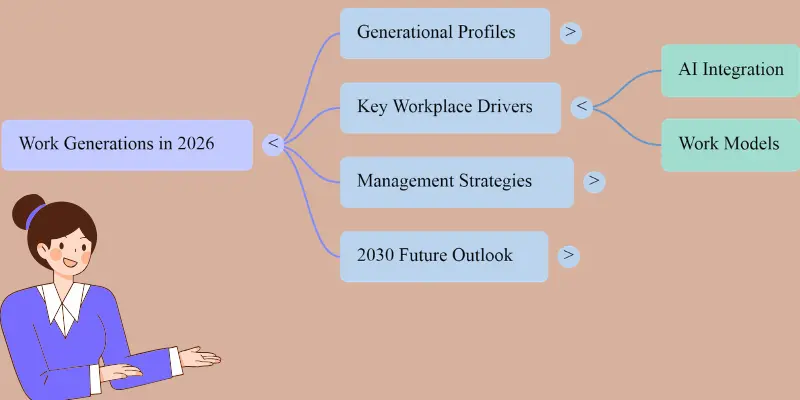
Who Are the Work Generations in 2026?
When people talk about work generations, they are usually trying to understand broad patterns in how different age groups enter, experience, and respond to work. That can be useful — but only if you treat these labels as a guide, not a rigid rulebook. No manager should assume that every employee in the same age band thinks, communicates, or works in exactly the same way. Role, culture, life stage, industry, and leadership environment still matter. Even so, in 2026, these generational categories remain a practical way to understand the changing shape of the workforce.
It is also worth noting that generation ranges can vary slightly by region or source. Still, the overall picture is clear: today’s workplace is no longer defined by just two or three age groups. It is moving toward a six-generation future, and that shift is already changing how leaders need to think about communication, learning, feedback, trust, and career development.
Silent Generation / Traditionalists (1928–1945)
This group now represents only a very small share of the active workforce — roughly 1%. In most organizations, they are no longer a major workforce segment, but where they are still present, they often bring deep institutional memory, long-term perspective, and a strong sense of commitment. For managers, their continued presence is a reminder that experience and continuity still have value, even as workplaces modernize rapidly.
Baby Boomers (1946–1964)
Baby Boomers still make up an important part of the workforce, at around 15%. Many remain active in senior, advisory, specialist, or mentoring roles, and they continue to play a major part in passing on knowledge, judgment, and professional standards. In 2026, their significance is not only about how many are still working, but about how much business-critical experience they hold. For managers, that makes knowledge transfer and thoughtful retention more important than ever.
Generation X (1965–1980)
Gen X accounts for roughly 31% of the workforce and continues to hold a strong position across management, technical, and leadership roles. Often seen as practical, self-directed, and efficient, this generation frequently acts as the bridge between older institutional knowledge and younger digital-first expectations. For managers, Gen X matters because they often carry both operational responsibility and cultural translation work inside organizations, especially during periods of rapid change.
Millennials (1981–1996)
Millennials now form one of the largest workforce groups at about 35–36%. In many organizations, they are no longer the “emerging” generation — they are the core of the workforce and increasingly the core of leadership pipelines as well. Their influence is especially visible in how organizations think about growth, purpose, flexibility, and collaboration. For managers, Millennials are central not just because of their size, but because their expectations have helped reshape modern workplace norms.
Generation Z (1997–2012)
Gen Z already represents roughly 18–26% of the workforce, making it a major force in 2026 rather than a future trend. This generation is helping redefine expectations around speed, communication, technology, learning, and work-life balance. In many teams, Gen Z is also bringing new assumptions about how quickly support, feedback, and digital tools should be available. For managers, understanding Gen Z is essential because their influence is already visible in team culture, hiring expectations, and the future leadership pipeline.
Generation Alpha (2010–2025)
Gen Alpha is the newest generation entering the conversation. The oldest members are now 16 or older in 2026, which means some are beginning to appear through early internships, gig work, and other forms of digital-first work exposure. Globally, Gen Alpha is projected at around 2 billion people, with estimates suggesting they could represent 19% of the workforce by 2035. That makes them impossible to ignore. For managers, the key point is not that Gen Alpha is suddenly everywhere, but that the conditions shaping them — ultra-digital environments, early tech fluency, and new expectations around work and identity — are starting to influence the workplace already.
Why this matters for leaders now
Taken together, these groups show just how complex the workplace has become. In some teams, you may already have employees shaped by very different economic realities, communication habits, and career expectations working side by side. In the near future, that overlap will only grow. That is why understanding work generations in 2026 is not about memorizing labels. It is about recognizing that leadership now requires more range, more flexibility, and more intentional design than ever before.
The next step is to look at what this generational mix actually means in practice — not just who is in the workforce, but how the balance is shifting and what that means for managers leading global teams.
2026 Workforce Snapshot – Global Composition & Trends
If the first step is understanding who the work generations are, the next step is understanding how the balance is shifting. In 2026, the workforce is not simply getting younger or older. It is doing both at once. Millennials and Gen Z are moving toward clear dominance, while older employees are staying in work longer and continuing to hold valuable experience, influence, and institutional knowledge. For managers, this creates a very different reality from the one many leadership habits were built for.
One of the clearest signals is where the workforce is heading by the end of the decade. Millennials and Gen Z are projected to make up roughly 74% of the global workforce by 2030, which means the center of working life is moving decisively toward younger generations. That matters because these groups are already reshaping expectations around communication, flexibility, feedback, development, and technology use. A management style designed for a more uniform workplace will struggle in this environment. Leaders now need systems that can handle different expectations without creating confusion or unfairness.
At the same time, older workers are not disappearing from the picture. In fact, their presence is still meaningful and, in many contexts, growing. Workers aged 65 and older are projected to make up 8.6% of the U.S. workforce by 2032, a sign that longer careers, later exits, and extended contributions are becoming part of the new normal. For employers, this has two immediate implications. The first is opportunity: experienced employees can anchor teams with judgment, stability, and mentoring. The second is risk: if organizations fail to capture and transfer their knowledge, they face a serious knowledge leak when those employees retire or reduce their involvement.
Another important shift is that Gen Z overtook Boomers in the workforce in 2024, which marked more than a symbolic handover. It showed that younger workers are no longer a side conversation or future issue. They are already a major force in shaping how work feels, how teams communicate, and how leadership is judged. For managers, this means that workplace design can no longer be based mainly on the assumptions of older models. If younger employees expect faster feedback, clearer purpose, stronger digital support, and more room to grow, leaders need to respond with intention rather than frustration.
Yet the answer is not to swing completely in the other direction. One of the most encouraging signals in this changing landscape is that more than 70% of people across generations say they enjoy cross-generational learning. That matters because it challenges the idea that age diversity is mainly a source of conflict. In reality, many employees see real value in learning from people who bring a different pace, skill set, or perspective. For managers, this is a major advantage. It means the goal is not to reduce differences, but to structure teams so those differences become useful.
This is especially important in a world where AI is reshaping roles, expectations, and confidence levels at work. Younger employees may often feel more comfortable experimenting with new tools, while older employees may hold stronger business context, pattern recognition, and decision-making experience. Without good leadership, that gap can create tension. With good leadership, it can create one of the most powerful forms of team learning available in 2026. What matters for managers is not just who knows the latest tool, but whether the team knows how to combine speed with judgment.
Hybrid and global work add another layer. In many organizations, distributed work is no longer a temporary adjustment; it is simply how work happens. That means generational differences now show up through screens, time zones, messaging platforms, and digital workflows rather than just in shared office space. A communication misunderstanding that might once have been solved quickly in person can now stretch across channels and cultures. This is why multigenerational leadership in 2026 is also deeply connected to clarity, team norms, and digital behavior.
There is also a quieter but equally serious challenge for leaders: the risk of wasted potential at both ends of the age spectrum. When older workers leave without passing on what they know, companies lose memory, judgment, and historical context. But when younger employees feel dismissed, underused, or unable to speak up, organizations pay a different kind of cost — an intelligence tax created by hidden ideas, silent frustration, and untapped ability. In both cases, the problem is not age itself. It is the failure to build a workplace where people across generations can contribute fully.
That is the real story of the 2026 workforce. It is larger, more layered, and more interdependent than many leaders assume. Younger generations are shaping the future fast, older generations are still central to the present, and AI is increasing the pressure on everyone to learn, adapt, and collaborate in new ways. For managers, the takeaway is clear: leading across generations is no longer about managing difference at the edges. It is about designing the core of how your team works.
The next question, then, is where these differences are most likely to show up in everyday work — and where the overlaps are stronger than people think.
Side-by-Side Comparison – Generational Preferences at Work
The most useful way to compare work generations is not to ask which group is “best” or “hardest” to manage. It is to ask where common workplace preferences tend to differ — and where they overlap more than people think. That distinction matters. When leaders treat generational patterns as fixed truths, they create stereotypes. When they treat them as signals, they gain a practical way to understand communication, motivation, feedback, and trust more clearly.
That is especially important in 2026, when daily work is shaped not only by age, but also by AI adoption, hybrid routines, cultural context, and role demands. A Gen Z employee may be highly comfortable with digital tools, but still want structure and coaching. A Gen X leader may value autonomy, but still care deeply about purpose. A Baby Boomer may prefer email or phone, while still adapting effectively to new systems. In other words, generational patterns can help you lead better — but only when you use them with care.
The table below offers a practical snapshot of common tendencies across generations in today’s workplace.
| Generation | Communication | Motivation | Feedback Style | AI Comfort | Loyalty Approach |
|---|---|---|---|---|---|
| Baby Boomers | Phone, email | Stability, recognition | More formal, often annual or structured | Adapting | Long-term, loyalty-based |
| Gen X | Direct, efficient | Autonomy, flexibility | As needed, practical | Moderate | Independent, often mission-aligned |
| Millennials | Email, Slack | Purpose and growth | Frequent | High | Values-driven |
| Gen Z | Video, Slack, emoji-style digital communication | Balance and impact | Real-time | Native or highly comfortable | Flexible, often open to side hustles |
| Gen Alpha | Immersive, digital-first | Wellbeing and creativity | Instant | Ultra-native | Entrepreneurial |
At first glance, the differences seem obvious. Some generations may prefer more formal communication, while others are comfortable with fast-moving digital exchanges. Some may respond better to structured recognition, while others want meaning, growth, or visible impact. Feedback expectations also vary. In many workplaces, older models were built around formal review cycles, while younger employees are more likely to expect faster, lighter, and more continuous feedback loops. AI adds another layer to this picture. Gen Z already shows especially high awareness of AI’s impact, with roughly 74–77% expecting GenAI to shape work, and frequent users tend to be more optimistic about that change.
But the bigger leadership lesson is not just about difference. It is about interpretation. As Cam Marston has suggested in discussing workplace generations, Gen X often grew up with a “figure it out” mindset, while younger workers may be more comfortable asking for help sooner. A manager who sees only the surface may misread one style as detached and the other as dependent. A better leader asks a more useful question: what kind of support helps this person perform well without reducing ownership?
This is where many generational conversations go wrong. They focus so much on contrast that they miss the overlap. Yes, communication styles may differ. Yes, feedback rhythms may differ. Yes, AI comfort levels may differ. But trust, respect, fairness, and purpose are not exclusive to any one generation. They matter across the board. Even motivation is not as divided as it first appears. Purpose may be strongly associated with Millennials and Gen Z, but meaning in work matters to older generations too — it may simply be expressed through different language, such as contribution, legacy, or commitment.
That is why it helps to read the table as a pattern guide, not a personality test. In practice, the differences between work generations can become much smaller when you control for context — such as role, team culture, national culture, work arrangement, or leadership style. A rigid manager can create friction with any generation. A clear, flexible, fair manager can build trust with almost all of them.
For leaders, the practical takeaway is simple: use generational patterns to ask better questions, not to make quicker assumptions. If one employee wants direct, minimal guidance and another wants more regular feedback, the answer is not to label one “old-school” and the other “high maintenance.” The answer is to create team norms that stay consistent while still allowing room for individual preferences. That is how differences become manageable instead of disruptive.
The next step is to go deeper into each group — not as stereotypes, but as evolving workforce realities with distinct strengths, pressures, and management needs in 2026.
Updated Profiles – Strengths, Challenges & 2026 Realities
By 2026, the most useful way to understand work generations is not as fixed personality types, but as groups shaped by different work conditions, different technologies, and different expectations about what support, progress, and success should look like. That is what makes generational leadership both challenging and valuable. Each group brings distinct strengths. Each group also faces pressures that managers can easily misread if they rely on stereotypes instead of observation.
The goal, then, is not to ask which generation is “right.” It is to understand what each group may contribute, where friction is likely to appear, and how leadership can turn those differences into performance rather than tension.
Baby Boomers & Gen X
Baby Boomers and Gen X continue to carry enormous value in today’s workplace, even as the generational center of gravity shifts. Boomers often bring experience, stability, perspective, and a strong sense of professional commitment. In many teams, they remain important sources of judgment, continuity, and mentorship. Gen X, meanwhile, is often marked by independence, efficiency, and a practical mindset. They are frequently the generation that quietly holds systems together while also translating between older workplace norms and newer expectations.
For managers, one of the biggest reasons these groups matter in 2026 is knowledge retention. Older workers are still very much part of the labor force, with employees aged 65 and older projected to make up 8.6% of the U.S. workforce by 2032. That makes their contribution more than symbolic. In many organizations, they hold deep institutional memory, strong client understanding, and lessons that are difficult to document fully. If that knowledge leaves without being shared, the business does not just lose people — it loses context.
At the same time, these generations are often misunderstood. Boomers may be seen as too attached to familiar ways of working when, in reality, many are adapting while still protecting standards and quality. Gen X may be read as distant or overly self-reliant when they are simply operating from a long-standing “figure it out” mindset. That difference matters. A manager who mistakes independence for disengagement may offer too little support. A leader who assumes experience means resistance may overlook one of the strongest mentoring resources on the team.
What this means in practice is that leadership should combine respect with structure. Boomers can be especially valuable in mentoring roles, knowledge transfer, and culture continuity. Gen X often responds well when given autonomy, clarity, and trust — but that does not mean they should be left unsupported during change. In 2026, the strongest managers do not force these employees into younger work patterns or freeze them inside old ones. They give them room to contribute what they do best while making sure they stay included in evolving tools, workflows, and expectations.
What this means for managers: Treat experience as a strategic asset, not a legacy issue. Capture knowledge before it leaves, and do not confuse independence with a lack of need for support.
Millennials & Gen Z
Millennials and Gen Z now shape much of the daily energy, direction, and cultural rhythm of the workplace. Millennials have helped normalize stronger expectations around purpose, growth, flexibility, and collaboration. Gen Z is accelerating many of those shifts while also raising the bar for digital fluency, communication speed, and responsiveness. Together, these generations are pushing leaders to rethink how work is structured, how trust is built, and how employees stay engaged over time.
One of the clearest themes across these groups is that work is rarely judged only by pay or title. Meaning, flexibility, learning, and alignment matter more visibly. That does not mean every Millennial or Gen Z employee wants the same thing. It does mean that many are less willing to stay committed to environments that feel unclear, rigid, or disconnected from growth. Gen Z, in particular, brings both opportunity and risk. They are highly aware that AI and GenAI will shape work, with roughly 74–77% expecting that impact, but awareness alone does not create loyalty. Without trust, support, and a clear reason to stay, turnover risk rises quickly.
This is where managers often make the wrong assumption. Frequent feedback can be mistaken for insecurity. A desire for flexibility can be mistaken for low commitment. A focus on purpose can be dismissed as idealism. But these patterns often reflect the environments these generations have grown up and worked in. Faster communication, constant platform changes, visible social and economic shifts, and AI-driven uncertainty all shape how they think about progress and stability. What may look demanding on the surface is often a request for clarity, relevance, and momentum.
That is why leadership matters so much here. Millennials and Gen Z often perform best when managers create regular feedback loops, connect day-to-day work to a larger purpose, and make expectations visible instead of assumed. This does not require constant praise or endless customization. It requires consistency. If employees understand what success looks like, how they can grow, and why their work matters, managers are far more likely to gain trust and reduce avoidable exits.
What this means for managers: Do not reduce purpose and feedback to generational preferences alone. Treat them as leadership tools. Clear growth paths, frequent check-ins, and visible meaning can do more to retain younger talent than generic loyalty language ever will.
Gen Alpha – The 2026 Newcomers
Gen Alpha is still at the earliest edge of work, but that is exactly why leaders should pay attention now. In 2026, the oldest members of this generation are already old enough for early internships, gig work, and other forms of digital-first participation. They are not yet a dominant workforce group, but they are becoming a design challenge for forward-looking employers. By the time many organizations fully react, expectations may already be changing.
This generation stands out for the conditions shaping it. Gen Alpha is growing up in highly digital, highly connected environments where screens, platforms, personalization, and fast interaction are normal. The generation is projected at around 2 billion people globally, with estimates suggesting it could account for 19% of the workforce by 2035. There is also a strong entrepreneurial signal here, with around 76% expressing the aspiration to be their own boss. For employers, that combination matters. It suggests a group likely to expect creativity, autonomy, speed, and technology-rich experiences from the very beginning.
The risk for managers is to either dismiss Gen Alpha as too early to matter or to overstate how different they will be. The better approach is preparation. If Gen Alpha enters work expecting more immersive, digital, and self-directed experiences, then traditional onboarding, rigid learning structures, and overly punitive environments may feel immediately out of step. This does not mean organizations should remove accountability. It means they should think more carefully about how people learn, test ideas, and build confidence.
That is where concepts like safe failure containers and immersive tech onboarding become especially important. Early-career employees often need room to experiment, make small mistakes, and learn without feeling that every misstep defines them. For Gen Alpha, that may be even more important because speed and digital familiarity can create confidence in some areas while hiding inexperience in others. Smart managers will not wait until this generation becomes large before adjusting. They will start now by designing entry-level systems that encourage exploration, guided learning, and responsible independence.
What this means for managers: The key with Gen Alpha is not prediction — it is preparation. Build onboarding, coaching, and experimentation systems now that can support a more digital, entrepreneurial, and fast-moving workforce.
Taken together, these updated profiles show why managing work generations in 2026 requires more than awareness. It requires leadership range. Some employees may need more autonomy, others more feedback. Some may bring context, others experimentation. Some may value stability, others motion. Strong managers do not flatten those differences. They create a team environment where each strength becomes useful and each challenge becomes manageable.
The next question is where one of the biggest sources of both friction and opportunity now sits: AI.
The AI Factor – Widening or Bridging Generational Gaps?
Few forces are changing the workplace faster than AI, and few are more likely to expose the differences between work generations in real time. In 2026, AI is not just a technology issue. It is a people issue, a confidence issue, and a leadership issue. It affects how employees learn, how quickly they adapt, how secure they feel in their roles, and how they judge whether their employer is preparing them for the future or leaving them behind.

That pressure does not fall evenly across the workforce. Younger employees, especially Gen Z and the leading edge of Gen Alpha, are often more comfortable experimenting with digital tools, testing new workflows, and learning through fast iteration. Millennials also sit close to this shift, with many already using new tools to improve speed, output, and flexibility. In fact, around 74–77% of Gen Z and Millennials expect GenAI to significantly change work, and daily users tend to be more optimistic about that future. For many leaders, that creates a tempting but risky assumption: that younger generations are naturally ready for AI while older generations are simply trying to catch up.
That view is too simplistic — and it can quickly damage trust. AI fluency is not the same as business judgment. Comfort with tools is not the same as knowing when a tool should not be used, what quality standards must be protected, or how a poor decision could affect clients, teams, or the organization over time. Older employees may not always move first, but they often bring context, pattern recognition, critical thinking, and professional caution that younger employees have not yet had time to build. If managers treat AI as a race that only rewards speed, they risk widening generational gaps instead of closing them.
At the same time, avoiding AI tension does not mean pretending the fear is not real. One of the most important pressure points in 2026 is the anxiety many younger workers feel about entry-level roles. Around 61–63% worry that AI could eliminate some of those jobs, which means the same generation expected to embrace AI may also feel deeply uncertain about what it means for their future. That creates a leadership challenge. If managers only celebrate efficiency gains without addressing fear, they may create silence instead of engagement. Employees may comply on the surface while privately feeling less secure, less loyal, and less willing to experiment.
This is why the best leaders treat AI as a bridge-building opportunity rather than a dividing line. The strongest multigenerational teams are not the ones where one age group teaches and the other simply listens. They are the ones where learning moves in both directions. Younger employees may show how a tool works, where it saves time, or how to test new workflows quickly. More experienced employees may explain when human judgment matters most, where risk lives, how stakeholder dynamics work, and why context changes the “best” answer. When those strengths are combined, AI becomes a shared capability rather than a source of status or insecurity.
One of the most effective ways to make that happen is reverse mentoring. In a reverse-mentoring model, a younger employee might teach AI workflows, prompting habits, or digital experimentation methods, while an older colleague shares decision-making logic, industry history, or client sensitivity. That structure does more than transfer skills. It changes relationships. It reduces the idea that one generation is behind and another is ahead. Instead, it creates mutual value. The message becomes clear: everyone has something important to teach, and everyone has something important to learn.
For managers, the practical goal is not to force uniform AI behavior across the team. It is to build enough shared confidence that employees can adapt without feeling judged, displaced, or left alone. That starts with making learning visible and safe. Leaders should normalize different starting points, encourage questions without embarrassment, and show that experimentation is welcome when paired with accountability. AI adoption becomes much healthier when employees understand that they are being asked to grow, not being quietly compared.
A simple upskilling approach can help here. Managers can ask three questions across the team: What AI tools are people already using? Where is confidence high or low? And where could pairing employees across generations create better results than training people separately? These questions matter because the biggest barrier is often not ability, but design. If your team learns in silos, AI becomes another divide. If your team learns together, AI can become one of the strongest reasons for cross-generational collaboration.
Imagine, for example, a Gen Z employee showing a senior colleague how a GenAI tool can speed up first-draft research or internal summaries. In the same exchange, that senior colleague explains how to test the output for quality, context, tone, and risk before anything goes further. Neither person is “the future” and neither person is “the past.” Together, they represent a stronger way of working than either could deliver alone.
That is the real leadership opportunity inside the AI moment. AI can widen generational gaps when managers assume that age predicts value. But it can bridge those gaps when leaders design learning around complementarity instead of comparison. In 2026, the question is no longer whether AI will change multigenerational teams. It already is. The real question is whether managers will let it create separation — or use it to build a smarter, more connected workplace.
What this means for managers: Do not frame AI as a contest between digital speed and traditional experience. Pair experimentation with judgment, create reverse-learning opportunities, and make adaptation feel shared rather than threatening.
Practical Strategies & Tools for Global Teams
Understanding work generations is useful, but leaders do not get results from awareness alone. They get results from design. In a global, hybrid, AI-shaped workplace, the strongest managers are not the ones who memorize generational traits. They are the ones who build a team environment where different preferences can coexist without turning into confusion, resentment, or silos.
That is the real challenge in 2026. If you overcorrect for generational differences, you can fall into a preference trap where every person expects a completely separate management style, communication channel, and feedback rhythm. But if you ignore those differences entirely, people feel unseen, misunderstood, or forced into habits that do not help them do their best work. The goal is not full customization and it is not rigid uniformity. It is a unified culture with flexible edges.
In practice, that means setting a clear team foundation while allowing thoughtful adaptation around it. Everyone should know how decisions are made, where updates live, how quickly responses are expected, and what good work looks like. Within that structure, managers can still adapt feedback style, support level, and learning pace to fit the person. This is especially important in global teams, where generational differences often sit on top of cultural differences, language differences, and time-zone realities. Without clarity, friction grows quietly. With clarity, diversity becomes easier to manage and far more valuable.
Below are some of the most practical tools leaders can use to turn multigenerational complexity into better teamwork.
1. Cross-Gen Onboarding Checklist
Onboarding is one of the first places where generational misunderstanding either begins or gets prevented. A strong cross-generational onboarding process does more than explain tasks. It helps people understand how the team works, how support is given, and how different working styles can still fit inside one culture.
A practical onboarding checklist should cover four things early:
- Communication preferences: Ask new team members how they prefer to receive updates, questions, and feedback.
- Social connection: Build early check-ins that help people feel included, not just informed.
- Purpose alignment: Explain not only what the role does, but why it matters to the team and the wider organization.
- Success clarity: Make expectations visible from the start so no one has to guess what good performance looks like.
This matters because different generations often arrive with different assumptions. Some may wait to be told. Others may ask quickly. Some may prefer formal structure. Others may want immediate context and freedom to move. Onboarding is where you reduce that friction before it becomes a pattern.
A manager might say:
“Before we get too far into the work, I want to understand how you work best. How do you like to receive feedback, what helps you feel clear and included, and what helps you settle into a new team confidently?”
That one conversation can prevent weeks of misunderstanding. It also signals something important from day one: this team has standards, but it also pays attention to people.
2. Build One Culture, Not Five Mini-Cultures
One of the biggest mistakes managers make with work generations is assuming that fairness means giving each generation its own separate workplace. That usually backfires. When every group is managed differently without a common structure, the team starts to feel fragmented. People compare treatment instead of focusing on contribution. Small differences begin to look like favoritism.
A better approach is to create a few shared norms that everyone can trust. For example:
- one clear place for team updates
- one agreed response window for important messages
- one shared rhythm for check-ins or feedback
- one clear standard for decision-making and accountability
Once those basics are in place, managers can flex around them. One employee may prefer written follow-up after a meeting. Another may benefit from a quick verbal check-in. One may want frequent developmental feedback. Another may want space and autonomy with fewer interruptions. The team remains united because the foundation is shared, even when the support is not identical.
This is where many managers improve dramatically. They stop asking, “How do I manage Boomers, Gen X, Millennials, Gen Z, and Gen Alpha separately?” and start asking, “What team norms create clarity for everyone, and where should I adapt to help each person succeed?” That shift turns generational complexity into something manageable.
3. Use Decision-Support Language Instead of Control Language
Many multigenerational tensions are not really about age. They are about how decisions are framed. Some employees want direct instruction. Others want room to think. Some want to move fast. Others want more time to weigh trade-offs. A manager who uses only one decision style will eventually frustrate someone.
That is why simple decision-support language can be so powerful. Instead of giving a narrow answer too early, try:
“Here are two solutions — which serves best?”
This kind of question works well because it invites judgment without removing accountability. It helps more independent employees feel trusted. It helps less experienced employees think more clearly. It also creates a coaching moment without turning every conversation into a lecture.
Used consistently, this kind of language strengthens decisiveness across generations. It is especially useful in teams where some employees are quick to act and others hesitate, or where managers want to support confidence without becoming the answer machine for everyone.
You can also adapt it slightly depending on the moment:
- “Here are two possible routes — what do you see as the stronger one?”
- “What would you choose here, and what trade-off comes with it?”
- “Which option serves the team best, not just the fastest?”
These questions encourage better thinking while still keeping the manager involved. In global teams, they are also useful because they reduce ambiguity and make reasoning more visible across cultures and communication styles.
4. Create a Safe Failure Container
If AI, hybrid work, and rapid change are reshaping the workplace, then learning has to become safer. This is especially important for Gen Z and Gen Alpha, who may be highly comfortable with digital tools but still early in judgment, confidence, and organizational experience. It is also valuable for older employees adapting to new systems who may avoid experimenting because they do not want to fail publicly.
A safe failure container is not a space without standards. It is a space where people can test, learn, and recover from smaller mistakes before those mistakes become larger and more expensive. In other words, it protects both growth and accountability.
A manager can create this by clearly defining:
- what can be experimented with
- what must be reviewed before final use
- where mistakes are acceptable
- what learning is expected afterward
For example, a leader might say:
“Try the tool on this first draft, not on the final client version. I want you to test what it can do, note what worked, and bring back one thing you would change next time. We’re learning here, but we’re learning with guardrails.”
That kind of dialogue helps employees across generations. Younger team members feel permission to learn. Older team members feel safer entering unfamiliar territory. And the whole team sees that experimentation is not chaos — it is structured development.
This matters even more in a global workplace, where employees may differ not only by age but by how comfortable they are with risk, authority, and asking questions. Safe failure creates a common learning language that reduces fear without weakening standards.
5. Use Short Social Check-Ins to Read the Room
Not every problem in a multigenerational team is technical. Many are emotional, relational, or hidden under silence. During change, managers often move straight to process and miss the mood of the room. That is why even a short “room reset” habit can be valuable.
Before or after a major change, spend intentional time asking simple questions:
- What feels clear right now?
- What feels frustrating?
- What support would help you move faster or better?
- Where do you think the team may be talking past each other?
These do not need to become long therapy sessions. The point is to surface friction before it hardens into conflict. In many teams, the real problem is not disagreement itself. It is unspoken assumptions. A Gen X employee may think younger colleagues are asking too many questions. A Gen Z employee may think older colleagues are withholding support. A manager who creates space for those tensions to be named calmly can often solve in thirty minutes what might otherwise drag on for weeks.
6. Turn Cross-Generational Learning into a Habit
The best multigenerational teams do not leave learning to chance. They build simple systems for it. Reverse mentoring is one example, but the deeper principle is broader: every generation should feel both useful and teachable.
That can look like:
- pairing digital fluency with business context
- asking experienced employees to share decision logic, not just outcomes
- asking younger employees to show tool use, workflow shortcuts, or new ways of approaching a task
- ending shared learning with one practical question: “What should we now change in how we work?”
This matters because it turns age diversity into contribution instead of comparison. It also helps prevent two common risks: the knowledge leak that comes when older workers leave without sharing what they know, and the intelligence tax that comes when younger workers are present but underheard.
What this means for managers
The most effective way to manage work generations in 2026 is to combine shared standards with human flexibility. Set clear norms. Adapt thoughtfully. Create safe learning spaces. Use language that builds judgment, not dependence. And remember that in global teams, age is only one layer of difference. When you lead with clarity, trust, and structure, generational diversity becomes much easier to turn into a real advantage.
The next step is to look ahead: if this is where multigenerational leadership stands now, what should managers be preparing for by 2030 and beyond?
Future Outlook – 2030 and Beyond
If managing work generations feels complex in 2026, the challenge is only going to deepen over the next few years. By 2030 and beyond, leaders are likely to face even greater generational overlap, more fluid career patterns, and a workplace where AI is no longer a separate topic but part of everyday work design. In other words, multigenerational leadership is not a temporary management trend. It is becoming a core leadership capability.
One major shift is simple scale. Millennials and Gen Z are expected to make up roughly 74% of the global workforce by 2030, which means younger generations will continue shaping the center of workplace culture, expectations, and talent strategy. But that does not mean older generations will stop mattering. Experienced employees will still remain important sources of judgment, continuity, and institutional memory, especially in organizations trying to balance speed with stability. For managers, this means the future will not belong to one generation. It will belong to teams that know how to combine generational strengths without letting those differences turn into silos.
At the same time, Gen Alpha will move closer to visible workforce participation. While still early in 2026, this generation is already on the edge of the conversation, and by the next decade, its influence will become much harder to ignore. If today’s leaders wait until Gen Alpha is fully established before adapting onboarding, development, and communication practices, they will already be behind. The smarter move is to begin now: create learning systems that are more digital, more interactive, and better suited to a workforce that expects both speed and meaning.
AI will also keep raising the stakes. What feels like a competitive advantage today may become a basic requirement tomorrow. That means the real divide will not be between employees who are young and old, but between organizations that build shared adaptability and those that do not. Leaders who treat AI as a cross-generational learning opportunity will be in a far stronger position than those who let it become a quiet source of fear, exclusion, or status competition. Over time, the best teams will likely be the ones that pair experimentation with judgment, efficiency with context, and technical comfort with human insight.
Another important shift is that management itself will need to become more design-driven. In the past, leaders could often rely on habit, hierarchy, or one dominant workplace culture. That is becoming less effective. The future will demand more intentional systems around feedback, communication, knowledge transfer, safe experimentation, and career growth. Managers will need to think more carefully about how teams actually function across generations, geographies, and digital environments — not just what they expect from individuals.
This is where multigenerational leadership turns from a challenge into a real strategic advantage. Organizations that learn how to manage work generations well will not simply reduce conflict. They will improve learning, strengthen retention, protect knowledge, and adapt faster to change. They will also be better prepared for the reality that future teams may include people with very different assumptions about authority, technology, career paths, and what good work should feel like.
So the real question for leaders is not whether the workforce will become more generationally complex. It will. The real question is whether you are building a workplace that can absorb that complexity and turn it into strength. The managers who start doing that now will be far better prepared for 2030 than those still relying on one leadership style for everyone.
Conclusion
Managing work generations in 2026 is not about memorizing labels or trying to fit people into neat categories. It is about understanding that today’s workplace brings together employees shaped by different tools, different career expectations, different communication habits, and different ideas about what support and success should look like. For managers, that reality can feel messy at times — but it also creates one of the biggest opportunities in modern leadership.
The strongest leaders do not treat generational difference as a problem to eliminate. They treat it as a reality to design for. They build clear team norms, create space for different working styles, and make sure no generation is reduced to a stereotype. They understand that experience and experimentation both matter, that digital fluency and judgment are stronger together, and that trust grows when people feel both supported and respected.
That is what makes multigenerational leadership so important now. In a workplace shaped by AI, hybrid collaboration, and global complexity, you cannot lead well with a one-style-fits-all approach. You need range. You need self-awareness. And you need systems that help people across generations contribute at their best.
In the end, success with work generations does not come from knowing who prefers email, who likes instant feedback, or who is most comfortable with AI. It comes from building a workplace where those differences do not block performance, but strengthen it. When managers lead with clarity, flexibility, and intention, generational diversity stops being a source of friction and starts becoming a real competitive advantage.
FAQ: Work Generations in 2026
Below are the five most important questions readers are likely to ask after reading this guide, especially if they are managing mixed-age teams in fast-changing, hybrid, or AI-shaped workplaces.
What are the main work generations in 2026?
The main work generations in 2026 are Baby Boomers, Gen X, Millennials, Gen Z, and the early edge of Gen Alpha. In some discussions, the Silent Generation is still mentioned, but it now represents a very small share of the active workforce.
What matters most for you as a manager is not just the labels, but the fact that these groups bring different work habits, different feedback expectations, and different levels of digital comfort. This guide also highlights a bigger shift: Millennials and Gen Z are moving toward workforce dominance, while older employees still hold major value through experience, continuity, and mentoring. That is why multigenerational leadership now requires more flexibility than ever.
How do you manage different generations without stereotyping them?
The best way to manage different generations is to use generational patterns as clues, not as fixed rules. Age can shape work preferences, but it should never replace real observation.
A practical approach is to do three things:
- set shared team norms for communication, decisions, and accountability
- ask each employee how they prefer to receive feedback and support
- adjust your style based on the person, not just the generation
This matters because context changes everything. Role, culture, and personality all influence behavior. As the article explains, trust, respect, fairness, and purpose matter across generations, even when they are expressed in different ways.
What is the best way to lead a team with five generations in one workplace?
The strongest approach is to build one clear team culture with flexible support around it. You do not need five separate management systems, but you do need more range as a leader.
Start with:
- one place for key updates
- one clear response norm
- one shared standard for quality and decisions
- regular check-ins that allow small personal adjustments
Then add tools like cross-gen onboarding, decision-support language, and reverse mentoring. These help people work together without feeling forced into one style. The guide also points out that more than 70% of people across generations enjoy cross-generational learning, which means age diversity can become a real strength when it is structured well.
How is AI changing the way different generations work together?
AI is changing multigenerational teams by creating both new tension and new learning opportunities. It can widen gaps when managers assume younger employees are naturally ready and older employees are not.
A better response is to pair digital experimentation with business judgment. For example, a younger employee may show how a tool speeds up first drafts, while a more experienced colleague explains how to test quality, tone, and risk. That is why reverse mentoring is one of the smartest strategies in this article.
The AI pressure is also emotional, not just technical. The guide notes that 61–63% of younger workers worry AI could remove some entry-level roles, so leaders should make learning feel shared, safe, and practical.
Why should managers care about Gen Alpha already?
Managers should care about Gen Alpha now because its earliest members are already approaching entry-level work exposure, internships, and digital-first work experiences. Waiting until they fully enter the workforce would be too late.
The article shows why this matters: Gen Alpha is growing up in highly digital environments and is likely to expect faster learning, more interactive onboarding, and more room for creativity and autonomy. That does not mean managers should overreact. It means they should prepare.
A smart next step is to improve entry-level systems now by using:
- clearer onboarding
- safe-failure containers
- guided experimentation
- stronger coaching for early-career talent
Preparation matters more than prediction here.
What is one simple change managers can make today to reduce generational friction?
Ask every team member how they prefer to communicate, receive feedback, and solve problems. This small step can prevent many of the misunderstandings that managers wrongly blame on age alone.
You can ask questions like:
- What helps you feel clear at work?
- How do you prefer feedback?
- When do you want guidance, and when do you want autonomy?
This works because it shifts leadership from assumption to design. Instead of guessing what each generation wants, you create clarity, trust, and practical support. In a workplace shaped by AI, hybrid work, and five generations, that kind of clarity is one of the fastest ways to improve teamwork.
If you want, share your own multigenerational team challenge in the comments, and I’ll help you think through it.

How to Feel Better When Sad: 51 Powerful Ways to Feel Better Fast (Even When It Hits for No Reason)



- Be Respectful
- Stay Relevant
- Stay Positive
- True Feedback
- Encourage Discussion
- Avoid Spamming
- No Fake News
- Don't Copy-Paste
- No Personal Attacks
- Be Respectful
- Stay Relevant
- Stay Positive
- True Feedback
- Encourage Discussion
- Avoid Spamming
- No Fake News
- Don't Copy-Paste
- No Personal Attacks
