Nervous System Regulation Without Therapy: 9 Free Techniques That Actually Work (An honest beginner’s guide — no app, no equipment, no upsell.)
Published: 21/05/2026
If you’ve ever known the answer and still watched your mind go blank the second people looked at you — this guide is for you. I lived in that moment for years.
I was a floor supervisor at a customer service center, and I dreaded one thing above all: management meetings. Every time my manager turned and asked me a simple question, my mind didn’t go foggy — it erased. My mouth went dry. My tongue felt heavy, like it belonged to someone else. I’d mumble something useless, the meeting moved on, and I’d sit there feeling small.
Then I’d walk out the door, and the answer would arrive. Word for word, detail for detail. It had been sitting there the whole time.
So I asked myself the question you’ve probably asked too: What is wrong with me? The honest answer surprised me: nothing. My nervous system was doing exactly what it’s built to do — shutting me down to protect me from a threat. The problem is it couldn’t tell the difference between real danger and a manager’s question. A meeting room isn’t a tiger. My body couldn’t tell the difference.
Once I understood that, I stopped fighting myself and started working with my body instead. It took time, and I’ll be honest later about how long. But these 9 free techniques are what carried me through, and I’ve rated each one by how strong the evidence actually is. No therapist, no app, no upsell.
This guide shares the 9 free techniques that actually helped me — rated honestly by evidence strength, with no upsell and no fluff.
What You’ll Learn (Quick Preview)
- 10 signs your nervous system may be dysregulated
- A decision tree to pick the right technique for the moment
- 9 free techniques rated by evidence strength
- The 5 honest mistakes I made (so you can skip them)
- When self-help isn’t enough — and what to do instead
- My honest 5-year timeline (no fake transformations)
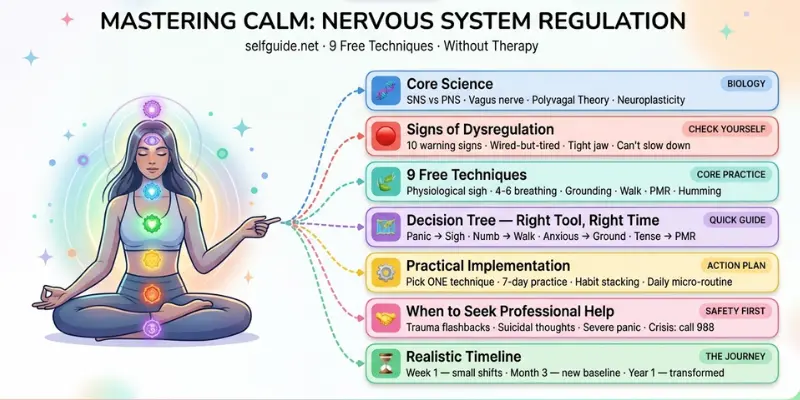
What “Nervous System Regulation” Actually Means
Your nervous system is like a thermostat for your body. When it senses danger — real or imagined — it cranks up your heart rate, tightens your muscles, and shuts down clear thinking so you can fight, flee, or freeze. This is called the sympathetic nervous system response. It saved your ancestors from tigers.
The problem? It can’t tell the difference between an actual tiger and a “we need to talk” email from your boss at 9pm.
Nervous system regulation just means giving your body the right signals to shift from “danger mode” back into “safety mode” — what experts call the parasympathetic response.
I’ll be straight with you about the science, though. A lot of this thinking comes from Polyvagal Theory, developed by Dr. Stephen Porges. It’s an influential framework, but it’s also debated among mainstream scientists. Some parts are well supported; others are still theoretical. Throughout this guide I’ll tell you which techniques have strong evidence and which are still being studied, so you can decide for yourself what’s worth trying.
10 Signs Your Nervous System Might Be Dysregulated
Before you try any technique, check whether you actually need this. Here’s what nervous system dysregulation often looks like in real life:
- You wake up tired even after 8 hours of sleep
- Your stomach feels “off” most days, even with no clear cause
- You feel “wired but tired” — exhausted but can’t relax
- You can’t focus or remember things you used to remember easily
- You overreact to small annoyances
- Your jaw, shoulders, or neck stay tight throughout the day
- You feel disconnected, numb, or “floating”
- You can’t slow down even when you want to
- Even small decisions feel exhausting
- Your body shakes involuntarily under stress
I lived with several of these for years without knowing what they meant. The shaking.The dry mouth. The way my tongue felt tired during important conversations — the exact thing that happened in those meetings. I thought I was just “bad under pressure.” I wasn’t. My nervous system was stuck in protection mode.
The good news: once you see the pattern, you can do something about it. (If naming what you feel is part of the struggle, this guide on understanding your emotions with the emotion wheel pairs well with this one.)
Why You Don’t Need a Therapist to Start (And When You Actually Do)
Let me give you the honest version of this conversation.
For most everyday stress, you can absolutely learn to regulate your nervous system on your own. These aren’t medical procedures. They’re skills humans have practiced for thousands of years — long before therapy existed.
But there are real situations where self-help is not enough. If any of these describe you, please reach out for professional support:
- You’re having recurring trauma flashbacks
- You’re having thoughts of self-harm or suicide
- You’re using substances (alcohol, drugs, food) to cope
- You have severe panic attacks that don’t respond to techniques
- Your daily life is significantly impacted
If you’re in crisis right now, please reach out:
- 🇺🇸 988 Suicide & Crisis Lifeline (call or text 988)
- 🌍 Psychology Today’s Therapist Finder (psychologytoday.com/us/therapists)
For everyone else — let’s continue.
Where to Start — The Beginner’s Decision Tree
One of the biggest mistakes most articles make is dumping 13 techniques on you without telling you which to try first. Let me fix that. Based on what you’re feeling right now, here’s where to start:
| If You Feel This | Try This Technique First |
|---|---|
| 🔴 Panicked, heart racing | #1 — Physiological Sigh (30 seconds) |
| 🥶 Numb, shut down, can’t move | #7 — Walking Outdoors (10+ minutes) |
| 🌀 Anxious thoughts won’t stop | #5 — 5-4-3-2-1 Grounding (2 minutes) |
| 💪 Body tense, can’t sleep | #3 — Progressive Muscle Relaxation (10 minutes) |
| 😩 Just generally stressed | #2 — Slow Exhale Breathing (2 minutes) |
| 🤔 Stuck on a problem | #8 — Solitude + Reflection (15-30 minutes) |
These six cover the moments you’ll hit most often. The other three are situational —you’ll find them below.
Pick ONE. Just one. Try it for 7 days before adding another.
9 Free Nervous System Regulation Techniques (Rated by Evidence)
Every technique below carries a rating for how strong the research behind it is:
- Strong evidence — multiple peer-reviewed studies
- Some evidence — limited but credible research
- Theoretical — sound mechanism but lacks isolated studies
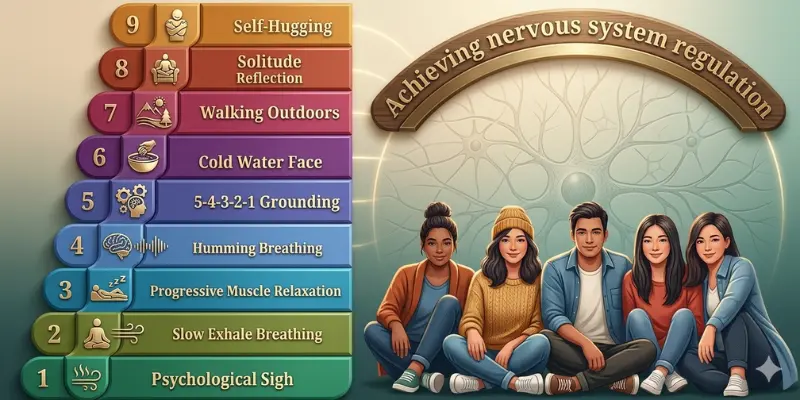
Technique #1: The Physiological Sigh
🟢 Evidence: Strong | ⏱ Time: 30 seconds
What it is: A specific breathing pattern — two quick inhales through the nose, followed by one long exhale through the mouth.
How to do it:
- Take a normal breath in through your nose
- Take a second quick “top-up” breath through your nose
- Slowly exhale through your mouth, longer than the inhales
- Repeat 1–3 times
Best for: Acute anxiety, panic moments, before a big meeting
Why it works:A 2023 Stanford Medicine study published in Cell Reports Medicine (Balban et al.) found that five minutes of daily cyclic sighing improved mood andlowered physiological arousal more than mindfulness meditation did. The double inhale reinflates collapsed air sacs in your lungs, and the long exhale signals safety to your brain.
Technique #2: Slow Exhale Breathing (4-6 Method)
🟢 Evidence: Strong | ⏱ Time: 2 minutes
What it is: Breathing in for 4 counts, then breathing out slowly for 6 counts (or longer).
How to do it:
- Inhale through your nose for 4 seconds
- Exhale through your mouth for 6 seconds (or longer)
- Repeat for 2 minutes
Best for: Everyday stress, before sleep, when you feel tension building
Why it works: Long exhales directly activate the vagus nerve, which signals your parasympathetic (“rest and digest”) response. The key is making your exhale longer than your inhale.
Technique #3: Progressive Muscle Relaxation
🟢 Evidence: Strong | ⏱ Time: 10 minutes
What it is: Systematically tensing and releasing each muscle group in your body.
How to do it:
- Lie flat. Start at your feet.
- Tense your foot muscles hard for 5 seconds, then release completely
- Move up — calves, thighs, stomach, chest, shoulders, hands, face
- Notice the contrast between tension and release
- Take 10–15 minutes total
Best for: Insomnia, chronic physical tension, end-of-day reset
Why it works: This technique has nearly 100 years of research behind it (developed by Dr. Edmund Jacobson in the 1930s). By intentionally creating and releasing tension, you teach your body to recognize when it’s holding stress — and how to let it go.
Technique #4: Humming or “Voo” Breathing
🟡 Evidence: Some | ⏱ Time: 1 minute
What it is: Breathing in normally, then making a long humming sound on the exhale.
How to do it:
- Take a normal breath in
- Exhale while making a low “mmmm” or “vooo” sound
- Make the exhale as long as you comfortably can
- Repeat 5–10 times
Best for: Stuck in office or public space, can’t move around
Why it works: The vibration from humming stimulates the vagus nerve directly through the vocal cords. It’s like giving yourself an internal massage.
Technique #5: The 5-4-3-2-1 Grounding
🟡 Evidence: Some | ⏱ Time: 2 minutes
What it is: A sensory grounding sequence that pulls you out of racing thoughts.
How to do it:
- Notice 5 things you can see
- Notice 4 things you can touch
- Notice 3 things you can hear
- Notice 2 things you can smell
- Notice 1 thing you can taste
Best for: Spiraling thoughts, dissociation, overwhelm
Why it works: It forces your brain to engage your senses instead of your worry loop.It’s used clinically in trauma therapy because it reliably interrupts the spiral — the same principle behind these mindfulness practices that reduce stress
.
Technique #6: Cold Water on the Face
🟡 Evidence: Some | ⏱ Time: 10 seconds
What it is: Splashing cold water on your face, especially around your eyes and cheeks.
How to do it:
- Fill a sink or bowl with cold water (around 10-15°C / 50-60°F)
- Splash on your face, focusing on cheeks and forehead
- Or: hold a cold washcloth on your face for 30 seconds
Best for: Emergency reset when you can’t do anything else
Why it works: This triggers the mammalian dive reflex — a primitive response that immediately slows your heart rate. The reflex itself is well-documented in research, even if its role in long-term regulation is still being studied.
Honest note: The Calm app’s blog has noted that cold exposure isn’t strongly science-backed as a stand-alone regulation method. So treat this as an emergency tool, not a daily practice.
Technique #7: Walking Outdoors
🟢 Evidence: Strong | ⏱ Time: 10+ minutes
This is one of the techniques I personally use the most.
When stress hits at work, I step outside and walk. Even just 10 minutes makes a difference. The combination of open air, physical movement, and changing scenery does something my desk cannot — it shifts my body out of the locked, tense state into something softer.
Here’s the part most people miss: Walking outdoors doesn’t just calm you down. It clears the mental fog. Once you get calm, you start seeing the solution instead of just the problem.
How to do it:
- Step outside. Any outdoor space works — park, street, balcony, parking lot.
- Walk for at least 10 minutes. No phone. No music. Just walk.
- Notice what’s around you — the sky, the trees, the air on your skin.
- Notice when your mind shifts from “this is a disaster” to “here’s what I could try.”
Best for: Feeling stuck, overwhelmed, or unable to see a way forward.
My honest take: There’s a line from Bruce Lee that changed how I think about stress. In a 1971 episode of
Longstreet, he said:”Now water can flow, or it can crash. Bewater, my friend.”
The idea is that water doesn’t fight the container it’s poured into —it shapes itself to whatever it meets. When I walk and my nervous system settles, Icatch myself doing the same thing: accepting the situation as it is and letting myself move around it, instead of bracing against it. That’s usually when the solution shows up. (If you want the science on why moving outdoors helps, see mindful nature walk for stress and anxiety relief and the mind-gut connection.)
Technique #8: Solitude + Quiet Reflection
🟡 Evidence: Some | ⏱ Time: 15–30 minutes
Most articles tell you to find your support system. That’s valid advice. But I want to offer a different angle: for some of us, solitude is the regulator.
I’m one of those people. When stress hits, my first instinct isn’t to call a friend — it’s to find a quiet space and sit with the situation. Alone.
Here’s why this works for me:
- 🧠 I can think clearly without performing for someone
- 🎯 I can analyze what’s actually happening
- 💡 I can find the solution side of the problem instead of just venting about it
- 🙏 I can return to my faith and trust that what’s outside my control will work out
How to do it:
- Find a quiet space — a closed room, your car, a corner of a park
- Turn off notifications. Put the phone face-down.
- Sit. Don’t journal yet. Just sit for 5 minutes.
- Then ask yourself: “What’s actually true about this situation?”
- Then: “What part is in my control? What part isn’t?”
Best for: Decision fatigue, processing difficult news, regaining perspective
A note on faith: If faith is part of your life, this is where it can become powerful. When I find a situation that’s not in my control, I leave it to God. Once I make peace with that, my nervous system settles. If faith isn’t part of your life, the underlying principle still works: “Acceptance of what I cannot control.”
Technique #9: Self-Hugging / Butterfly Tap
🔵 Evidence: Theoretical | ⏱ Time: 1 minute
What it is: Crossing your arms over your chest and alternately tapping your shoulders.
How to do it:
- Cross your arms so your hands rest on opposite shoulders
- Slowly alternate gentle taps — left, right, left, right
- Keep a slow, even rhythm for 1 minute
Best for: Emotional distress when alone, comforting yourself
Honest note: This technique is adjacent to EMDR (Eye Movement Desensitization and Reprocessing) research, but I have to be honest — it doesn’t have strong isolated research as a stand-alone regulation tool. That said, it’s harmless and many people report feeling soothed by it. Try it. If it works for you, great. If not, skip it.
The 5 Honest Mistakes I Made (And You’ll Probably Make Too)
I learned all of these the hard way. Save yourself the trouble.
Mistake #1: Avoiding the Situation Instead of Facing It
This is the mistake I made for years. And it cost me.
When stress hit, I looked for the safe option. I delayed difficult conversations. I passed on the meetings where I’d be challenged. I chose the easy task over the one that scared me.
I told myself I was being smart. Strategic. Protecting myself.
But here’s what I eventually learned: you cannot regulate a nervous system that has never been tested.
Every time I avoided a stressful situation, three things happened:
- My comfort zone shrank. The list of things I could handle without anxiety got smaller, not bigger.
- My self-belief weakened. Every avoidance was secretly telling my brain “you can’t handle this.”
- My real potential stayed hidden. I never got to find out what I was capable of.
The truth is uncomfortable but freeing: the only way to expand your capacity for stress is to face the stress in front of you. Not all at once. Not recklessly. But face it — while using these regulation techniques to support your nervous system through the moment.
🔑 Avoidance is a trap that looks like safety.
Mistake #2: Trying All 9 Techniques at Once
When you read a list like this, the temptation is to try everything. Don’t.
Pick ONE. Practice it for 7 full days. Notice what happens.
Then — and only then — add a second. Your nervous system needs repetition to learn, not variety.
Mistake #3: Expecting Instant Results
Let me be honest about my own timeline. I didn’t transform in 30 days. It took me about 5 years, gradually, to go from someone who went blank in every meeting to someone who can sit confidently in any room.
There was no single moment of magic. Just thousands of small repetitions, small choices to face the moment instead of avoid it, small reminders that “this too shall pass.”
If a blog promises you transformation in 30 days, they’re lying or selling you something. Plan for years, not weeks. But trust that the years will compound.
Mistake #4: Confusing Numbness with Calm
This one is subtle but important.
When you’ve been stressed for a long time, your nervous system sometimes goes the other way — into shutdown or dissociation. This can feel like calm, but it’s not.
Real regulation feels like:
- Energy you can use
- Clarity in your thoughts
- A relaxed but engaged body
- Emotional access — you can feel feelings appropriately
Numbness / shutdown feels like:
- Flatness, no energy
- Going through the motions
- Disconnection from your body
- Inability to feel even good emotions
If your “calm” feels like the second list — that’s not regulation. That’s shutdown. Talk to a professional.
Mistake #5: Doing It Without Any Anchor
Techniques alone aren’t enough. You need a deeper anchor — something that reminds you why staying regulated matters when life pushes you.
For some people, that anchor is faith. For others, it’s a clear value system. For others, it’s purpose tied to family or work.
For me, the anchor is: my job is to give 100%; the result is not in my hands. That belief lets me show up fully without being attached to whether it works out a specific way. The pressure releases.
Find your anchor. Without one, the techniques are just tricks.
How Long Until You Feel Different — The Honest Timeline
Most blogs lie about this. Let me tell you the truth.
- Week 1: Small shifts. You’ll have one or two moments where the technique actually works — and that’s powerful proof of concept.
- Month 1: Noticeable calm in everyday stress moments. People might say “you seem different.”
- Month 3: A new baseline emerges. You realize things that used to set you off don’t anymore.
- Year 1: You’re a different version of yourself. But you’re still practicing.
- Year 5 (where I am): You handle situations now that would have shut you down completely 5 years ago. But you’re still learning. Growth doesn’t end.
⚠️ Honest warning: This is a practice, not a pill. There’s no graduation day.
A Letter to the Anxious Person Reading This
If I could travel back in time and sit next to my younger self — that nervous floor supervisor going blank in meetings — here’s what I would tell him:
“Don’t worry so much about what others think. Be patient — everything works out in the end. Failure isn’t the end of the road. It’s just a lesson dressed up as a disaster.”
But the most important thing I would tell him is this:
“Compromise on your methods if you must — but never compromise your ultimate goals. Give your 100%, and trust God with the rest.”
I share this with you because if you’re reading this, you might be where I was — looking at this list of techniques and wondering “will any of this actually work for me?”
It will. But not because the techniques are magic.
They work because they create space — small, daily, repeatable moments where your nervous system learns it’s safe again. Where you remember that you are not your stress. Where you stop fighting the moment and start moving with it.
The techniques are not the destination. They are the bridge.
You’re closer than you think.
Frequently Asked Questions
Q1: Can you really regulate your nervous system without a therapist?
For most everyday stress and anxiety, yes. These techniques are skills humans have practiced for thousands of years before therapy existed. That said, if you’re dealing with trauma flashbacks, suicidal thoughts, severe panic attacks, or substance use as coping — please reach out for professional support. Self-help works for many things, but not everything.
Q2: Which technique should I try first?
Start with the Decision Tree earlier in this guide. If you’re panicked, try the Physiological Sigh. If you’re shut down, walk outdoors. If your thoughts are spiraling, try the 5-4-3-2-1 grounding. Pick ONE and practice for 7 days before adding another.
Q3: Why doesn’t deep breathing work for me?
A few possible reasons. Most people don’t breathe out long enough — your exhale needs to be LONGER than your inhale to activate calm. Some people also have trauma histories where breath focus can feel triggering — if that’s you, try walking outdoors or grounding instead. Breath isn’t the only path to regulation.
Q4: How long until I see real results?
Realistic answer: small shifts in week 1, noticeable calm by month 1, a new baseline by month 3. Total nervous system transformation takes 1-5 years depending on what you’re working with. Don’t trust anyone who promises faster.
Q5: Is cold water exposure backed by science?
Partially. The mammalian dive reflex (the heart-rate slowing response) is well-documented. But broader claims about cold exposure regulating the nervous system are still being studied. Use cold water as an emergency reset, not a daily ritual.
Q6: What are the signs of a dysregulated nervous system?
Common signs include: chronic fatigue despite enough sleep, feeling “wired but tired,” digestive issues without clear cause, racing or numb feelings, tight jaw and shoulders, overreacting to small annoyances, involuntary shaking under stress, and difficulty focusing. See the full 10-sign checklist above.
Q7: Are these techniques safe for trauma survivors?
Most are. But trauma survivors should approach this carefully. Some techniques (especially deep breathing or body scanning) can feel activating rather than calming if your body associates inward focus with danger. Start with external techniques first — walking outdoors, 5-4-3-2-1 grounding, cold water. And consider working with a trauma-informed therapist alongside self-practice.
Q8: What if breathing makes my anxiety worse?
This happens to some people, especially if you have a history of trauma or panic. If breathing makes you more anxious, skip breath-focused techniques entirely. Walking outdoors, grounding through the senses, and progressive muscle relaxation are great alternatives.
Q9: When should I stop self-regulating and see a professional?
When self-help isn’t enough. Specifically: if you’re having trauma flashbacks, suicidal thoughts, severe panic attacks that don’t respond to techniques, substance use as coping, or if your daily life is significantly impaired. The 988 Crisis Lifeline (US) is available 24/7 by call or text. Psychology Today has a free therapist finder online.
Q10: Can I do these while pregnant or breastfeeding?
Most are completely safe — walking, slow breathing, grounding, humming, solitude, butterfly tapping. Be cautious with cold water exposure if you have any pregnancy-related conditions, and skip intense breathwork patterns. When in doubt, ask your doctor.
Your Next Step
You’ve just read about 9 free techniques. Don’t try them all.
Pick ONE. Just one. The one that feels most doable right now.
Try it for 7 days. Notice what changes.
That’s it. That’s how you start.
💬 P.S. Which technique are you trying first? Drop a comment below — I read every reply. And if this helped, share it with one person who might need it.





- Be Respectful
- Stay Relevant
- Stay Positive
- True Feedback
- Encourage Discussion
- Avoid Spamming
- No Fake News
- Don't Copy-Paste
- No Personal Attacks
- Be Respectful
- Stay Relevant
- Stay Positive
- True Feedback
- Encourage Discussion
- Avoid Spamming
- No Fake News
- Don't Copy-Paste
- No Personal Attacks
