Empathy vs Sympathy: What’s the Real Difference and When to Use Each
Published: 26/04/2026
You meant well. You really did.
Your friend called, voice cracking, to tell you her mother had passed. And you said — because you genuinely wanted to connect — “I know exactly how you feel. I lost my grandmother two years ago.”
She went quiet.
Not because she was ungrateful. Not because you said something cruel. But because in that one sentence, the conversation quietly shifted — from her grief to your memory. From her pain to your parallel story.
That is the difference between empathy and sympathy in action. And most people cross that line every single day without realising it.
What Is the Difference Between Empathy and Sympathy?
Empathy means feeling WITH someone — you step into their emotional world and understand their experience from the inside. Sympathy means feeling FOR someone — you acknowledge their pain with genuine warmth, but from your own emotional position. Both responses come from care. Neither is cold or unkind. The difference is simply how close you get — and knowing which one to offer can quietly change everything.
Here is what this guide covers:
- The clearest plain-English distinction between empathy and sympathy — with a simple comparison table
- Two types of empathy most people don’t know exist — and why both matter
- Four real-life scenarios showing exactly what each response looks and sounds like
- When sympathy is actually the MORE appropriate response — a perspective nobody in this space talks about
- A step-by-step empathy guide with actual phrases you can use today
- What empathy burnout is, who is most at risk, and how to protect yourself
You don’t need a psychology degree to use any of this. You just need one conversation where you want to show up better than you did last time.
Let’s start with the difference that changes everything.
The Core Difference Between Empathy and Sympathy
Think of it this way.
Your friend is drowning in the middle of a lake. Sympathy stands on the shore and calls out: “That looks terrible — I really hope you make it.” Empathy jumps in.
That is the analogy researcher Brené Brown has built her career around — and it holds up because it is viscerally true. Empathy is not just understanding someone’s pain from a distance. It is choosing to enter it with them.
But here is what most articles skip: jumping in is not always the right move. Sometimes the person in the water needs you calm on the shore, not flailing beside them. We will come back to that. First, let’s get the core distinction absolutely clear.
Feeling WITH vs Feeling FOR
Empathy and sympathy both come from the Greek word pathos — meaning feeling or suffering. The difference is in the prefix.
Sympathy adds sym — meaning together. You feel alongside someone, from your own position. You acknowledge their pain without leaving yours.

Empathy adds em — from the German Einfühlung, meaning feeling-into. You step inside their experience. You temporarily leave your own emotional position and inhabit theirs.
Sympathy says: “I see your pain.” Empathy says: “I feel your pain — tell me more about it.”
Neither is wrong. Neither is cold. One simply goes closer.
The Comparison at a Glance
| Empathy | Sympathy | |
|---|---|---|
| What it means | Feeling WITH someone | Feeling FOR someone |
| Emotional position | Inside their experience | Outside, looking in |
| Typical phrase | “That sounds really hard — tell me more” | “I’m so sorry you’re going through this” |
| Creates | Deep emotional connection | Warm acknowledgment |
| Best used when | Someone needs to feel truly understood | Someone needs comfort without intrusion |
One thing worth saying clearly before we go further: the goal of this article is not to convince you that empathy is superior. It is to help you choose the right response for the right moment. Sometimes that means going closer. Sometimes it means staying warm on the shore. Knowing the difference is the skill.
The Two Types of Empathy You Need to Know
Most people think of empathy as one thing — a feeling you either have in a moment or you don’t. The reality is more interesting, and more useful.
Psychologists distinguish between two distinct forms of empathy. Understanding both will immediately change how you show up in emotional conversations.
Cognitive Empathy — Understanding With Your Head
Cognitive empathy is the ability to accurately understand how another person is feeling — without necessarily feeling it yourself. It is perspective-taking. It is the intellectual recognition of someone else’s emotional state.
A skilled negotiator uses cognitive empathy. So does a good therapist, a thoughtful manager, and anyone who has ever read a room correctly before speaking.
The catch? You can be cognitively empathetic and emotionally absent — and people feel the difference immediately.
Imagine a manager who correctly identifies that a team member is struggling after a difficult project. She says all the right things — “I can see this has been hard” — but she is half-watching her laptop while she says it. Her words are empathetic. Her presence is not. The team member walks away feeling processed, not heard.
Cognitive empathy without warmth is like a technically correct answer delivered in a cold tone. The content is right. The connection is missing.
Affective Empathy — Feeling With Your Heart
Affective empathy is emotional resonance. It is when you genuinely feel something because another person is feeling it. You tear up because your friend is crying — before they have even explained why. Your stomach drops when someone describes their anxiety because your body is registering it alongside them.
This is the form of empathy that creates the deepest human bonds. It is also the form that — without proper boundaries — can drain you completely. More on that in a moment.
Why You Need Both
Cognitive empathy without affective empathy feels clinical. Affective empathy without cognitive empathy can feel overwhelming — for both of you.
The goal is to use your head to understand, and your heart to connect.
When a friend is describing a painful situation, your cognitive empathy helps you follow what they are saying accurately. Your affective empathy signals to them — through your tone, your silence, your expression — that what they are sharing genuinely matters to you.
One without the other leaves a gap. Together, they are what most people mean when they say someone truly “gets” them.
Now that you know what both look like in theory — here is what they look like in real life.
Empathy vs Sympathy in Real Life — 4 Scenarios That Show the Difference
This is where most articles on this topic completely fall short. They give you one example — usually involving a job loss — and call it done.
Real life is messier and more varied than that. So here are four scenarios across different contexts, each showing both responses side by side — and a note on what makes the difference.
When a Friend Is Grieving
Your close friend calls to tell you her father has died.
Sympathetic response: “I’m so sorry for your loss. Let me know if there is anything I can do.”
Empathetic response: Silence for two seconds. Then: “I don’t even know what to say. Tell me about him.”
What makes the difference: “Let me know if there is anything I can do” is one of the most well-intentioned phrases in the English language — and one of the least useful. It puts the burden of asking back onto the person who is already carrying the most weight. The empathetic response does not offer a solution. It opens a door.
When a Colleague Receives Difficult Feedback
A team member comes to you after being passed over for promotion. You can see they are devastated.
Sympathetic response: “That must be frustrating. These decisions are never easy — I’m sure they saw something promising in you.”
Empathetic response: Phone face-down on the desk. Full eye contact. “That sounds genuinely disappointing after the year you have put in. What part of this is hardest for you right now?”
What makes the difference: The sympathetic response moves too quickly toward reassurance. It is kind — but it skips the feeling. Solving before feeling is the most common empathy failure in professional settings. The empathetic response stays in the discomfort with the other person, rather than rushing both of you out of it.
When Your Partner Is Upset With You
Your partner tells you that something you did last week genuinely hurt them.
Sympathetic response: “I hear you. I’m sorry you feel that way.”
Empathetic response: “I think I understand why that hurt. Can you help me understand it a little better? I want to get this right.”
What makes the difference: “I’m sorry you feel that way” is one of the most quietly damaging phrases in any relationship. It acknowledges the feeling without taking any ownership of the situation that caused it. It sounds empathetic. It is not. The empathetic response stays curious instead of defensive — and curiosity, in conflict, is one of the most disarming things you can offer.
When a Child Comes Home Upset
Your ten-year-old comes home from school with red eyes. Their best friend said something cruel in front of the whole class.
Sympathetic response: “Oh no — that’s awful. I’ll call the school tomorrow morning.”
Empathetic response: Kneel to eye level. “That sounds really painful. Do you want to tell me what happened?”
What makes the difference: Action before feeling-acknowledgment is one of the most common mistakes in emotional support — at any age. When someone is hurting, their first need is to feel seen — not fixed. The empathetic response does not ignore the problem. It simply earns the right to address it by first making the person feel heard.
When Sympathy Is Actually the Right Response (Nobody Talks About This)
Here is the part of this conversation that almost nobody is willing to have.
Every article you will find on empathy vs sympathy positions sympathy as the lesser option — the emotional training wheels you use until you develop real empathy. That framing is not just incomplete. It is wrong. And it leads people to perform empathy in moments where sympathy would have been kinder.
Sympathy Is Not the Inferior Option
Sympathy is not a failure of empathy. It is a different — and sometimes more respectful — form of care.
Consider what sympathy actually does. Research by psychologist Daniel Batson suggests that sympathy — feeling FOR someone in need — is actually a more direct motivator of helping behaviour than empathy [VERIFY]. When you feel sympathy for someone, you are moved to act on their behalf. That is not a lesser response. That is a profoundly human one.
The problem is not sympathy. The problem is using sympathy in moments that call for empathy — and using empathy in moments that call for sympathy.
In my experience, some of the most genuinely caring responses I have witnessed were sympathetic — a quiet “I’m so sorry” from someone who did not try to enter the pain, but simply stood beside it with full warmth. That person read the room correctly. They gave exactly what was needed.
5 Situations Where Sympathy Is the Kinder Response
While empathy is often seen as the gold standard for connection, there are moments where maintaining a respectful emotional distance is actually the more compassionate and professional choice.
- At a funeral or public memorial — Deep emotional resonance in a group setting can feel intrusive rather than connecting. A warm, composed expression of sympathy respects both the grief and the space.
- In professional condolences — A formal note to a colleague who has lost someone does not require you to emotionally immerse yourself in their loss. Sincere, warm acknowledgment is both appropriate and enough.
- When someone is venting and does not want advice — Sometimes people need to be heard, not felt-with. Sympathy creates space without pressure.
- When you do not know the person well — Attempting deep emotional resonance with someone who has not invited that closeness can feel presumptuous. Sympathy honours the appropriate level of intimacy.
- When the person says “I’m fine” and means it — Sometimes people have processed their pain and genuinely do not want to re-enter it with you. Sympathy acknowledges without reopening.
The skill is not choosing empathy over sympathy. The skill is reading what the person in front of you actually needs — and offering that.
How to Show Empathy — A Step-by-Step Guide With Real Phrases
Knowing what empathy is and knowing how to show it are two completely different things. This section is about the second one.
What I have seen consistently is that people do not fail at empathy because they do not care. They fail because they have never been given a practical process. They rush to respond. They reach for reassurance. They say the right words in the wrong order.
Here is a process that actually works — and phrases you can use starting today.
The 5-Step Empathy Process
Empathy is not a passive feeling but a deliberate skill that requires shifting your focus from formulating a response to truly witnessing another person’s experience.
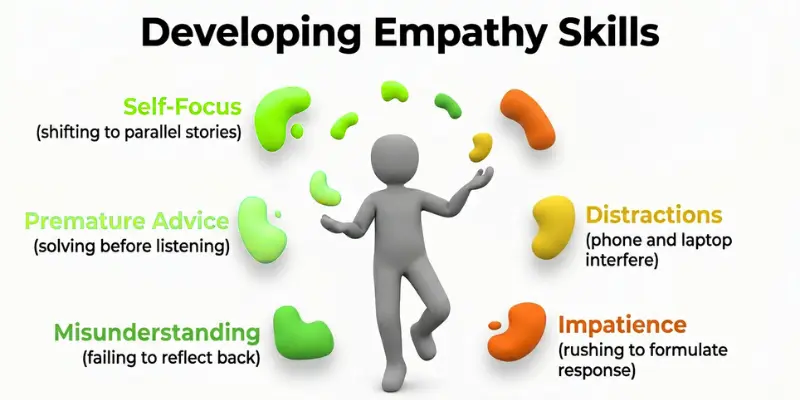
- Pause — Give yourself two full seconds before responding. Silence signals you are absorbing what was shared, not queuing up your reply. This is harder than it sounds. Do it anyway.
- Remove distractions — Phone face-down. Laptop closed. Full physical presence before any words. Your body communicates before your mouth does.
- Reflect back what you heard — Use: “What I’m hearing is…” or “It sounds like you’re feeling…” This confirms you understood — and gives them a chance to correct you if you didn’t.
- Ask before you advise — “Do you want help thinking through this, or do you mostly need me to listen right now?” This single question prevents the most common empathy failure: solving before the person feels heard.
- Stay in their world — Resist the pull toward your own parallel story. “That reminds me of when I…” is almost always a step away from empathy and toward sympathy. Stay focused on them.
Phrases That Show Empathy — Without Saying “I Understand”
“I understand” is the most overused phrase in emotional conversations. It closes the door. These open it:
- “That sounds really hard. I’m here.”
- “I can’t imagine how that feels — but I want to.”
- “Tell me more. I’m listening.”
- “What do you need from me right now?”
- “You don’t have to explain it perfectly. I’m not going anywhere.”
- “That makes complete sense given everything you’ve been through.”
The common thread in every phrase above is this: they make more room, not less.
What Not to Say — And Why These Phrases Backfire
| Phrase | Why It Backfires |
|---|---|
| “I know exactly how you feel” | Shifts the focus from them to you |
| “At least…” | Immediately minimises their experience |
| “Everything happens for a reason” | Invalidates their pain with a platitude |
| “You should try…” | Moves to advice before the feeling is acknowledged |
| “I’m sure it’ll be fine” | Closes the emotional conversation before it begins |
| “I’m sorry you feel that way” | Acknowledges the feeling but not the cause |
A common mistake I notice is people reaching for these phrases not out of coldness — but out of discomfort. We rush to reassure others because sitting in someone else’s pain, without fixing it, is genuinely difficult. Empathy asks you to do it anyway.
Can Empathy Burn You Out? (What Nobody Tells You)
If you are a naturally empathetic person — the friend everyone calls in a crisis, the colleague who always seems to know when something is wrong — this section is for you.
Because nobody talks about the cost.
What Empathy Burnout Actually Is
Compassion fatigue — sometimes called empathy burnout — is what happens when you absorb other people’s emotional pain without adequate replenishment or boundaries. It is not the same as regular burnout, which builds slowly from workload and stress.
Empathy burnout can happen suddenly. You can be managing well on Monday and feel emotionally numb by Friday — not because anything changed in your circumstances, but because you gave away more than you had.
Research published in 2025 clarifies something important: empathy does not automatically cause burnout. The risk emerges specifically when empathy is practiced without emotional boundaries — when you feel WITH others but have no process for returning to yourself afterward.
Who is most at risk? Caregivers. Therapists. Teachers. Parents of children going through difficult periods. And — perhaps most commonly — the person in any friend group who is everyone else’s safe place to land.
Signs You May Be Experiencing Empathy Burnout
- You feel emotionally flat after conversations that used to feel meaningful
- You are avoiding people who need support — not because you stopped caring, but because you have nothing left to give
- You feel guilty for not feeling more — a kind of numbness that confuses you
- Emotional conversations leave you physically exhausted, not just tired
- You notice yourself giving sympathetic responses when you used to give empathetic ones — this is your nervous system quietly protecting itself
That last sign is the one most people miss entirely. When your empathy disappears and only sympathy remains, it is not a character failure. It is a warning signal.
3 Ways to Protect Yourself Without Becoming Cold
- Practice self-compassion first — Researcher Kristin Neff’s work shows that self-compassion is not selfish — it is what replenishes your capacity to care for others. You cannot pour from an empty cup, as the saying goes. But more specifically: you cannot feel WITH others if you have stopped feeling for yourself.
- Set time boundaries, not emotional ones — You do not have to choose between being present and being protected. “I’m completely here for you right now — can we talk for the next twenty minutes?” is both empathetic and boundaried. The limit is on time, not on care.
- Name what you are feeling after heavy conversations — The same technique that helps others — affect labelling, putting a name to an emotion — works for you too. After a draining conversation, take two minutes to identify what you are actually feeling. Naming it reduces its intensity. This is not dramatic or time-consuming. It is two minutes and a honest sentence.
In my experience, the people most at risk of empathy burnout are not the cold or the distant. They are the most caring people in any room — the ones who absorb everyone’s pain and give it a home inside themselves. Over time, that home fills up. The answer is not to stop caring. It is to learn how to return to yourself after you have been somewhere else for someone else.
KEY TAKEAWAYS
- Empathy means feeling WITH someone; sympathy means feeling FOR someone — both come from genuine care.
- Empathy has two forms: cognitive (understanding with your head) and affective (feeling with your heart) — you need both to connect fully.
- The most common empathy mistake is responding before the other person feels truly heard.
- Sympathy is not inferior to empathy — in many contexts it is the more respectful and appropriate response.
- Never use “at least” — it immediately shifts from empathy to sympathy and minimises the other person’s experience.
- Empathy burnout is real — practicing empathy without emotional boundaries drains your capacity over time.
- Empathy is a learnable skill — research confirms it is not a fixed trait you either have or you don’t.
Conclusion
Empathy and sympathy are not rivals competing for the title of better emotional response. They are two different ways of showing up for someone — and the real skill is knowing which one the moment is asking for.
Here is what that looks like in practice.
Empathy says: I am going to leave my position for a moment and stand inside yours. I am going to feel the weight of what you are carrying — not so I can fix it, but so you do not have to carry it alone.
Sympathy says: I see your pain from where I am standing. I cannot fully enter it — and I am not going to pretend I can. But I am here, I care, and that is real.
Both of those responses, offered sincerely, are acts of genuine human connection. Neither one is a consolation prize.
What changes everything is not choosing empathy over sympathy — it is choosing consciously rather than automatically. Pausing for two seconds before you respond. Asking yourself what this person actually needs right now. Resisting the pull toward reassurance when what is needed is presence.
That pause — small as it sounds — is where the real difference lives.
Your Next Step
You do not need to overhaul the way you communicate. Start with one thing this week.
Pick one conversation — with a partner, a friend, a colleague, a child — where you would normally rush to respond. And this time, pause for two full seconds first. Put your phone face-down. Reflect back what you heard before you offer anything else.
Notice what changes. Not just in them — in you.
If you found this guide useful, share it with someone who shows up for people the way you try to. They will find something in here worth keeping.
And if you are still working on understanding your own emotions before you can fully step into someone else’s — our guide on the emotion wheel is a natural place to start. Knowing what you feel is the foundation of knowing what others feel.
Written by the SelfGuide editorial team — a group of personal growth researchers and writers dedicated to turning complex psychological concepts into practical, human tools anyone can use. At SelfGuide.net, we believe self-understanding is not a luxury. It is the foundation of every meaningful relationship, decision, and conversation in your life.
Frequently Asked Questions About Empathy vs Sympathy
Empathy means feeling WITH someone — you step into their emotional experience and understand it from the inside. Sympathy means feeling FOR someone — you acknowledge their pain with genuine warmth, but from your own emotional position. Empathy creates deep connection. Sympathy offers comfort and care from a respectful distance. Both responses come from genuine kindness. The difference is simply how close you get emotionally.
Knowing which one to offer depends on the situation, your relationship with the person, and — most importantly — what they actually need in that moment. Empathy is not always the right answer. Sometimes warm, grounded sympathy is exactly what someone needs most.
Neither is universally better. Empathy creates deeper emotional connection and is most powerful when someone needs to feel truly understood. Sympathy is more appropriate in public settings, professional condolences, or when someone has not invited emotional closeness. The goal is not to always choose empathy — it is to read the moment correctly and respond with genuine care.
A useful question to ask yourself before responding: does this person need me to enter their emotional world right now, or do they need me to acknowledge their pain from a place of warmth and steadiness? The answer to that question — not a fixed rule — should guide your response every time.
“I understand” closes emotional conversations rather than opening them. Instead, try phrases that make more room for the other person to feel heard. Some examples that work consistently well:
- “That sounds really hard. I’m here.”
- “Tell me more — I’m listening.”
- “What do you need from me right now?”
- “I can’t imagine how that feels — but I want to.”
- “That makes complete sense given everything you’ve been through.”
The pattern behind every phrase above is the same — they invite rather than conclude. They signal that you are present and paying attention, not moving toward a solution or an exit. That signal, more than any specific wording, is what empathy actually sounds like.
Yes — and it is more common than most people realise. When empathy is practiced without emotional boundaries, it can lead to compassion fatigue — a state of emotional exhaustion caused by repeatedly absorbing other people’s pain without adequate replenishment. It is not the same as regular burnout. It can arrive suddenly, even in people who felt completely fine the week before.
The risk is not empathy itself. Research published in 2025 confirms that empathy does not automatically lead to burnout — the relationship between the two is far more nuanced than that. The risk comes specifically from empathising without ever returning to yourself afterward. Practical boundaries — on time, on emotional load, on how much you carry home — protect your capacity to keep caring without running empty.
No — and the distinction matters. Sympathy is warmth directed toward someone in pain. It comes from a place of genuine care and equal standing. Pity, by contrast, carries a sense of looking down — feeling sorry for someone from a position of perceived superiority or distance. Sympathy says: “I care about what you are going through.” Pity says: “I am glad that is not happening to me.”
Sympathy is a sincere and valuable emotional response. Pity is often uncomfortable for the person receiving it — it can make them feel small rather than supported. If you have ever avoided expressing sympathy because you worried it would come across as pity, that worry itself shows you are operating from a place of genuine care — which is the foundation of sympathy, not pity.
Empathy is a learnable skill — not a fixed personality trait. Research published in 2025 by Martingano and colleagues directly addresses this as one of the most persistent myths about empathy: the belief that you either have it or you do not. The evidence says otherwise. Empathy can be developed through deliberate practice — active listening, perspective-taking exercises, expanding your emotional vocabulary, and building the habit of pausing before responding.
Some people find empathy comes more naturally than others, just as some people find certain skills easier to learn. But easier is not the same as fixed. If you have ever felt more empathetic in one relationship than another — with a close friend versus a difficult colleague, for example — you have already experienced your own empathy varying by context. That variation is proof it is not fixed. It is trainable.
Empathy burnout — also called compassion fatigue — tends to feel less like exhaustion and more like emptiness. Where regular burnout makes you feel tired, empathy burnout makes you feel flat. You may notice that conversations which used to feel meaningful now leave you numb. You might find yourself avoiding people who need emotional support — not because you stopped caring, but because you genuinely have nothing left to offer them.
Other signs include feeling guilty for not feeling more, physical fatigue after emotional conversations, and — one of the most telling — noticing that your responses have become sympathetic rather than empathetic. When your natural warmth retreats to a safe distance without you choosing it, that is your nervous system signalling that it needs rest. It is not a character failure. It is a signal. The appropriate response is not to push through — it is to step back, practice self-compassion, and give yourself the same care you give so readily to others.






- Be Respectful
- Stay Relevant
- Stay Positive
- True Feedback
- Encourage Discussion
- Avoid Spamming
- No Fake News
- Don't Copy-Paste
- No Personal Attacks
- Be Respectful
- Stay Relevant
- Stay Positive
- True Feedback
- Encourage Discussion
- Avoid Spamming
- No Fake News
- Don't Copy-Paste
- No Personal Attacks
